Peter Skene Ogden Historical Marker, Terrebonne, Oregon

Peter Skene Ogden Historical Marker, Terrebonne, Oregon

Born somewhere between 1790 and 1794 in Quebec, Canada, Peter Skene Ogden was a trapper during the height of the beaver trade. He was a member of the Hudson’s Bay Company even after it merged with the Northwest Fur Company in 1821.

In 1824, Ogden was tasked by John McLoughlin to lead the Snake River Country Expeditions. His goal was to discourage American trappers from entering the area to maintain British control of the trade. Along with the traders were a group of Americans directed by Jedediah Smith.

The two sets of traders separated at Beaver River, and Ogden continued south. This took the group through what is now Smithfield, Hyrum, Logan and Huntsville. While the town of Ogden bears his name, it is unlikely that the man himself visited the area.

Ogden was forced from going any further on his journey after an argument with the “Ashley Men” who convinced many of Ogden’s men to defect with 700 pelts. He returned to the Flathead Post.

Ogden would continue to lead many expeditions for the Hudson’s Bay Company. He had a large impact on the fur trade. He would return to Utah for an expedition from 1828 to 1829. After that, he would never again return to what would become the State of Utah.

Ogden would continue working for the Hudson’s Bay Company until a few months before his death in 1854.

Historical Marker Inscription

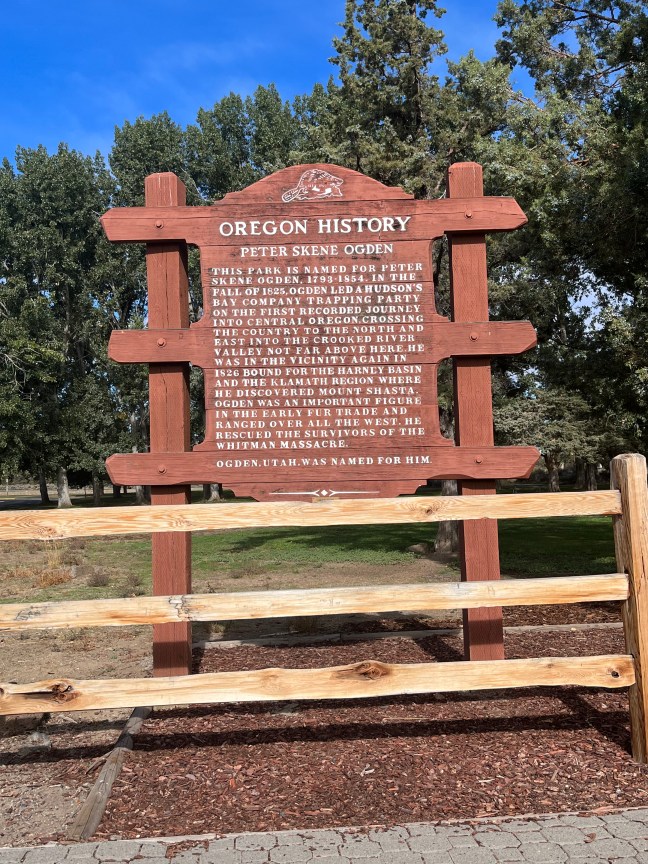
This park is named for Peter Skene Ogden, 1793-1854. In the fall of 1825, Ogden led a Hudson’s Bay Company trapping party on the first recorded journey into central Oregon, crossing the country to the north and east into the Crooked River Valley not far above here. He was in the vicinity again in 1826 bound for the Harney Basin and the Klamath region where he discovered Mount Shasta. Ogden was an important figure in the early fur trade and ranged over all the West. He rescued the survivors of the Whitman Massacre.

Ogden, Utah, was named for him.

Location
44° 23’ 25.398” N, 121° 11’ 34.968” W
Peter Skene Ogden State Scenic Viewpoint, Terrebonne, OR  97760, United States


Ponchatoula Depot Historical Maker, Ponchatoula, Louisiana

Ponchatoula Depot Historical Marker, Ponchatoula, Louisiana

The city of Ponchatoula started as a train depot in the mid-1800s. The original depot was erected in 1854. The first structure was burnt down by Union soldiers during the American Civil War. A new depot was built during 1895 and remodeled in 1920.

Nowadays, the depot serves as a shopping market with 30 booths.

Historical Marker Inscription

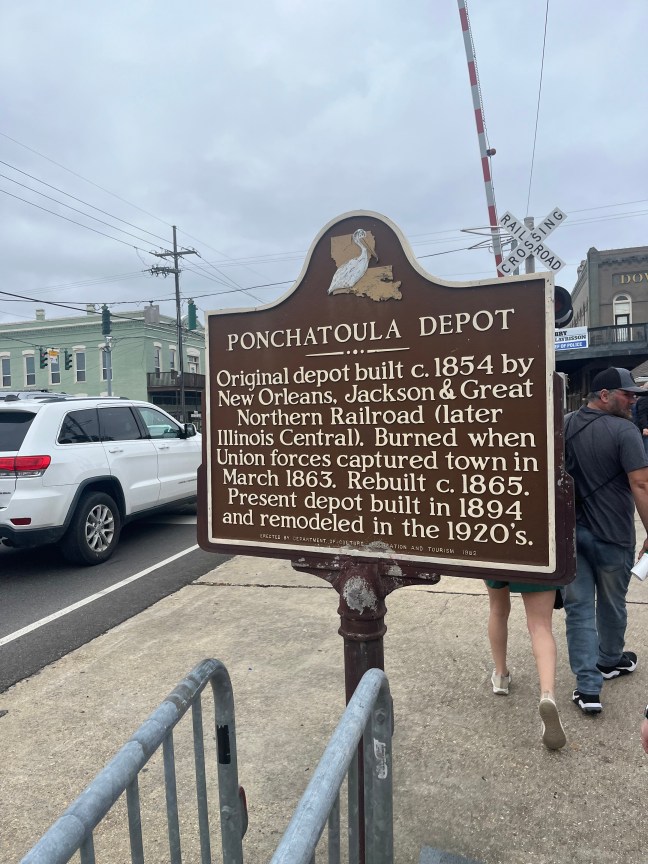
Original depot built c. 1854 by New Orleans, Jackson & Great Northern Railroad (later Illinois Central). Burned when Union forces captured town in March 1863. Rebuilt c. 1865. Present depot built in 1894 and remodeled in the 1920’s.

Erectec by Department of Culture, Recreation and Tourism 1982

Location

30° 26’ 20.220” N, 90° 26’ 28.242” W
10 E Pine St, Ponchatoula, LA  70454, United States

Double Springs Historical Marker, Gardnerville, Nevada

Double Springs Historical Marker, Gardnerville, Nevada

Double Springs was a hotel on the toll road to Aurora and Bodie. It was named after two springs that had been used by Native Americans for round dances in the spring and fall. The earliest recorded name of the place was Round Tent Ranch.

Rancher S.D. Fairchild claimed over 300 acres in the area in 1861. He opened a hotel, barn and stable. Later, the property was owned by H.W. Bagley and then James C. Dean, who became a notorious figure in the area.

The Double Springs Hotel was torn down in 1887. The lumber was moved to South Camp, a mining camp, and used for buildings there. All that’s left to mark the spot is the historical marker.

Historical Marker Inscription

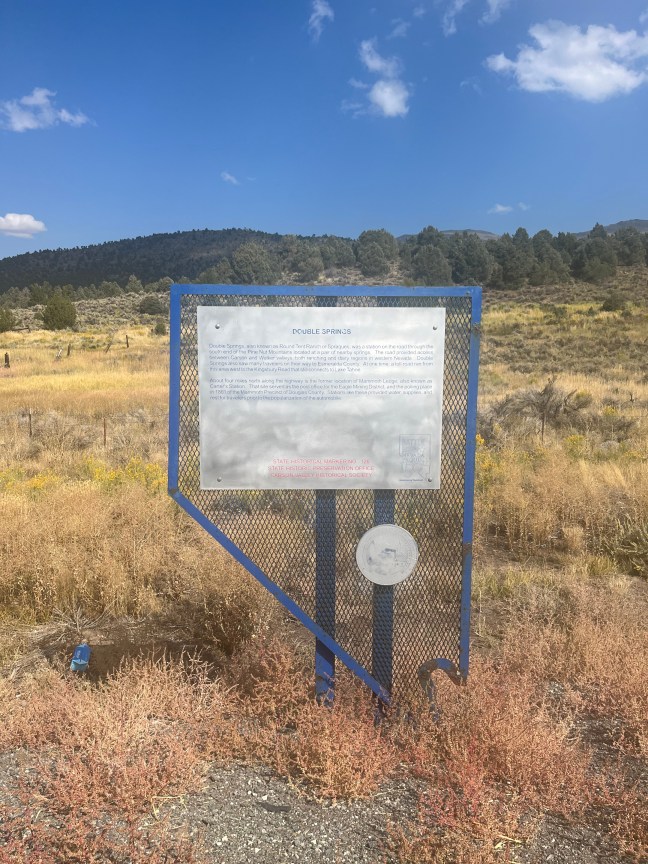
Double Springs, also known as Round Tent Ranch or Spragues, was a station on the road through the south end of the Pine Nut Mountains located at a pair of nearby springs. The road provided access between Carson and Walker valleys, both ranching and dairy regions in western Nevada. Double Springs also saw many travelers on their way to Esmeralda County. At one time, a toll road ran from this area west to the Kingsbury Road that still connects to Lake Tahoe.

About four miles north along the highway is the former location of Mammoth Ledge, also known as Carter’s Station. That site served as the post office for the Eagle Mining District, and the polling place in 1861 of the Mammoth Precinct of Douglas County. Stations like these provided water, supplies, and rest for travelers prior to the popularization of the automobile.

STATE HISTORICAL MARKER NO. 126

STATE HISTORIC PRESERVATION OFFICE

CARSON VALLEY HISTORICAL SOCIETY

Location

38° 47’ 36.882” N, 119° 35’ 58.458” W
US Hwy 395 S, Gardnerville, NV  89410, United States