Greenhill Community/Greenhill Farming

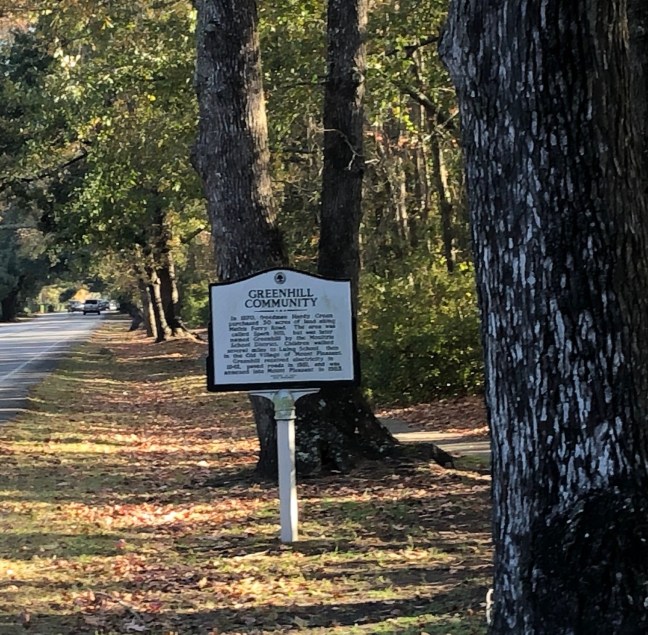
Greenhill Community Historical Marker, Mount Pleasant, SC

Originally called Spark Hill, the location would later be called Greenhill. It was one of several African American communities in the Greater Mount Pleasant area. Freedman Hardy Green bought 30 acres in the area in 1870. Children from the neighboring Old Village community would walk to the town to attend the Laing School. The community was sustained by farming.

Now, the area is a residential community.

Historical Marker Inscription

Greenhill Community

In 1870, freedman Hardy Green purchased 30 acres of land along Mathis Ferry Road. The area was called Spark Hill, but was later named Greenhill by the Moultrie School District. Children walked several miles to Laing School, then in the Old Village of Mount Pleasant. Greenhill received electricity in 1942, paved roads in 1951, and was annexed into Mount Pleasant in 1983.

Greenhill Farming

Farming was the major source of income in Greenhill. People, produce and livestock were carried aboard boats from a dock behind Somerset Point to the Charleston City Market. In the 1920s and ‘30s, mules and wagons transported goods to a ferry at Shem Creek. The LOOP Bus became a major source of transportation in the 1940s. Greenhill continues to thrive as a residential community.

Location

32° 48’ 52.128” N, 79° 52’ 6.900” W

932–940 Mathis Ferry Rd, Mount Pleasant, SC  29464, United States

James Stuart Cain Historical Marker, Bodie, California

James Stuart Cain House Historical Marker, Bodie, California

Bodie ghost town is located in California off Highway 395. The reason that the town still stands today is largely due to James Stuart Cain. Cain moved to Bodie in 1879. He was only 25 but quickly made his fortune by investing in lumber, mining, freighting and banking. He brought lumber across Mono Lake, which helped build the town properties and mines.

Later, he would be the owner of the town bank as well as the Standard Mill. Cain and his family would own most of the town by the time he passed away in 1938. He and his family were dedicated to preserving the town, hiring security to guard it and caretakers to maintain the vacant buildings.

In 1962, the family gave the ghost town to the State of California. It is run by the California Department of Parks and Recreation. It is preserved in a state of “arrested decay” so that it looks exactly the same as it did during its heyday period. It was named a National Historic Landmark in 1961. The state legislature created the Bodie State Historic Park in 1962.

Historical Marker Inscription

Pioneer banker and mining man born in 1854 and moved to Carson City, Nevada, in 1875. Shortly thereafter he and Martha D. Wells of nearby Genoa were married and moved to Bodie where he engaged in lumber, freighting, banking, and mining operations. At one time he owned Mono County’s only bank. In 1938 Mr. Cain passed away at 84 years of age. Through his faith and efforts Bodie remains today.

Dedicated September 12, 1964.

Location

38° 12’ 47.892” N, 119° 0’ 42.430” W

Main St, Bridgeport, CA  93517, United States

Mount Lassen/The Noble Pass Historical Marker

Mount Lassen Historical Marker, Shingletown, California

This marker commemorates the early pioneers who crossed the peak of Mt. Lassen in 1852. Mt. Lassen sits at 10,451 feet. In May 1852, William H. Noble led emigrants through the Sierra via a wagon road. The pass linked the Humboldt-Nevada Road with Shasta and Northern California, and it was on this pass that the emigrants first looked at Sacramento Valley.

The previous year, Noble had seen the pass and recognized that it would work well for commercial use. He and a few other men convinced emigrants to start taking the pass in 1852. Because of his discovery and convincing pioneers to actually use the pass, it eventually became known as Noble Pass.

Historical Marker Inscription

Chaos Crags

Mt. Lassen

Mt. Lassen

10,451 Feet

This tablet marks the route of those early pioneers who, in 1852, first went over

The Noble Pass

Linking the Humboldt-Nevada Road with Shasta and Northern California, and their road is followed at this locality by

The Park Highway

Dedicated to the Pioneers of Northern California by Mr. & Mrs. B. F. Loomis

Sponsored by the Shasta Historical Society

MCMXXXI

Location

40° 33’ 29.058” N, 121° 31’ 54.528” W
Lassen Volcanic National Park Hwy, Shingletown, CA  96088, United States

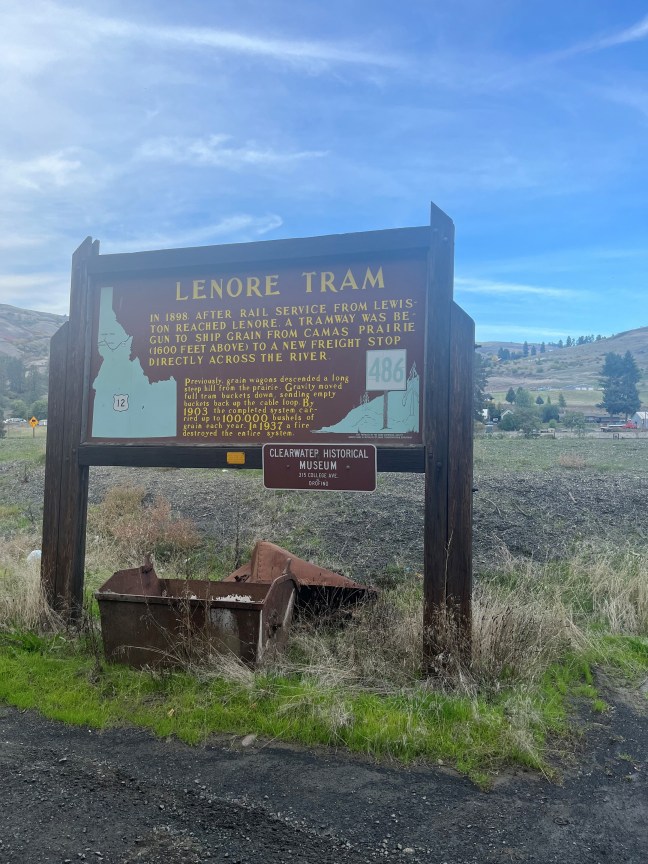
Lenore Tram Historical Marker, Lenore, Idaho

Lenore Tram Historical Marker, Lenore, ID

Lenore, Idaho, was a major railroad station during the early 1900s. In fact, it had its own post office, general store and hotel. It was also the location of the largest grain tram on the lower Clearwater River.

The tram would carry the grain four miles from the top of the canyon and then down the river to the railroad freight stop. Between 75,000 and 100,000 bushels would be carried to the railroad tracks from Camas Prairie each year. Camas Prairie was located 1,600 feet above at the top of the ridge.

In 1937, a fire destroyed the tram, and it was never rebuilt.

Historical Marker Inscription

In 1898, after rail service from Lewiston reached Lenore, a tramway was begun to ship grain from Camas Prairie (1600 feet above) to a new freight stop directly across the river.

Previously, grain wagons descended a long steep hill from the prairie. Gravity moved full tram buckets down, sending empty buckets back up the cable loop. By 1903 the completed system carried up to 100,000 bushels of grain each year. In 1937 a fire destroyed the entire system.

Location

46° 30’ 22.908” N, 116° 33’ 10.338” W

37966 US-12, Lenore, ID  83541, United States

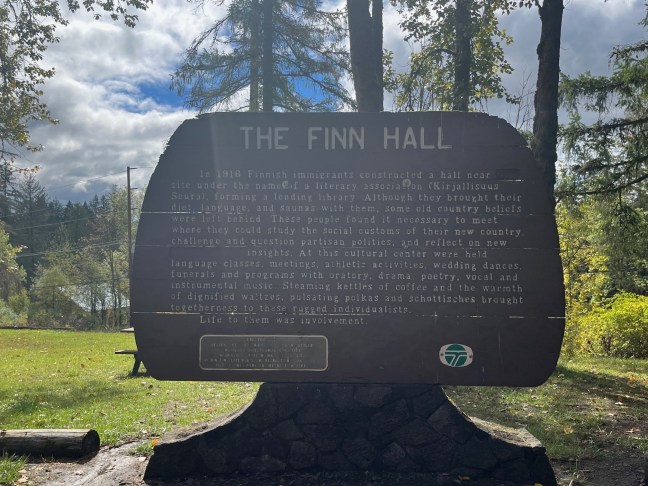
The Finn Hall

The Finn Hall Historical Marker, Woodland, WA

Originally built in 1916, the Finn Hall in Washington State was a lending library for immigrants from Finland.  The original Finn Hall burned down. Finn Halls (or Finnish halls) were the names given to the cultural centers for Finnish immigrants to the United States and Canada.

The historical marker is inside a five-acre park where the original hall was located.

Historical Marker Inscription

In 1916 Finnish immigrants constructed a hall near site under the name of a literary association (Kirjallisuus Seura), forming a lending library. Although they brought their diet, language, and saunas with them, some old country beliefs were left behind. These people found it necessary to meet where they could study the social customs of their new country, challenge and question partisan politics, and reflect on new insights. At this cultural center were held language classes, meetings, athletic activities, wedding dances, funerals and programs with oratory, drama, poetry, vocal and instrumental music. Steaming kettles of coffee and the warmth of dignified waltzes, pulsating polkas and schottisches brought togetherness to these rugged individualists.

Life to them was involvement.

Erected By

Descendants and friends of Finnish Settlers
Woodland Bicentennial Committee
Washington State Highways Commission
Washington State Parks and Recreation Commission
Cowlitz County Parks and Recreation Dept.

Location

45° 56’ 36.630” N, 122° 41’ 34.908” W

Old Lewis River Rd, Woodland, WA 98674, United States

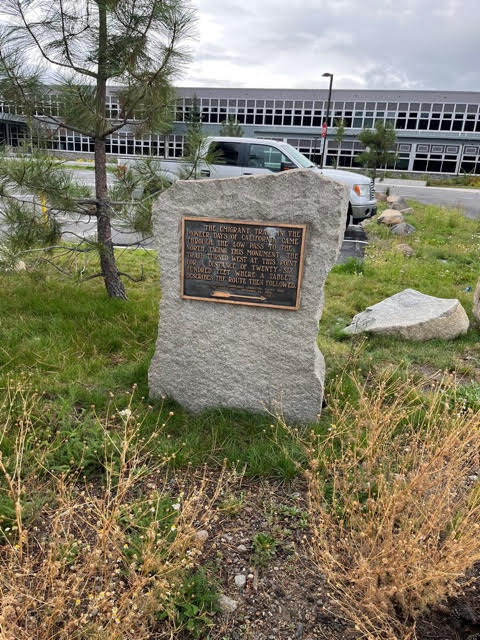
The Emigrant Trail Historical Marker, Truckee, California

The Emigrant Trail Historical Marker, Truckee, California

This trail was the original wagon route that went over Donner Summit when emigrants moved west towards California. During the 1850s and 1860s, emigrants were heading to California, hoping to obtain land, gold or new opportunities. They often faced harsh conditions from the weather, terrain and attacks from Native Americans whose lands they were traversing or trying to take over.

The Emigrant Trail crossed many Midwestern states. Pioneers along this trail would eventually reach California, Utah, Washington or Oregon.

Currently, the trail is a recreational area for biking, hiking and other activities.

Historical Marker Inscription

The Emigrant Trail in the pioneer days of California came through the low pass to the north, facing this monument. The trail turned west at this point for a distance of twenty-six hundred feet where a tablet describes the route then followed.

Placed by Historic Landmarks Committee, Native Sons of the Golden West, September 14, 1929.

Location

39° 19’ 32.862” N, 120° 13’ 0.990” W
11769–11771 Donner Pass Rd, Truckee, CA  96161, United States

Tom’s Place Historical Marker, Crowley Lake, CA

Tom's Place Historical Marker, Crowley Lake, California

German man Hans Lof built the original building that later became known as Tom’s Place in 1917. It started as a gas station and then was expanded. Thomas and Hazel Yerby purchased the property in 1923. They added a lodge in 1924. The area began attracting tourists who wanted to fish and visit Yosemite.

After Tom Yerby died in 1940, Hazel continued to run the place until 1945 when she sold it. Around this time, the highway was paved making it easier to access the area. In 1947, the lodge burned down.

After changing hands for several years, Mark and Michelle Layne purchased the property in January 2000, and they continue to run it to the present.

Historical Marker Inscription

This way-station, rest area and resort has served the residents and visitors of the Eastern Sierra for over 100 years.

Originally built and managed by Hands Lof, it operated as a seasonal cafe, bar, gas station, pack station and camp ground from 1917 to 1923 when it was purchased by Tom and Hazel Yerby.

The Yerbys improved and expanded the facilities with the construction of guest cabins and a full service lodge in 1924 (sadly the lodge burned down in 1947).

With the grading and paving of Hwy 23 (the predecessor of US-395) it became a year-round destination resort town known as – Tom’s Place. In 1961 a post office was established here and operated for several years.

After the death of Tom Yerby, the resort was sold and over the years it changed hands several times. However its popularity did not diminish and the name remained the same.

Today, the current owners maintain the hospitality and ambiance started by its founders. Thus ensuring Tom’s Place will remain a Mono County landmark for the next 100 years.

Dedicated
September 9, 2017
Bodie Chapter No 65
B Clampus Vitus

Location

8180 Crowley Lake Drive, Crowley Lake California 93546

37.5613° N, 118.6812° W

James Sinclair Historical Marker, Radium Hot Springs, BC

James Sinclair Historical Marker, British Columbia, Canada

James Sinclair began working for the Hudson Bay Company in 1826. He was the son of HBC officer Willian Sinclair. He initially worked at both Fort Albany and Chickney Goose Tent, located in Ontario.

In 1827, he relocated to the Red River Settlement in Manitoba and became a private trader. He later began fur trading, selling the furs back to the Hudson Bay Company. The goal was to keep American competitors from accessing the furs.

This is also the reason that the HBC wanted to reduce population growth in the settlement. To do this and improve Great Britain’s claim to the area, they arranged for a group of families to move into Oregon at the Columbia River. Sinclair was the guide who led the settlers through the plains and Rocky Mountains.

He would eventually move to the Oregon Territory, living in both Oregon and California. He would later become the head of HBC’s Fort Walla Walla. On March 26, 1856, he would be killed during an attack by Native Americans at the fort.

Historical Marker Inscription

In 1841, Sinclair guided 200 Red River settlers from Fort Garry through the Rockies to Oregon in an attempt to hold the territory for Great Britain. By 1854 he had recrossed the mountains several times by routes which later were followed by trails and highways — a tribute to this great pathfinder, traveller, free trader and colonizer.

Providence of British Columbia

1966

Location

50° 36’ 3.852” N, 116° 3’ 31.050” W

7875–7889 Highway 93, Radium Hot Springs BC V0A 1M0, Canada

Settlement of Hatch Historical Marker, Hatch, Utah

Settlement of Hatch Historical Marker, Hatch, Utah

Known initially as Hatch or Hatchtown, the town was created Meltiar Hatch and his two wives, Mary Ann and Permelia, and their children. It was an order by the Church of Latter-Day Saints leaders to settle the Dixie Mission. The three thought they were in Utah, but redrawn boundary lines had put the settlement in Nevada.

After discussions with Brigham Young,  everyone decided to move back to Utah. The first move was to Panguitch in South Utah. Later, the family moved 20 miles to the south where Mammoth Creek connects with the Sevier River. Other settlers also began moving into the area. The Hatch home was the central location of both LDS worship and school sessions. This is why the town was named Hatchtown.

In the early 1900s, The Upper Sevier Reservoir Company decided to build a dam despite the fears of the community. In 1903, the dam broke. It was rebuilt, and then the dam broke again in 1914. During the second dam break, many homes were destroyed, and people were left homeless. This was one of the reasons that the town was moved one and a half miles south of the original location. The town of Hatch was incorporated on January 3, 1934.

Historical Marker Inscription

In 1872 Meltiar Hatch settled at the head of the Sevier River, near the junction of Mammoth and Asay Creeks. He engaged in stock raising and operated a water-power sawmill. Soon other settlers came. Land was surveyed and irrigation ditches dug. Lime was burned by Neils P. Clove. First school was in the Hatch home, Abram Workman teacher. 1888 the Asay post office was transferred to Hatch, Neils Ivor Clove, Postmaster. In 1892 the Church of Jesus Christ of Latter-day Saints organized Mammoth Ward, Aaron Asay, Bishop. 1899 the Ward name was changed to Hatch. 1901 to 1904, the town was moved to the present site under the leadership of Bishop Rosmus Lynn.

Erected by The Daughters of Utah Pioneers in 1964, No. 292

Location

37° 38’ 59.280” N, 112° 26’ 4.482” W
2–24 W Center St, Hatch, UT 84735, United States

Emigrant Road, Jerome, ID

Emigrant Road Historical Marker, Jerome, ID

Known as the Emigrant Road, this route was favored by the Hudson’s Bay Company during the mid-1800s. The road ran from Snake River in the north to South-Central Idaho. As an alternative to the Oregon Trail, which tended to be difficult, the Hudson’s Bay Company traders used it to go between Fort Hall and Fort Boise.

Emigrants, on the other hand, had to take a route further south since the road was not initially designed to allow for wagons. With later improvements, emigrants would be able to use this route.

There is a dispute amongst historians as to whether this road was part of the North Alternate to the Oregon Trail, which would have made it part of the Oregon Trail System.

Historical Marker Inscription

More than a century ago, fur trappers and emigrants followed an old Indian trail that crossed here on its way to Oregon.

Hudson’s Bay Company traders preferred this route between Fort Hall and Fort Boise, but early emigrant wagons had to travel a road south of Snake River until ferries and road improvements let wagons come this way. Shoshone Falls — known until 1849 as Canadian Falls to British and French trappers — was a spectacular attraction along this road.

Location

42° 37’ 13.032” N, 114° 26’ 57.978” W
US-93 N, Jerome, ID  83338, United States