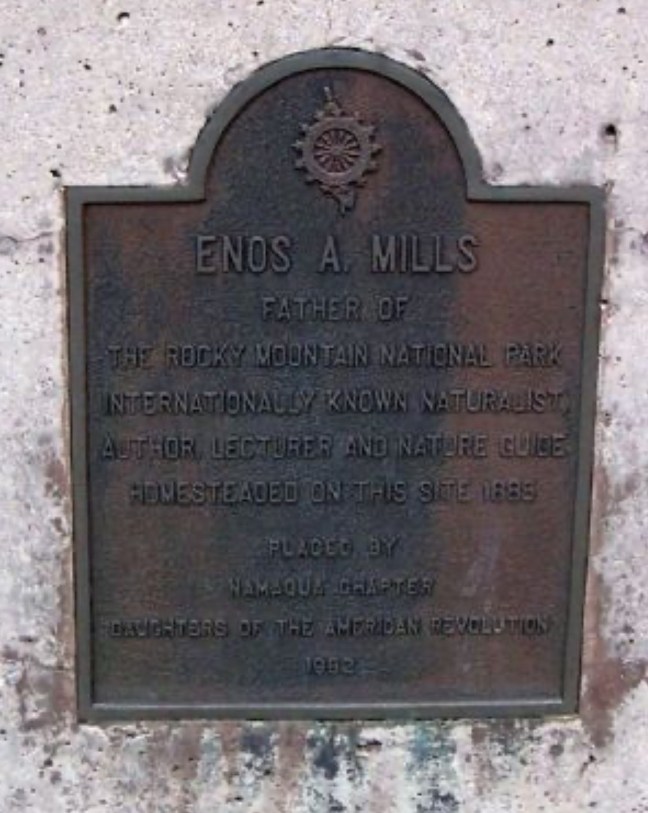
Enos A. Mills Historical Marker, Estes Park, Colorado

Enos A. Mills Historical Marker, Estes Park, Colorado

Born in 1870 and originally from Kansas, Enos A. Mills moved to Colorado during the early years of his life. He first ascended Longs Peak (14,255 feet tall) at 15. In 1887, Mills moved to Montana but would spend his summers traveling the West Coast.

After meeting naturalist John Muir in 1889 in California, Mills dedicated his life to conserving the natural world. Mills returned to Colorado in 1902 and bought a homestead in Estes Park. From here, he would take guests into the Rocky Mountain wilderness.

From 1902 to 1906, Mills worked as the Colorado State Snow Observer, where he measured snow depths. This helped predict spring and summer runoffs. From 1907 to 1909, he was also a government lecturer on forestry.

But Mills is best known for trying to protect the area around Longs Peak and turn it into a national park. Working with groups like the Sierra Club and the Daughters of the American Revolution, Mills finally got Congressional approval to create Rocky Mountain National Park in 1915.

Mills would summit Longs Peak 340 times both by himself and as a guide. He became known as the “Father of Rocky Mountain National Park”. Mills died in 1922 at the age of 52.

Historical Marker Inscription

Father of
the Rocky Mountain National Park
internationally known naturalist, author, lecturer and nature guide
Homesteaded on this site in 1885

Placed by NAMAQUA Chapter, Daughters of the American Revolution
1952

Location

40° 16.795′ N, 105° 32.487′ W
Estes Park, Colorado

Roger Wolcott Toll Historical Marker, Estes Park, Colorado

Roger Wolcott Toll Historical Marker, Estes Park, Colorado

Born on October 17, 1883, in Denver, Colorado, Roger Toll was an early employee of the National Park Service. He initially served as the superintendent of Mount Ranier National Park. Toll was appointed to the position by the first National Park Service director, Stephen Mather. He would also go on to serve in the same position at Rocky Mountain and Yellowstone National Parks.

Toll was instrumental in doing investigations and creating reports on potential new national parks, monuments and boundary extensions. Some of these recommendations included Joshua Tree, Death Valley, the Everglades and Big Bend. He also worked on a commission that included George Wright to investigate creating some protected areas along the Mexican-American border.

Wright and Toll were sadly killed in a car accident near Deming, New Mexico, on February 25, 1936. They were on their way to investigate the Ajo Mountains in Arizona.

Historical Marker Inscription

The mountain index on this rock is a memorial to
Roger Wolcott Toll
Superintendent of Mount Rainer National Park 1919-1921 *** of Rocky Mountain National Park 1921-1928 of Yellowstone National Park 1929-1935

Civil Engineer ** Naturalist Mountaineer *** Whose love of the high country was manifested by helping to make it more accessible for you and your friends

Location

40° 24.861′ N, 105° 43.44′

Near Estes Park, Colorado

Tarryall Diggings, Jefferson, Colorado Historical Marker

Tarryall Diggings Historical Marker in Colorado

Near Jefferson, located in Park County, Colorado, is the ghost town of Tarryall. It was once known as Tarryall City and was a town created by the gold rush. The town was founded in 1859 and was in existence for four years.

Apparently, the name came from when a group of miners that included William J. Holman and Earl Hamilton stumbled across a stream in South Park looking for gold. The group was exhausted and wanted to “tarry here”. Another member responded, “Yes, we’ll tarry all.” And the name was born. Soon, it also became clear that the stream was filled with gold.

The belief that there was abundant gold in the area encouraged miners to head out to this area of South Park. The town of Tarryall City was created on one side of the stream, and Hamilton was built on the other. The town at its height had approximately 6,000 people. Around $2 million in gold value at the time was collected from the Tarryall Diggings. Even today, visitors can find well over 11,000 mines that were once active in the area.

However, by the end of 1861, Tarryall City and its neighbor Hamilton had quickly declined. By 1867, they were virtually ghost towns.

Historical Marker Description

This memorial is the property of the State of Colorado

Extending up the creek to the mountains were the
Tarryall Diggings
Discovered in July, 1859. Towns of Hamilton and Tarryall (2 miles west) thrived in 1860s. A newspaper and numerous business houses flourished. The towns have long since disappeared. Large trees now grow in the sluice tailings on the bluff ½ mile west. The diggings have produced $2,000,000 in gold.

Erected by by The State Historical Society of Colorado.
From The Mrs. J.N. Hall Foundation and by Foster Cline
1933

Location

39° 19.971′ N, 105° 52.035′ W
Jefferson, Colorado

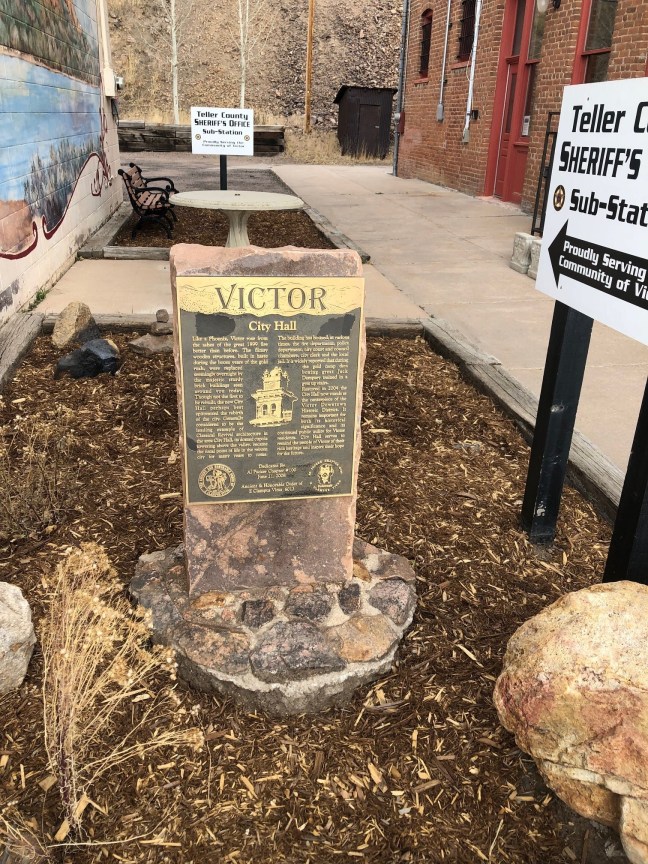
Victor City Hall Historical Marker, Victor, Colorado

Victor City Hall Historic Marker, Victor, Colorado

Victor, Colorado, was founded in 1891 after gold was discovered in the nearby Cripple Creek mining district. The location eventually became known as the City of Mines, and the largest gold mine was on Battle Mountain above Victor.

The original buildings were wood and were burned down in a fire in 1899. The new buildings were made of brick, including the City Hall. The City Hall is the highlight of the Victor Downtown Historic District, which is listed on the National Register of Historic Places.

City Hall, Victor, Colorado

Historical Marker Inscription

Like a Phoenix, Victor rose from the ashes of the great 1899 fire better than before. The flimsy wooden structures, built in haste during the boom years of the gold rush, were replaced seemingly overnight by the majestic sturdy brick buildings seen around you today. Though not the first to be rebuilt, the new City Hall perhaps best epitomized the rebirth of the city. Generally considered to be the leading example of Classical Revival architecture in the area City Hall, its domed cupola towering above the valley, became the focal point of life in the reborn city for many years to come.

The building has housed, at various times, the fire department, police department, city court and council chambers, city clerk and local jail. It is widely reported that during the gold camp days boxing great Jack Dempsey trained in a gym up stairs.

Restored in 2004 the City Hall now stands as a centerpiece of the Victor Downtown Historic District. It remains important for both its historical significance and its continued public utility for Victor residents. City Hall serves to remind the people of Victor of their rich heritage and inspire their hope for the future.

Dedicated by Al Packer Chapter #100 June 21, 2008

Ancient & Honorable Order of E Clampus Vitus 6013

Location

38° 42’ 38.220” N, 105° 8’ 33.340” W

500 Victor Ave, Victor, CO  80860, United States

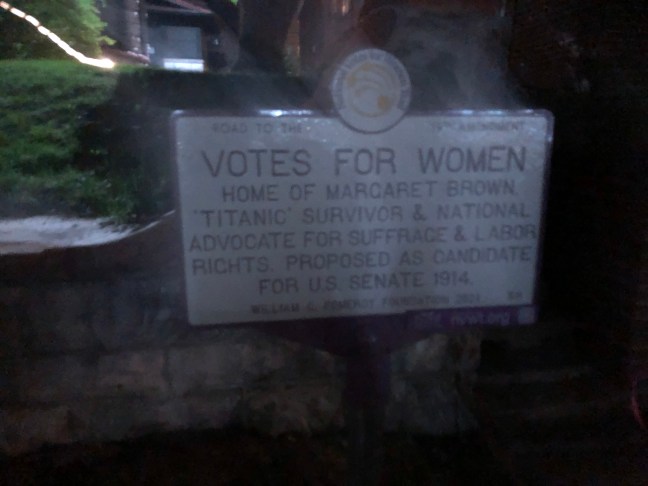
Votes for Women, Molly Brown House, Denver, CO

Votes for Women Historical Marker Denver Colorado

Women received the right to vote in Colorado in 1893. After this momentous occasion, Colorado suffragists strived to get women the right to vote on a national level. A member of this movement was Margaret “Molly” Brown, who became famous because she was a Titanic survivor, the doomed ocean liner that sunk in 1912.

She joined the Congressional Union for Woman Suffrage in 1914 and attended the suffrage convention in Rhode Island. Later, Brown was proposed as a U.S. Senate Candidate by the Congressional Union for Woman Suffrage. She was also involved with different labor issues and was part of the Red Cross in France during World War I.

The marker is part of the National Votes for Women Trail. It sits in front of the Molly Brown House Museum, which was Brown’s old home.

Historical Marker Description

Road to the 19th Amendment

Home of Margaret Brown, ‘Titanic’ survivor & national advocate for Suffrage & Labor Rights. Proposed as candidate for U.S. Senate 1914.

William C. Pomeroy Foundation 2021 58

Location

1320 North Pennsylvania Street, Denver, Colorado 80203, United States

39° 44′ 14.310″ N, 104° 58′ 51.720″ W

Lime Creek Burn 1879

Lime Creek Burn 1879 Historical Marker, Colorado

The Lime Creek fire burned 26,000 acres in 1879, which was a major drought year. The fire burned an area of the San Juan Mountains between Molas Pass and Coal Creek Pass, located along U.S. 550. The Ute Native Americans were blamed for the fire, which they supposedly lit for being pushed out of Colorado.

Since the area had been a drought, there were other fires that year. According to records, 1879 had less than half of the normal annual rainfall of the year, making it one of the driest years on record.

Historical Marker Inscription

This man-caused forest fire burned 26,000 acres consuming approximately 150,000,000 board-feet of timber. Reforestation by direct seeding and planting of seedling trees was started in 1911 and continues today.

The project was financed by federal funds and contributions from the conservation-minded Colorado Federation of Women’s Clubs.

Location

U.S. 550, CO 81433 United States (near the Post Office)

37° 42′ 54.960″ N, 107° 45′ 16.920″ W


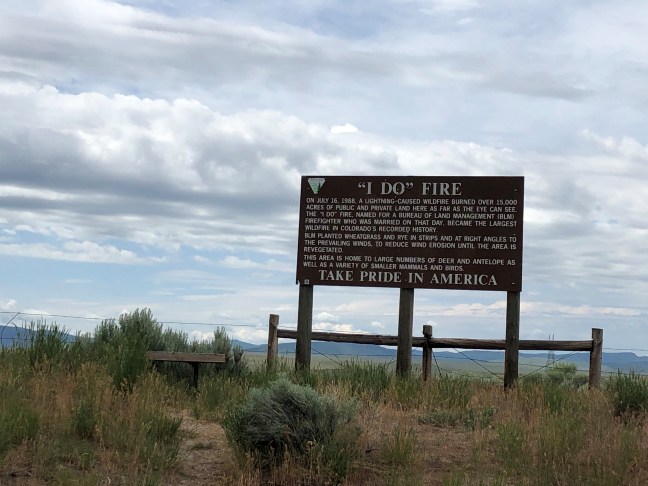
“I Do” Fire, Maybell, Colorado

I Do Fire Colorado, Maybell, CO

Colorado is no stranger fires. They happen on a regular – and increasingly frequent – basis. The “I Do” Fire was one of the largest at the time. Currently, the largest Colorado wildfire in state history is the Cameron Peak fire, which burned over 208,000 acres.

Historical Marker Inscription

On July 16, 1988, a lightning-caused wildfire burned over 15,000 acres of public and private land here as far as the eye can see. The “I Do” Fire, named for a Bureau of Land Management (BLM) firefighter who was married on that day, became the largest wildfire in Colorado’s recorded history.

BLM planted wheatgrass and rye in strips and at right angles to the prevailing winds, to reduce wind erosion until the area is revegetated.

This area is home to large numbers of deer and antelope as well as a variety of smaller mammals and birds.

Take Pride in America

Location

U.S. Highway 40, West of County Road 143 approximately 5 miles from Maybell, Colorado

N 40° 28.999, W 108° 10.923

Escalante Canyon Historical Marker, Delta, CO

Escalante Canyon Historical Marker, Delta, CO

Escalante Canyon is a beautiful and historical canyon located near Delta, Colorado. The canyon is named after two Franciscan priests, Silvestre Vélez de Escalante and Atanasio Domínguez. They were part of expedition that happened in 1776 to find an overland route between Santa Fe, New Mexico, and a Roman Catholic mission in Monterey, California. While the priests didn’t actually pass through the canyon, it is still named after Escalante.

The canyon was formed over 600 million year ago and is a 1,300 foot deep gorge, carved by the Escalante Creek. The canyon features petroglyphs that trace back to the earliest people. It is known that the Ute Indians made the North Fork of the Escalante River their winter home, and early settlers eventually moved in to take advantage of the easy water supply, forcing many natives off their lands. Cattle outfits also began using the canyon in the late 1800s.

Escalante Canyon was a notable part of the Colorado Sheep War as well. The Spanish had introduced sheep into America, and their numbers had increased to over 2 million by 1896. Some settlers also brought sheep with them when the area was opened to settlers in 1882. With the rise of cattle in the region, conflicts between two sides for grazing lands was inevitable.

Cattle owners would threaten sheep owners by wearing masks. These marauders eventually became known as the Night Riders. In 1915, the Night Riders attacked at a band of sheep in the Oh-Be-Joyful Creek area. They drove a herd of 200 sheep of a cliff while the owner was tied to the tree. Then, on June 9, 1917, Ben Lowe and a former local Delta County sheriff, Cash Sampson, died during a shootout, each falling to the other’s gun.

The two had supper at J.W. Musser’s ranch. When they were leaving, they got into an argument that left both men dead only a few feet apart. While there were no witnesses to the argument, it is very likely that it was due to Sampson investigating Lowe as being part of the sheep slaughter than had taken place previous year.

Within the canyon, you can find the stone cabin of Captain Henry A. Smith, who was a Civil War veteran. He used local sandstone to build his cabin and made his living as a tombstone carver. The cabin is located 18 miles from the Escalante Bridge.

Historical Marker Inscription

Named after one of the two priests Escalante and Dominguez after their expedition in 1776. Rich in history this canyon has seen its share of human beings starting with the earliest Native Americans since circa 700 AD. After the Civil War, Captain Henry A. Smith, a tombstone carver, made this canyon his home. The canyon hosted the Colorado Sheep War during March 1916 and a shootout left residents Cash Sampson and Ben Lowe dead.

The previous plaque was dedicated June 12, 2003.

This plaque rededicated July 17, 2010 by Al Packer Chapter 100

E Clampus Vitus

Location

US-50 E, Delta, CO 81416

38° 47′ 2.760″ N, 108° 14′ 47.970″ W

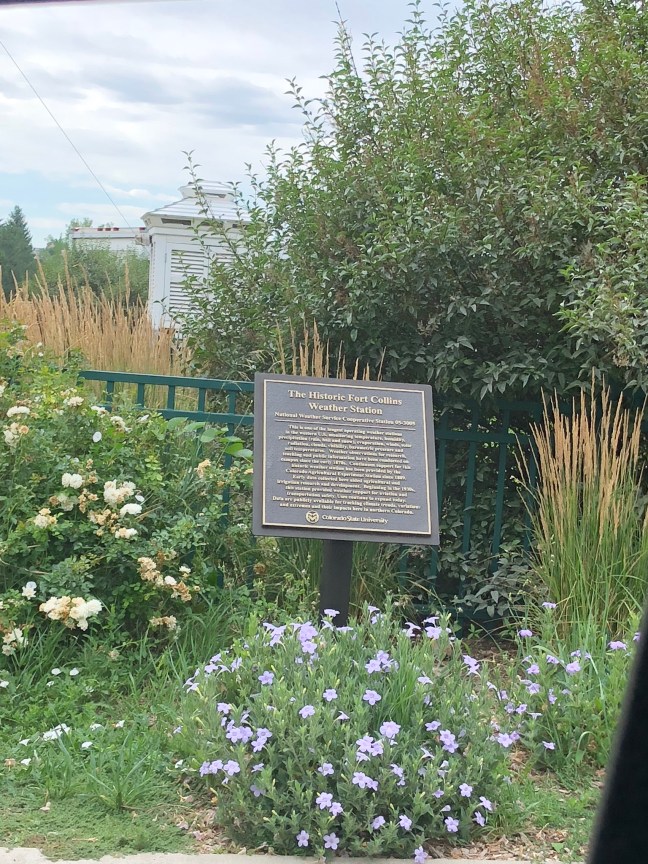
The Historic Fort Collins Weather Station

The Historic Fort Collins Weather Station Historical Marker

Located on the campus of Colorado State University near the Lory Student Center, the Historic Fort Collins Weather Station began collecting data in the 1870s. It was located near the site of the “Old Main” building, which was lost to arson in 1970.

Data is available in both digital and hard copy forms dating back to 1889, and data is updated every 10 minutes. This data includes information about humidity, wind speeds and direction, temperature, pressure, soil temperatures and solar radiation.

Colorado State University

Historical Marker Inscription

This is one of the longest operating weather stations in the western U.S. monitoring temperature, humidity, precipitation (rain, hail and snow), evaporation, winds, solar radiation, clouds, visibility, barometric pressure and soil temperatures. Weather observations for research, teaching and public information have been conducted on campus since the early 1870s. Continuous support for this historic weather station has been provided by the Colorado Agricultural Experiment Station since 1889. Early data collected here aided agricultural and irrigation research and development. Beginning in the late 1930s, this station provided weather support for aviation and transportation safety. Uses continue to expand today. Data are publicly available for tracking climate trends, variations and extremes and their impacts here in northern Colorado.

Location

Colorado State University, Fort Collins, CO 80523

40° 34.582′ N, 105° 5.158′ W

Old Spanish Trail North Branch

Old Spanish Trail North Branch: Colorado Historical Marker

From about 1830 to 1848, the Old Spanish Trail was used to bring textiles from Santa Fe to Los Angeles, which were then traded for mules and horses for the New Mexico and Missouri markets. The trail is considered to be one of the most difficult trails in the United States.

Originally part of ancient, Native American Indian trade routes (one part of which was in use for nearly 1,000 years), the trade routes were connected later by Spanish, Mexican and American traders.

The trail was divided into two routes: the North Branch went north into the San Luis Valley in Colorado, which then went west over Cochetopa Pass, following the Gunnison and Colorado Rivers. It eventually connected with the South Branch near the Green River. The South or Main Branch went northwest to Green River, Utah, passing the Colorado San Juan mountains.

There have been many efforts over the years to preserve the Old Spanish Trail and make it part of the National Historic Trails system.

Historical Marker Inscription

This sign marks an important junction of the Old Spanish Trail. Both forks, east and west, of the North Branch of this Trail converged at Saguache before continuing west of Cochetopa Pass and on to Los Angeles.

The Old Spanish Trail was the principle mule pack route for explorers and traders until 1848, evolving into a wagon road and currently a modern highway.

The purpose of this sign is twofold: first, to note the 4th Annual Conference of the Old Spanish Trail National Association that convened at Saguache, Colorado on June 21-22, 1997; and second, to celebrate the vital contribution of the early trails, before which, all life was limitation.

Location:

Located in Saguache, Colorado, at the intersection of 8th Street (Highway 285) and Christy Avenue in a park.

38° 5.132′ N, 106° 8.527′ W.