Rapid City Founders Camp Site, South Dakota

Rapid City Historical Marker South Dakota

The location of Rapid City was initially occupied by Native Americans before European American settlers arrived. White settlers started heading to this area in 1874 due to the discovery of gold in the Black Hills.

In 1876, a group of 11 settlers made camp at what would become known as Founder Rock. This is where these men laid out the original plan for Rapid City. The founders’ initials can still be located on the sandstone outcropping.

The men laid out a one-square-mile business district, originally called Hay Camp. It would later become Rapid City, naming it after the creek that ran through the town.  During the late 1800s, it became a transportation hub for stagecoaches, wagons and rail traffic. Later, Rapid City would be advertised as the “Gateway to the Black Hills”. The nickname is still used today.
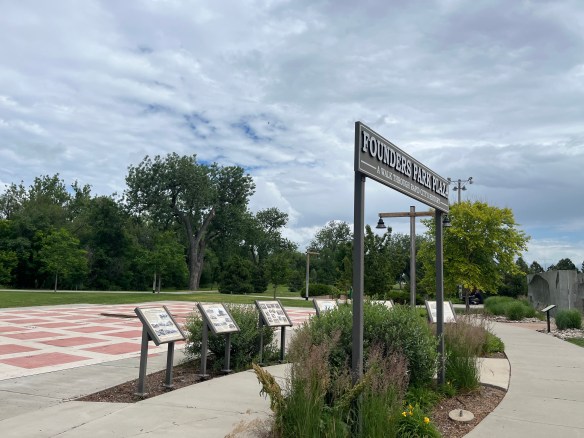
Rapid City Founders Park Historical Marker

Historical Marker Inscription

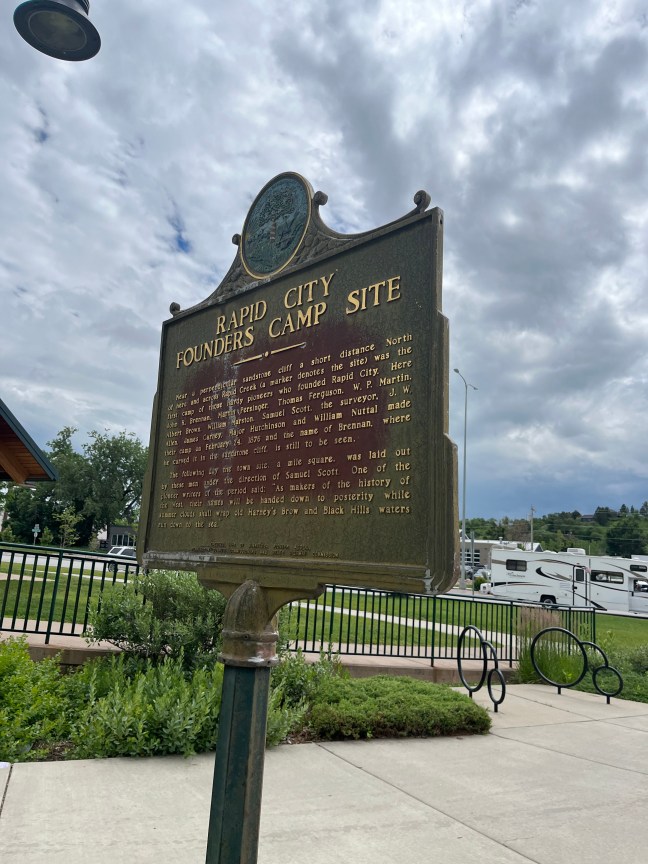
Near a perpendicular sandstone cliff a short distance North of here and across Rapid Creek (a marker denotes the site) was the first camp of those hardy pioneers who founded Rapid City. Here John R. Brennan, Martin Persinger, Thomas Ferguson, W. P. Martin, Albert Brown, William Marston, Samuel Scott, the surveyor, J. W. Allen, James Carney, Major Hutchinson and William Nuttal made their camp on February 24, 1876 and the name of Brennan, where he carved it in the sandstone cliff, is still to be seen.

The following day the town site, a mile square, was laid out by these men under the direction of Samuel Scott. One of the pioneer writers of the period said: “As makers of the history of the West, their names will be handed down to posterity while summer clouds shall wrap old Harney’s Brow and Black Hills waters run down to the sea.”

Location

Founders Park, 1236–1420 W Omaha St, Rapid City, SD  57701, United States

44° 5’ 4.690” N, 103° 14’ 34.788” W
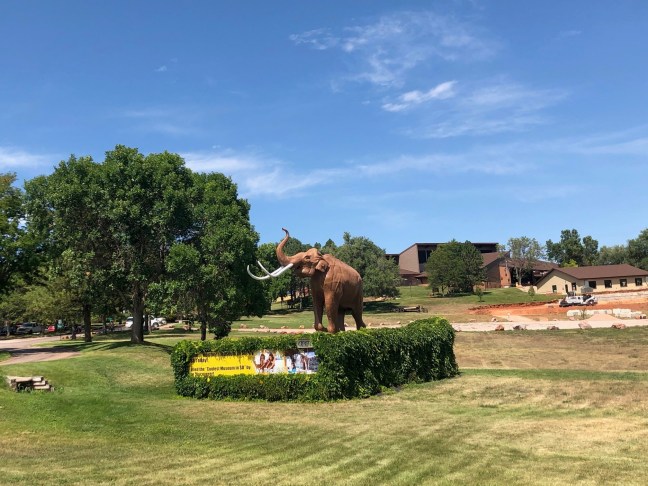
The Mammoth Site of Hot Springs, SD, Historical Marker

Mammoth Site Hot Springs, SD

The Mammoth Site in Hot Springs, South Dakota, is an active dig site that allows visitors to view different fossils from the Ice Age, mainly mammoth, including tusks and skulls. The Mammoth Site was discovered in June 1974 when heavy equipment operator, George Hanson, began leveling ground to build a housing development. While grading a hill, Hanson discovered a tusk and other bones.

Phil Anderson, the landowner, contacted several universities to see if they were interested in seeing the find. All declined. George Hanson instead took the bones to his son, Dan Hanson, who had taken classes in archaeology and geology. He then called his former college professor, Dr. Larry Agenbroad, who later contacted Dr. Jim Mead.

Mammoth Site, Hot Springs, South Dakota

In 1975, Dr. Agenbroad and Dr. Mead along with volunteer students started excavating the area. What they found was a massive mammoth graveyard due to an ancient sink hole (animals would come to drink or eat at the location, fall in and couldn’t escape due to the steep, slippery sides). By the end of 1975, realizing that the area was of major interest to science, Phil Anderson along with the local community founded The Mammoth Site of Hot Springs, SD, Inc.

There is a fee to enter the active dig site.

Historical Marker Inscription

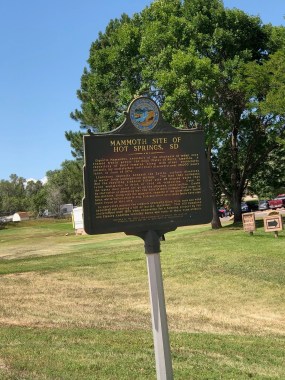
Mammoth Site, Hot Springs, SD, Historical Marker

Gigantic mammoths, ancestors of the majestic elephants of today, once roamed freely across the High Plains of North America. A repository of their remains, along with other kinds of animals, lay undisturbed until their discovery over 26,000 years later, in June of 1974.

Limestone deposits beneath the earth’s surface dissolved in water from underground springs. The land then collapsed and the resulting sinkhole filled with 95 degree water that lured mammoths to drink or feed on vegetation. Once in the water they could not get up the slippery, steep incline. Death by starvation or drowning was the fate of most animals that came to the sinkhole. Along with the mammoth, remains of the giant short-faced bear, white-tailed prairie dog, fish and other associated fauna have also been found at the site.

As centuries passed, the sinkhole gradually filled. Rain, snow and wind wore away the soil leaving a hill of buried skeletons. This hill remained undisturbed until 1974 when excavation for a housing project by Phil and Elenora Anderson revealed bones and tusks of these huge animals.

Location

1800 US 18 Bypass, Hot Springs, South Dakota 57747
N 43° 25.370 W 103° 29.028