Robinson-Maloney Dantzler House, Biloxi, MS

Robinson-Maloney Dantzler House Historical Marker, Biloxi, MS

Built in 1849 by John Ghamm (J.G.) Robinson, the house was a two-story residence with a  two-tiered gallery. It was a Greek Revival mansion with extensive woodwork and windows, and formal gardens.

J.G. Robinson was an English planter. He was the owner of the house until 1873 when it was sold to Frederick Gaupp. It was bought by the Maloney family in 1884, which owned the house until 1912. It was sold a couple of more times, ending up with the Dantzler family in 1918.

It was later purchased by the Catholic Diocese in 1921, which used the house as the Notre Dame High School for boys and then the Sisters of the Little Flower Convent of Mercy.

The house was damaged during Hurricane Camille in 1969 and destroyed by Hurricane Katrina in 2005.

Historical Marker Inscription

Originally a raised-cottage Greek Revival mansion similar to Beauvoir, the house located here was built ca. 1849 by J. G. Robinson, a wealthy English cotton planter. It was the center of an estate that included a ten-pin bowling alley, billiard hall, bath house, thoroughbred stables, kennels, gardens and a wharf for docking two prized yachts. About 1908 the Maloney family enlarged the house with a second story addition and two-tiered wrap-around porches in the Neo-Classical style. Destroyed by Hurricane Katrina in 2005.

Location

1048 Beach Boulevard, Biloxi, MS 39530 United States

30° 23′ 41.088″ N, 88° 54′ 3.798″ W
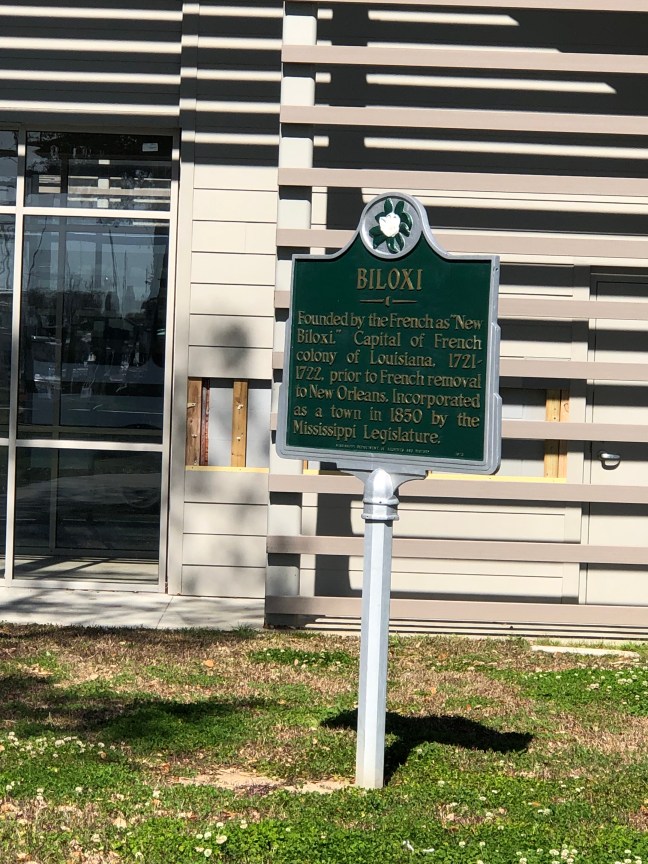
Biloxi, Mississippi Historical Marker

Biloxi, MS Historical Marker

From as early as 8,000 BC to the 1700s, Native Americans made Biloxi home. Then, in 1697, the Comte de Ponchartrain, French Minister of Marine, ordered Pierre Le Moyne, Sieur d’Iberville, to find the mouth of the Mississippi River. In the course of looking for it, Iberville and 14 men came to what would become Biloxi, named after the Biloxi Native Americans, who the crew met and befriended. These Native Americans might have only arrived at the coast a short while before the French.

Biloxi became the capital of the French territory from about 1719 to 1722 when the capital was moved to New Orleans. By 1779, the French had ceded the Mississippi Coast to Spain, and it briefly (in 1810) became a part of the Republic of West Florida. In fact, over the years, Biloxi was under the French, Spanish, British, West Florida Republic, Confederacy and the United States flags.

Mississippi officially became a state in 1817. By 1850, Biloxi was incorporated as a township and became a favorite summer resort.

Historical Marker Inscription

Founded by the French as “New Biloxi.” Capital of French colony of Louisiana, 1721-1722, prior to French removal to New Orleans. Incorporated as a town in 1850 by the Mississippi Legislature.

Location

Biloxi Small Craft Harbor, 679 Beach Boulevard, Biloxi, MS 39350 United States

30° 23′ 33.372″ N, 88° 53′ 3.840″ W