Church of the Redeemer Biloxi, Mississippi Historical Marker

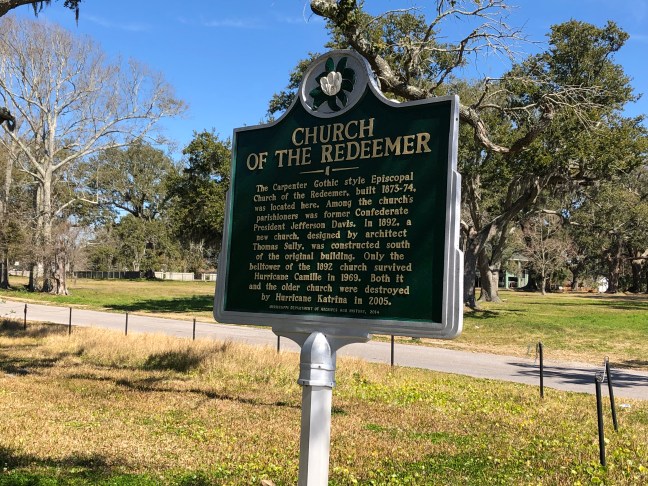
Church of the Redeemer Historical Marker, Biloxi, MS

The Church of the Redeemer was built in 1874 and initially sat on the corner of Howard Avenue and Nixon Street in Biloxi, MS. The congregation had received its charter from the Mississippi Legislature in 1853. It was officially admitted to the Diocese in 1859. After its construction, it was the first Protestant church in the area.

Later in 1891, the church was moved to Beach Boulevard on land donated by Harry T. Howard. Known as the new church, it was used for 78 years until it was destroyed by Hurricane Camille on August 17, 1969. Both the church and the rectory were taken out by the hurricane. The bell tower and original “old church” survived, the latter with significant damage.

The old church was later repaired, and service was held there on Christmas Eve 1969. The church survived until Hurricane Katrina hit the area on August 29, 2005. It destroyed the remaining church and bell tower.

Historical Marker Inscription

The Carpenter Gothic style Episcopal Church of the Redeemer, built 1873-74, was located here. Among the church’s parishioners was former Confederate President Jefferson Davis. In 1892, a new church, designed by architect Thomas Sully, was constructed south of the original building. Only the belltower of the 1892 church survived Hurricane Camille in 1969. Both it and the older church were destroyed by Hurricane Katrina in 2005.

Mississippi Department of Archives and History, 2014

Church of the Redeemer Historical Marker, Biloxi, MS

Location

30° 23’ 36.498” N, 88° 52’ 54.690” W

612 Beach Blvd, Biloxi, MS  39530, United States

Robinson-Maloney Dantzler House, Biloxi, MS

Robinson-Maloney Dantzler House Historical Marker, Biloxi, MS

Built in 1849 by John Ghamm (J.G.) Robinson, the house was a two-story residence with a  two-tiered gallery. It was a Greek Revival mansion with extensive woodwork and windows, and formal gardens.

J.G. Robinson was an English planter. He was the owner of the house until 1873 when it was sold to Frederick Gaupp. It was bought by the Maloney family in 1884, which owned the house until 1912. It was sold a couple of more times, ending up with the Dantzler family in 1918.

It was later purchased by the Catholic Diocese in 1921, which used the house as the Notre Dame High School for boys and then the Sisters of the Little Flower Convent of Mercy.

The house was damaged during Hurricane Camille in 1969 and destroyed by Hurricane Katrina in 2005.

Historical Marker Inscription

Originally a raised-cottage Greek Revival mansion similar to Beauvoir, the house located here was built ca. 1849 by J. G. Robinson, a wealthy English cotton planter. It was the center of an estate that included a ten-pin bowling alley, billiard hall, bath house, thoroughbred stables, kennels, gardens and a wharf for docking two prized yachts. About 1908 the Maloney family enlarged the house with a second story addition and two-tiered wrap-around porches in the Neo-Classical style. Destroyed by Hurricane Katrina in 2005.

Location

1048 Beach Boulevard, Biloxi, MS 39530 United States

30° 23′ 41.088″ N, 88° 54′ 3.798″ W

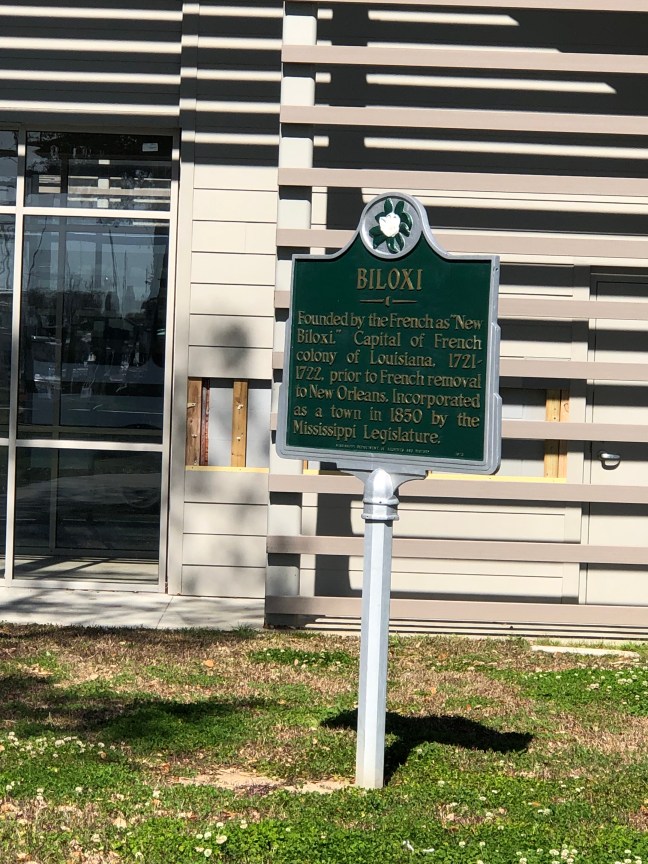
Biloxi, Mississippi Historical Marker

Biloxi, MS Historical Marker

From as early as 8,000 BC to the 1700s, Native Americans made Biloxi home. Then, in 1697, the Comte de Ponchartrain, French Minister of Marine, ordered Pierre Le Moyne, Sieur d’Iberville, to find the mouth of the Mississippi River. In the course of looking for it, Iberville and 14 men came to what would become Biloxi, named after the Biloxi Native Americans, who the crew met and befriended. These Native Americans might have only arrived at the coast a short while before the French.

Biloxi became the capital of the French territory from about 1719 to 1722 when the capital was moved to New Orleans. By 1779, the French had ceded the Mississippi Coast to Spain, and it briefly (in 1810) became a part of the Republic of West Florida. In fact, over the years, Biloxi was under the French, Spanish, British, West Florida Republic, Confederacy and the United States flags.

Mississippi officially became a state in 1817. By 1850, Biloxi was incorporated as a township and became a favorite summer resort.

Historical Marker Inscription

Founded by the French as “New Biloxi.” Capital of French colony of Louisiana, 1721-1722, prior to French removal to New Orleans. Incorporated as a town in 1850 by the Mississippi Legislature.

Location

Biloxi Small Craft Harbor, 679 Beach Boulevard, Biloxi, MS 39350 United States

30° 23′ 33.372″ N, 88° 53′ 3.840″ W

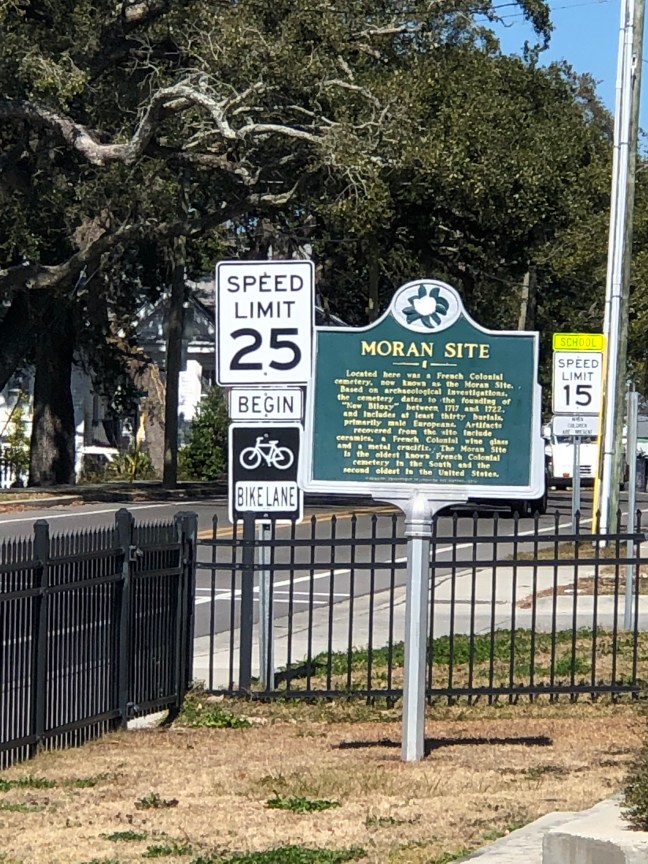
Moran Site, Biloxi, Mississippi

Moran Site, Biloxi, Mississippi

What was once a Colonial cemetery is now the French Colonial Memorial Garden, located at the Biloxi Visitors Center. The memorial park and garden commemorates the 1700s cemetery, which is the second oldest French Colonial cemetery in the United States.

The site dates back to the 1720s when Biloxi was a staging ground for European settlers and African slaves. From here, they would be relocated further into the French Louisiana Colony.

Found here were 32 graves of French Colonial settlers from the 1700s. The graves were mainly European men, and several artifacts were also discovered at this location. Remains were initially uncovered here in 1914, but it was unknown who they belong to. In 1969, Hurricane Camille unearthed more remains. A total of 12 burials were discovered at that time. Excavations post Hurricane Katrina in 2005 located an additional 20 graves.

The site is named after the Moran family who lived and worked at the site in 1952. The dedication of the memorial garden took place in 2017.

Historical Marker Inscription

Located here was a French Colonial cemetery, now known as the Moran Site. Based on archaeological investigations, the cemetery dates to the founding of “New Biloxi” between 1717 and 1722, and includes at least thirty burials, primarily male Europeans. Artifacts recovered from the site include ceramics, a French Colonial wine glass and a metal crucifix. The Moran Site is the oldest known French Colonial cemetery in the South and the second oldest in the United States.

Location

Biloxi Visitors Center, 1050 Beach Blvd, Biloxi, MS 39530

30° 23.719′ N, 88° 54.101′ W