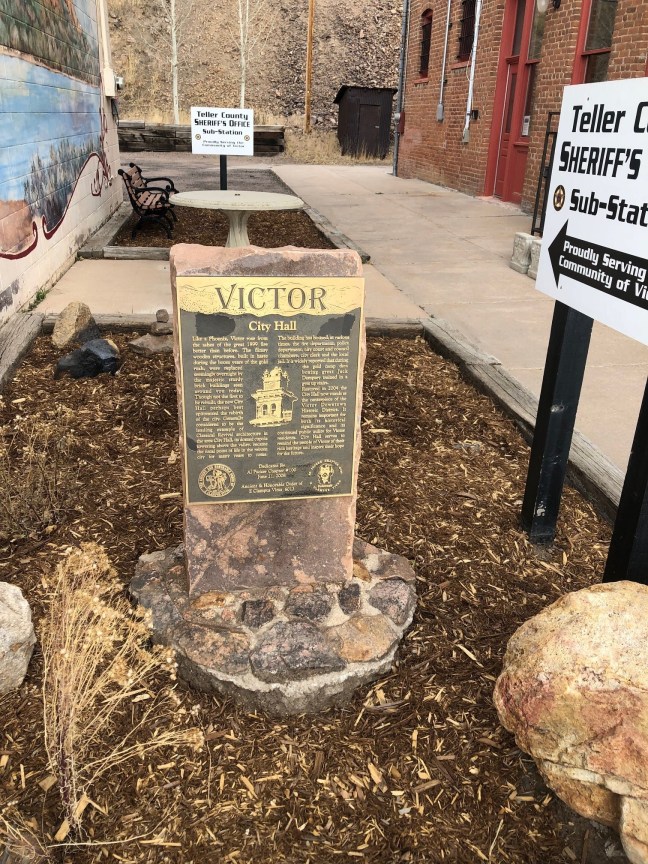
Victor City Hall Historical Marker, Victor, Colorado

Victor City Hall Historic Marker, Victor, Colorado

Victor, Colorado, was founded in 1891 after gold was discovered in the nearby Cripple Creek mining district. The location eventually became known as the City of Mines, and the largest gold mine was on Battle Mountain above Victor.

The original buildings were wood and were burned down in a fire in 1899. The new buildings were made of brick, including the City Hall. The City Hall is the highlight of the Victor Downtown Historic District, which is listed on the National Register of Historic Places.

City Hall, Victor, Colorado

Historical Marker Inscription

Like a Phoenix, Victor rose from the ashes of the great 1899 fire better than before. The flimsy wooden structures, built in haste during the boom years of the gold rush, were replaced seemingly overnight by the majestic sturdy brick buildings seen around you today. Though not the first to be rebuilt, the new City Hall perhaps best epitomized the rebirth of the city. Generally considered to be the leading example of Classical Revival architecture in the area City Hall, its domed cupola towering above the valley, became the focal point of life in the reborn city for many years to come.

The building has housed, at various times, the fire department, police department, city court and council chambers, city clerk and local jail. It is widely reported that during the gold camp days boxing great Jack Dempsey trained in a gym up stairs.

Restored in 2004 the City Hall now stands as a centerpiece of the Victor Downtown Historic District. It remains important for both its historical significance and its continued public utility for Victor residents. City Hall serves to remind the people of Victor of their rich heritage and inspire their hope for the future.

Dedicated by Al Packer Chapter #100 June 21, 2008

Ancient & Honorable Order of E Clampus Vitus 6013

Location

38° 42’ 38.220” N, 105° 8’ 33.340” W

500 Victor Ave, Victor, CO  80860, United States
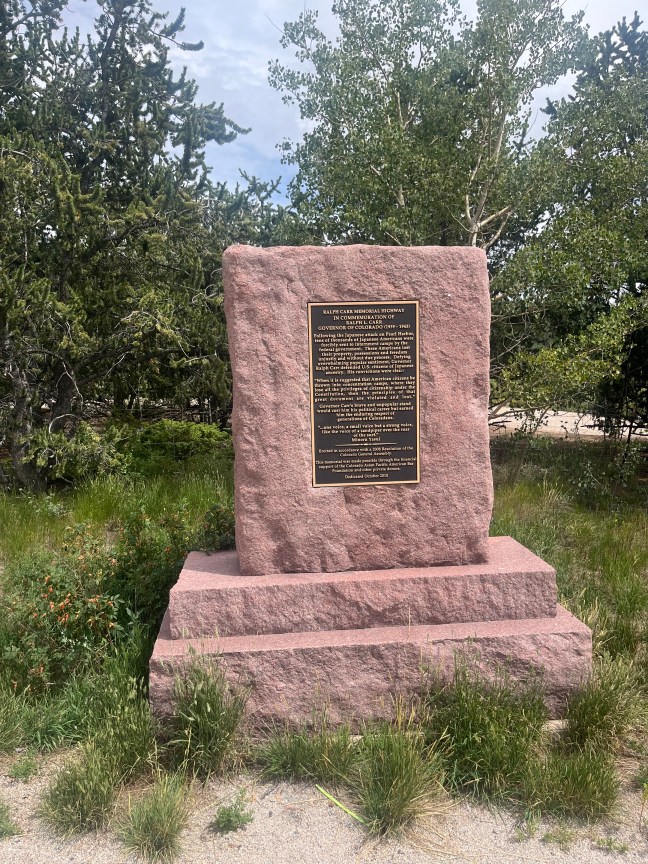
Ralph Carr Memorial Highway

Ralph Carr Memorial Highway Historical Marker Colorado

In the same place as the South Park historical marker on 285 at Kenosha Pass is another marker dedicated to Ralph Carr, a former governor of Colorado. Serving during World War II, Carr was the only Western governor to oppose the internment of Japanese Americans after the bombing of Pearl Harbor. He even gave speeches and wrote a letter published in the Pacific Citizen newspaper of the Japanese American Citizens’ League to encourage Japanese Americans to come to Colorado.

While only serving as governor for one term due to his resistance to the internment push, he did make Denver a popular postwar destination for Japanese Americans after they were released from internment camps. There was a large Japanese contingent in Colorado from the 1950s to the 1960s.

Carr’s support for Japanese Americans cost him the governorship, and he lost a Senate campaign in 1942. He tried running for Colorado governor again in 1950, but died right before the election at 62 years old.

Historical Marker Inscription

Ralph Carr Memorial Highway in Commemoration of Ralph L. Carr Governor of Colorado (1939-1943)

Following the attacks of Pearl Harbor, tens of thousands of Japanese Americans were forcibly sent to internment camps by the federal government. These Americans lost their property, possessions and freedoms unjustly and without due process. Defying overwhelming popular sentiment, Governor Ralph Carr defended U.S. citizens of Japanese ancestry. His convictions were clear:

“When it is suggested that American citizens be thrown into concentration camps, where they lose all privileges of citizenship under the Constitution, then the principles of that great document are violated and lost.”

Governor Carr’s brave and unpopular stand would cost him his political career but earned him the enduring respect of generations of Coloradans.

“…one voice, a small voice but a strong voice, like the voice of a sandpiper over the roar of the surf.” – Minoru Yasui “

Erected in accordance with a 2008 Resolution of the Colorado General Assembly.

This memorial was made possible through the financial support of the Colorado Asian Pacific American Bar Foundation and other private donors.

Dedicated October 2010

Location: US-285, Lake George, CO 80827

Latitude: 39° 24′ 12.432″ N Longitude: 105° 45′ 16.152″ W

Leadville Historical Marker

It was the lure of gold that caused Leadville to be founded. Placer gold was found by Abe Lee in California Gulch, which is about a mile east of Leadville, during the Pikes Peak Gold Rush in 1860. The first gold was discovered in April, but by the end of summer, the population of Leadville would reach over 10,000.

By 1866, nearly all the gold deposits were exhausted, and many miners left. The rest moved closer to town, which had been covered with a heavy, black sand. It was discovered that this sand was actually cerussite, which contains at least 15 ounces of silver per ton.

Leadville was again a boom town by 1879. With the new influx, hotels, brothels, saloons, restaurants and more were built. Many mines also were created, and fortunes were made, especially by silver magnate and Tabor Opera House builder Horace Tabor and even the Guggenheims. Horace Tabor would even give the site its official name, based on the lead ore found in the area.

The Marker Inscription

Entering The Cloud City. Altitude 10,152 Ft.

“Here on the roof-top of the nation flourished about 1844 the most famous silver mining camp in the world. Perhaps 30,000 fortune hunters made this town about 1890 the second largest city of Colorado. Here grew fabulous fortunes – among many of H.A.W. Tabor. A Gay and cultivated social life, violent labor contests, ambitious projects like the ice palace marked the city.

In 1860, gold was discovered nearby in California Gulch but soon exhausted. The miners scattered. Seventeen years later a heavy sand discarded by prospectors as a nuisance in the pine woods hereabouts was found to be silver carbonate.

Westward loom Mount Elbert, Colorado’s highest peak, and Mount Massive. The Sawatch (Blue Earth) range to the west and the Mosquito to the east contain several of the loftiest mountains in North America.

Healy House and Dexter Cabin State Museum, Harrison Avenue and East Tenth Street, depicts life in pioneer Leadville.”

Location: 39° 15.785′ N, 106° 17.459′


John B. “Texas Jack” Omohundro 1846-1880

As you’re entering Leadville on the south end of town on Highway 24, you’ll run into two historical markers: one is the main Leadville marker, and the second is dedicated to John B. “Texas Jack” Omohundro.

The History

Texas Jack lived from July 26, 1846 until June 28, 1880. He served as a Confederate soldier during the American Civil War and then later as a scout for the U.S. Army during the Indian Wars.

Texas Jack moved to Fort Hays, Kansas, in 1869. Here, he met both Wild Bill Hickok, famous gunfighter, gambler and showman, and California Joe Milner, who was a miner and frontier scout. Within the same year, he always become friends with William F. “Buffalo Bill” Cody, who was at Fort McPherson working with the 5th U.S. Cavalry.

By 1872, Cody and Texas Jack were appearing on stage together as part of the live show “Scouts of The Prairie”. In 1873, Wild Bill would join the show, which was renamed “Scouts of The Plains”. Throughout the 1870s, Texas Jack would be part of the theater.

Texas Jack died due to pneumonia on June 28, 1880 in Leadville, Colorado, about one month short of his 34th birthday. Unlike Hickok and Cody, he never became a household name.

To learn more about Texas Jack, check out the Buffalo Bill Center of the West site.

The Historical Marker

The inscription on the marker is as follows:

“Born in Virginia, Texas Jack came west after the Civil War at age 16 to become a cowboy. He later made a name for himself as a plainsman and U.S. government scout who led the Pawnee Indians on their summer hunts and was guide for such notables as the Earl of Dunraven.

In 1872, with friend W. F. (Buffalo Bill) Cody, he achieved national fame by starting the first wild west shows in America. (Texas Jack was honored posthumously in 1994 by induction into the National Cowboy Hall of Fame’s Hall of Great Western Performers located at Oklahoma City).

Jack and his lovely wife, the celebrated danseuse Mlle. Guiseppina Morlacchi resided in Leadville where on June 28. 1880 he died at age 33. He is buried in Leadville’s Evergreen Cemetery.”

Location: 39° 15.785′ N, 106° 17.459′