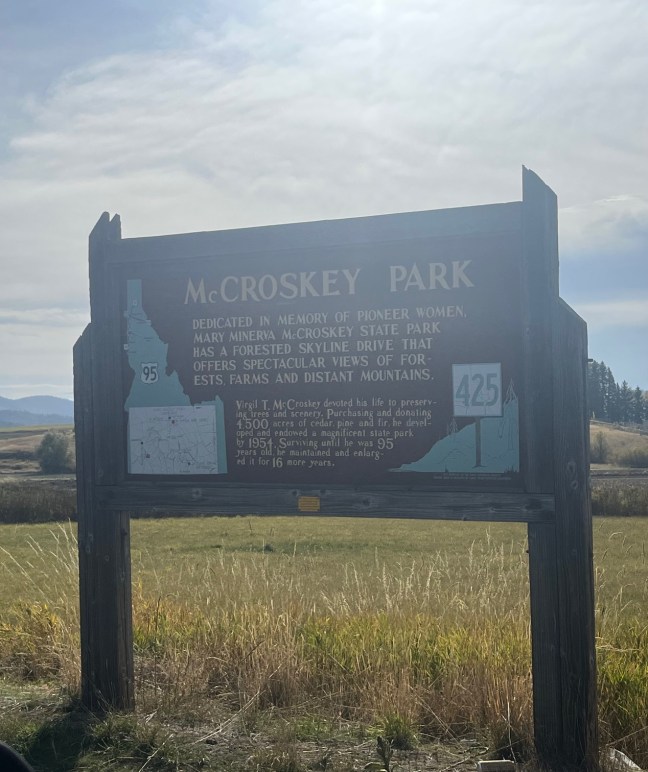
McCroskey Park Historical Marker, Tensed, ID

McCroskey Park Historical Marker, Tensed, ID

McCroskey State Park was developed by Virgil Talmadge McCroskey. McCroskey was a successful pharmacist and lived from 1876 to 1970. Compared to John Muir, he would buy properties and put efforts into their conservation. These were eventually converted into two parks: Steptoe Butte State Park (Washington) and Mary Minerva McCroskey State Park (Idaho).

The McCroskey State Park, also known as Skyline Drive, includes 32 miles of trails as well as an 18-mile Skyline Drive.

Historical Marker Inscription

Dedicated in memory of pioneer women, Mary Minerva McCroskey State Park has a forested skyline drive that offers spectacular views of forest, farms and distant mountains.

Virgil T. McCroskey devoted his life to preserving trees and scenery. Purchasing and donating 4,500 acres of cedar, pine and fir, he developed and endowed a magnificent state park by 1954. Surviving until he was 95 years old, he maintained and enlarged it for 16 more years.

Location

47° 8’ 57.080” N, 116° 54’ 39.060” W

381600–381690 US-95, Tensed, ID  83870, United States

World’s Largest Mill, Potlatch, Idaho

World's Largest Mill Historical Marker Potlatch, ID

The Potlatch Lumber Company was founded in 1903. In 1900, Frederick Weyerhaeuser and other investors bought white pine forestland in North Central Idaho. In 1906, the company created its first sawmill along the Potlatch River. The area around the mill became a company town. The mill grew to become the largest white pine mill in the world. It would hold this title for 20 years.

In 1926, the Clearwater Timber Company, which was also founded by Weyerhaeuser, would create the Clearwater Mill in Lewiston, ID. It would take over the title of the world’s largest white pine mill from Potlatch.

Historical Marker Inscription

Potlatch Lumber Company’s Sawmill Built Here in 1906, Was One of the Largest in the World.

Expanding operations to the West, Weyerhaeuser timber barons invested in Idaho’s prime white pine stands. By 1920, their mill was cutting 175 million board feet each year. Logs and lumber were moved by the Washington, Idaho and Montana Railway through stations uniquely named for eastern colleges: Yale, Princeton, Harvard, Cornell, Purdue.

Text prepared by the Potlatch Historical Committee and the Idaho State Historical Society
Marker Made and Installed by Idaho Transportation Department

Location

46° 55’ 30.480” N, 116° 54’ 10.170” W
125 Sixth St, Potlatch, ID  83855, United States

Company Town, Potlatch, Idaho Historical Marker

Company Town, Potlatch, Idaho Historical Marker

Started as a company town for Potlatch Forest, Inc., it was founded by Frederick Weyerhaeuser and several other investors in 1900. By 1906, the town had the world’s largest White Pine sawmill. The sawmill was located on the Potlatch River.

During World War II, the company helped with the war efforts. After the war, with a booming housing market, Potlatch Forest, Inc. built a plywood plant in Lewiston, Idaho. It continued to grow throughout the 1950s and 1960s.

By the 1980s, however, the company began to struggle with the fluctuations in the housing market. It attempted to modernize during the 1980s and 1990s. In 2018, however, it merged with Deltic Timber with the consolidation’s new name being PotlatchDeltic Corporation.

With the closure of the sawmill, the town has seen a dramatic drop in population.

Historical Marker Inscription

Built as a model town, Potlatch was owned by Weyerhaueser’s Potlatch Lumber Company.

Spokane architect C. Ferris White designed the new community in 1905. Workers’ housing stood close to the mill. Managers’ homes were built away from the plant’s noise and smoke. The railroad depot separated town from industry. All company owned, Potlatch was complete with churches, school, gym, hospital, opera house, and company store.

Location

46° 55’ 30.492” N, 116° 54’ 10.170” W
125 Sixth St, Potlatch, ID  83855, United States

Lenore Tram Historical Marker, Lenore, Idaho

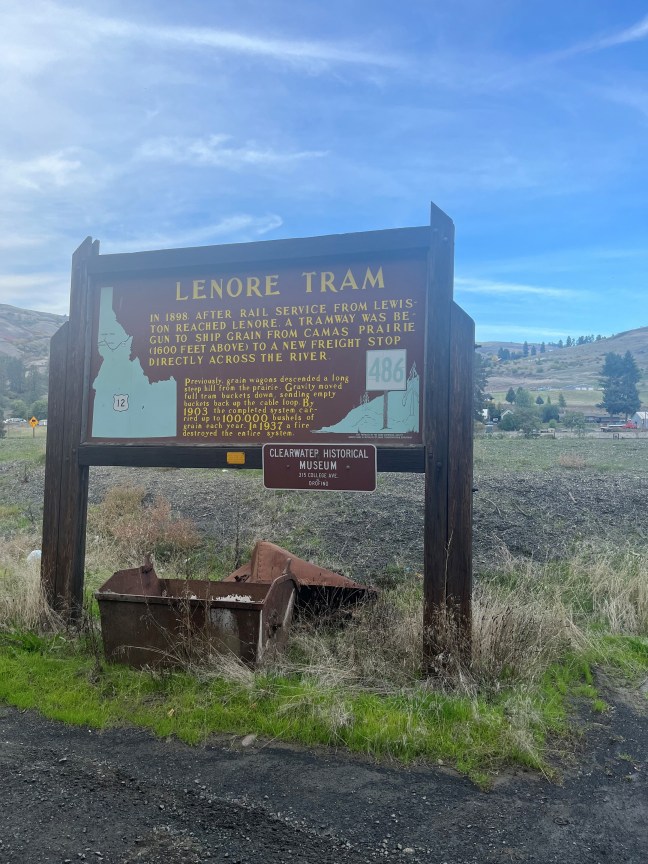
Lenore Tram Historical Marker, Lenore, ID

Lenore, Idaho, was a major railroad station during the early 1900s. In fact, it had its own post office, general store and hotel. It was also the location of the largest grain tram on the lower Clearwater River.

The tram would carry the grain four miles from the top of the canyon and then down the river to the railroad freight stop. Between 75,000 and 100,000 bushels would be carried to the railroad tracks from Camas Prairie each year. Camas Prairie was located 1,600 feet above at the top of the ridge.

In 1937, a fire destroyed the tram, and it was never rebuilt.

Historical Marker Inscription

In 1898, after rail service from Lewiston reached Lenore, a tramway was begun to ship grain from Camas Prairie (1600 feet above) to a new freight stop directly across the river.

Previously, grain wagons descended a long steep hill from the prairie. Gravity moved full tram buckets down, sending empty buckets back up the cable loop. By 1903 the completed system carried up to 100,000 bushels of grain each year. In 1937 a fire destroyed the entire system.

Location

46° 30’ 22.908” N, 116° 33’ 10.338” W

37966 US-12, Lenore, ID  83541, United States