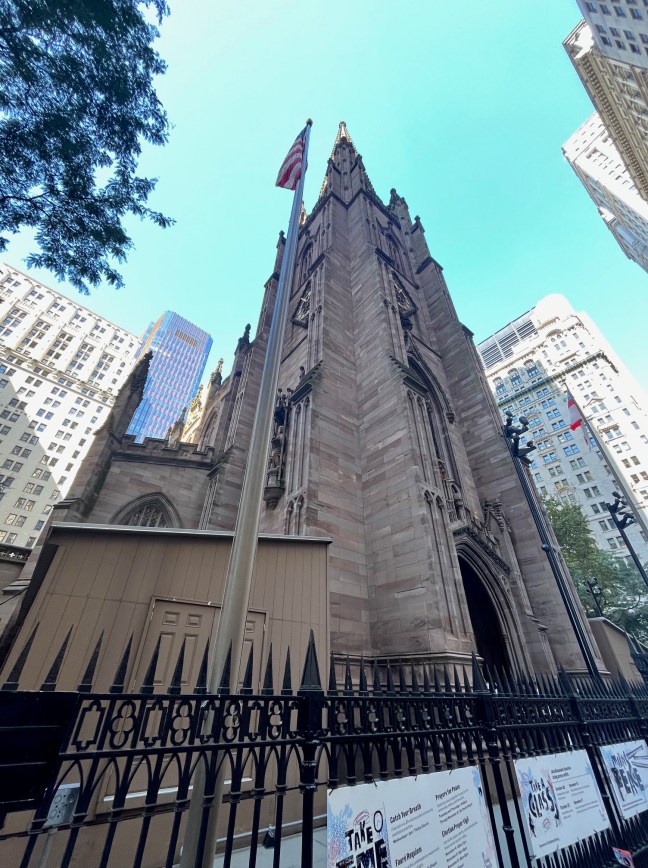
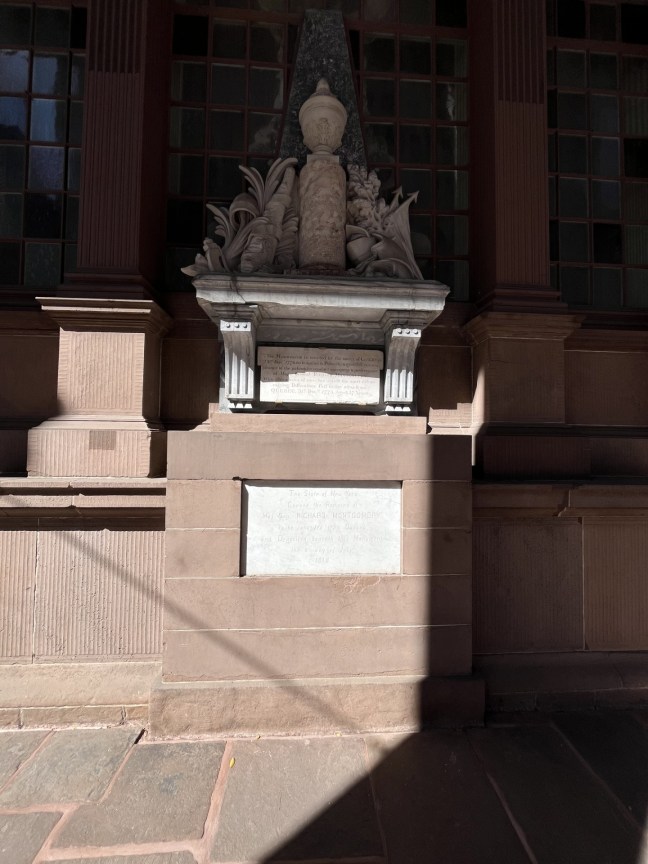
The Cherub Gate Historical Marker, New York City

Cherub Gate at Trinity Church, New York City

A cherub decorates the back entrance of Trinity Church. The cherub originally adorned the St. Mary-le-Bow church which was located in London’s East End. This church was designed and built by Christopher Wren. It was completed in 1680 but was destroyed during the German Blitz in May 1941 during World War II.

Trinity Church was the sister church to St. Mary-le-Bow and pledged $50,000 to the London congregation to rebuild the parish. The cherub had been found in the rubble of the destroyed church. After the London church was rebuilt around 1963-1964, the cherub was presented to Trinity Church.

Historical Marker Inscription

The cherub above is a gift to Trinity Church from the Church of St. Mary le Bow in London which was designed by Sir Christopher Wren in 1680 and was destroyed in an air raid on May 10, 1941. The cherub survived the bombing and was presented to Trinity Church on June 11, 1964

Location

40° 42’ 30.492” N, 74° 0’ 45.180” W

78 Trinity Pl, New York, NY  10038, United States
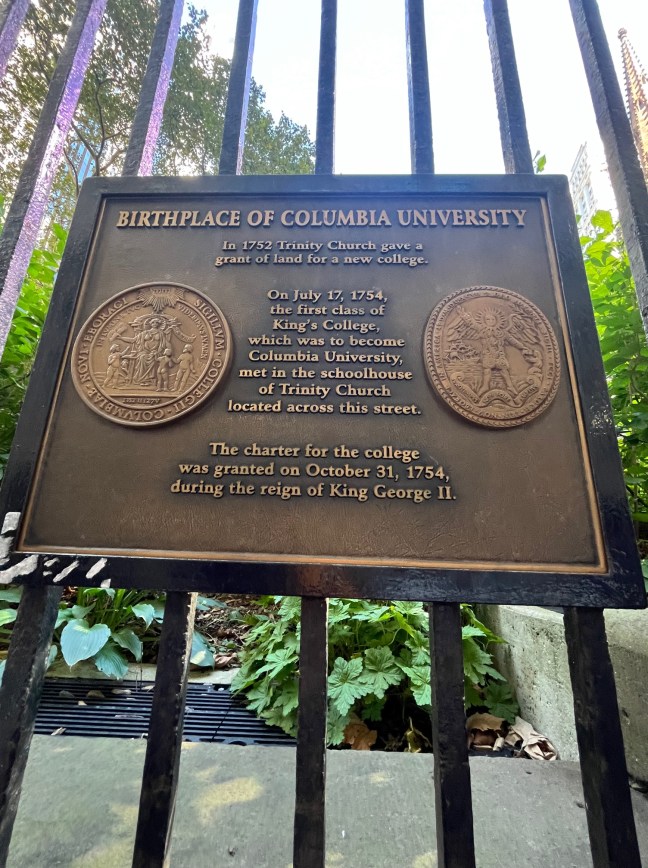
Birthplace of Columbia University Historical Marker, New York City

Columbia University Historical Marker, New York City, NY

Columbia University began as an all-boys school in 1754 in New York City’s lower Manhattan area. It was originally called King’s College and was created via a royal charter granted by Great Britain’s King George II. The first class was held in a schoolhouse that was part of Trinity Church.

Many of the students of King’s College went on to illustrious careers. These include Alexander Hamilton, John Jay and Robert R. Livingston.

During the American Revolution, classes were suspended from 1776 to 1783.  In 1784, King’s College changed its name to Columbia College. In 1857, the college moved from Park Place to Madison Avenue. It was moved once again in 1896 to its current location in Morningside Heights. It was also renamed again to Columbia University. The university started admitting women in 1983.

Trinity Church, New York City, NY

Historical Marker Inscription

In 1752 Trinity Church gave a grant of land for a new college.

On July 17, 1754, the first class of King’s College, which was to become Columbia University, met in the schoolhouse of Trinity Church located across this street.

The charter for the college was granted on October 31, 1754, during the reign of King George II.

Location

40° 42’ 28.458” N, 74° 0’ 44.930” W

75 Broadway, New York, NY  10006, United States

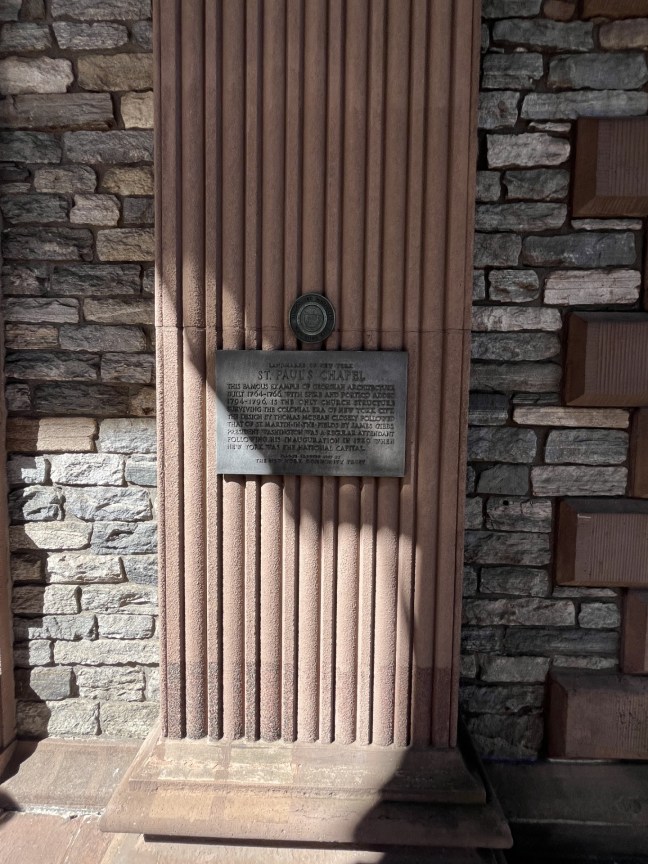
St. Paul’s Chapel Historical Marker, New York City, NY

St. Paul's Chapel Historical Marker New York City

St. Paul’s Chapel was built between 1764 and 1766 and officially opened in 1766. It was established as an outreach center for Trinity Church’s growing congregation. The Great Fire of 1776 destroyed the original Trinity Church, but the chapel survived. The congregation made this their main prayer spot, with congregants including George Washington, who stopped here after his inauguration as president. This is the only surviving Colonial-era church in the city.

Located near the World Trade Center, the chapel survived the attacks on September 11, 2001, and was a place of respite for first responders.

St. Paul's Chapel New York City, NY

Historical Marker Inscription

Landmarks of New York

St. Paul’s Chapel

This famous example of Georgian architecture built 1764-1766, with spire and portico added 1794-1796, is the only church structure surviving the Colonial era of New York City. The design by Thomas McBean closely followed that of St. Martin. In the fields by James Gibbs, President Washington was a regular attendant following his inauguration in 1789 when New York was the national capital.

Place erected 1997 by
The New York Community Trust

Location

40° 42’ 40.302” N, 74° 0’ 31.390” W

214 Broadway, New York, NY  10038, United States