Historic Guernsey Area, Wyoming

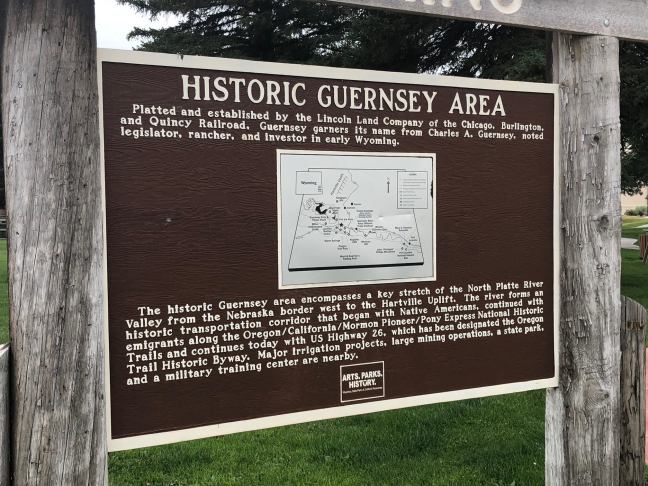
Guernsey, WY Historical Marker

Located near the Haystack Mountains and the North Platte River, Guernsey, Wyoming, was originally known as the “emigrant wash tub” since it was the area where the pioneers typically washed their clothes, took baths and watered whatever livestock they had with them. Guernsey was located right on the Oregon Trail. You can still see the ruts from the wagons in the area, and the carved names of the pioneers who traveled along the route.

The area is named after Charles A. Guernsey, a New Yorker who moved to the area in 1880. The town was officially incorporated in 1902. By this year, the Chicago, Burlington and Quincy Railroad had made it as far as Guernsey.

Historical Marker Inscription

Platted and established by the Lincoln Land Company of the Chicago, Burlington and Quincy Railroad, Guernsey garners its name from Charles A. Guernsey, noted legislator, rancher, and investor in early Wyoming.

The historic Guernsey area encompasses a key stretch of the North Platte River Valley from the Nebraska border west to the Hartville Uplift. The river forms an historic transportation corridor that began with the Native Americans, continued with emigrants along the Oregon/California/Mormon Pioneer/Pony Express National Historic Trails and continues today with US Highway 26, which has been designated the Oregon Trail Historic Byway. Major irrigation projects, large mining operations, a state park, and a military training center are nearby.

Location

60-98 East Whalen Street, Guernsey, WY 82215, USA

42°16’11.298″ N, 104° 44′ 24.870″ W

Old Trace, Mississippi

Old Trace, Natchez Trace Parkway, MS

The Natchez Trace Parkway is a 444-mile drive that stretches through Mississippi, Alabama and Tennessee – linking Nashville, TN, to Natchez, MS. The current roadway mainly follows the path of the Old Natchez Trace, which was a combination of a wilderness road, horse trail and foot path. One of most frequently used sections of the trail was known as Natchez or Chickasaw Trail.

It was regularly used throughout the late 1700s and early 1800s as a commercial road between the East and the Southwest and Mississippi River, but it had been animal and Native American trail for thousands of years. The original wilderness road ran through Old Town, MS, which was an area settled due to the abundance of bison and water. This section is known as the Old Natchez Trace.

Due the difficulty of navigating the Natchez Trace, in 1800, the U.S. Congress created legislation to create a major road that would allow for easier travel between Nashville and Natchez. “The Government Road” was completed in 1802, and this road linked Nashville with the original Trace.

Historical Marker Inscription

Two portions of a nearly 200 year old wilderness road, the Old Natchez Trace, are preserved here. Nearly 500 miles long, it grew from Indian trails to a national road and communications link between the Old Southwest and the United States to the northeast.

A short 5-minute loop walk to your left lets you see both sections and lets you stroll down a steeply eroded, sunken part of the Old Natchez Trace.

Location

Natchez Trace Parkway, Ridgeland, MS 39157, United States

32° 25′ 28.758″ N, 90° 5′ 20.440″ W