World’s Largest Mill, Potlatch, Idaho

World's Largest Mill Historical Marker Potlatch, ID

The Potlatch Lumber Company was founded in 1903. In 1900, Frederick Weyerhaeuser and other investors bought white pine forestland in North Central Idaho. In 1906, the company created its first sawmill along the Potlatch River. The area around the mill became a company town. The mill grew to become the largest white pine mill in the world. It would hold this title for 20 years.

In 1926, the Clearwater Timber Company, which was also founded by Weyerhaeuser, would create the Clearwater Mill in Lewiston, ID. It would take over the title of the world’s largest white pine mill from Potlatch.

Historical Marker Inscription

Potlatch Lumber Company’s Sawmill Built Here in 1906, Was One of the Largest in the World.

Expanding operations to the West, Weyerhaeuser timber barons invested in Idaho’s prime white pine stands. By 1920, their mill was cutting 175 million board feet each year. Logs and lumber were moved by the Washington, Idaho and Montana Railway through stations uniquely named for eastern colleges: Yale, Princeton, Harvard, Cornell, Purdue.

Text prepared by the Potlatch Historical Committee and the Idaho State Historical Society
Marker Made and Installed by Idaho Transportation Department

Location

46° 55’ 30.480” N, 116° 54’ 10.170” W
125 Sixth St, Potlatch, ID  83855, United States

Company Town, Potlatch, Idaho Historical Marker

Company Town, Potlatch, Idaho Historical Marker

Started as a company town for Potlatch Forest, Inc., it was founded by Frederick Weyerhaeuser and several other investors in 1900. By 1906, the town had the world’s largest White Pine sawmill. The sawmill was located on the Potlatch River.

During World War II, the company helped with the war efforts. After the war, with a booming housing market, Potlatch Forest, Inc. built a plywood plant in Lewiston, Idaho. It continued to grow throughout the 1950s and 1960s.

By the 1980s, however, the company began to struggle with the fluctuations in the housing market. It attempted to modernize during the 1980s and 1990s. In 2018, however, it merged with Deltic Timber with the consolidation’s new name being PotlatchDeltic Corporation.

With the closure of the sawmill, the town has seen a dramatic drop in population.

Historical Marker Inscription

Built as a model town, Potlatch was owned by Weyerhaueser’s Potlatch Lumber Company.

Spokane architect C. Ferris White designed the new community in 1905. Workers’ housing stood close to the mill. Managers’ homes were built away from the plant’s noise and smoke. The railroad depot separated town from industry. All company owned, Potlatch was complete with churches, school, gym, hospital, opera house, and company store.

Location

46° 55’ 30.492” N, 116° 54’ 10.170” W
125 Sixth St, Potlatch, ID  83855, United States

Gunnison Historical Marker, Utah

Gunnison Utah Historical Marker

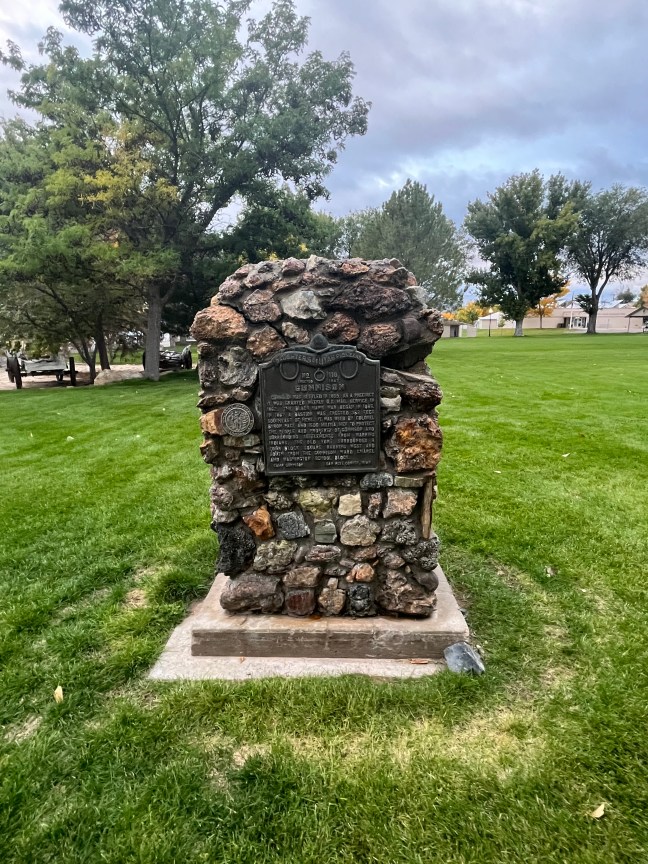
Named after Captain John W. Gunnison, an explorer responsible for finding a railroad route through the Rocky Mountains, the town was settled in the spring of 1859 by a group of Mormons. They were led by Bishop Jacob Hutchinson and directed to name the town by Brigham Young.

The original site of the town was located in a swampy area that was extremely muddy. When Brigham Young came to the area for a second visit in 1862, he recommended moving the town to its present location. The new location didn’t have a water source so the first task was to dig a ditch from the river to the town.

The early settlers came into conflict with the local Native Americans during the Black Hawk War. Some settlers died during the conflict, but the majority stayed and thrived.

Agricultural activities have been the main staple of the area since its inception. Sugar beets, which can be turned into sugar, were a main export. By 1900, due to the construction of the railroad, the population had doubled. Gunnison officially became a town in 1893.

In present times, cattle, dairy, small grains and alfalfa provide the main sources of income for the valley.

Historical Marker Inscription

Gunnison was settled in 1859. As a precinct it was granted weekly U.S. Mail service in 1862. The Black Hawk War began in 1865. In 1867 a bastion was erected 362 feet southeast of here. It was used by Colonel Byron Pace and 1500 militia men to protect the people and property of Gunnison and surrounding settlements from warring Indians. The old fort surrounded a four block square running west and south from the Gunnison Ward Chapel and Washington School block.

San Pete County, Utah

Location

39° 9’ 32.170” N, 111° 49’ 6.642” W
Gunnison City Park, 285 N Main St, Gunnison, UT  84634, United States

Canadian Northern Railway Station, Vancouver, British Columbia

Canadian Northern Railway Station Historical Marker, Vancouver, Canada

Vancouver’s Pacific Central Station is made from granite, andesite and brick. The station was opened in November 1919 from land that had previously been tidal mudflats. It was the western terminus of the Canadian Northern Pacific Railway. According to reports of the time, the cost of the station was estimated to have been as high as 1 million dollars.

In 1993, the station began offering intercity bus services as well. It is also the terminus for Amtrak and VIA Rail.

Historical Marker Inscription

Canadian Northern Railway Station, Vancouver, British Columbia

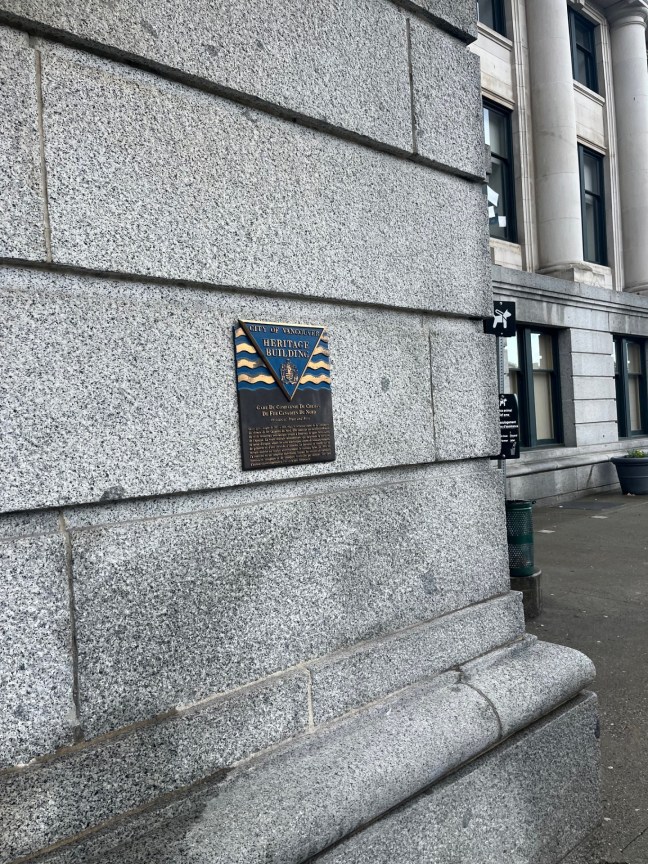
City of Vancouver Heritage Building

Canadian Northern Railway Station

Architect: Pratt and Ross

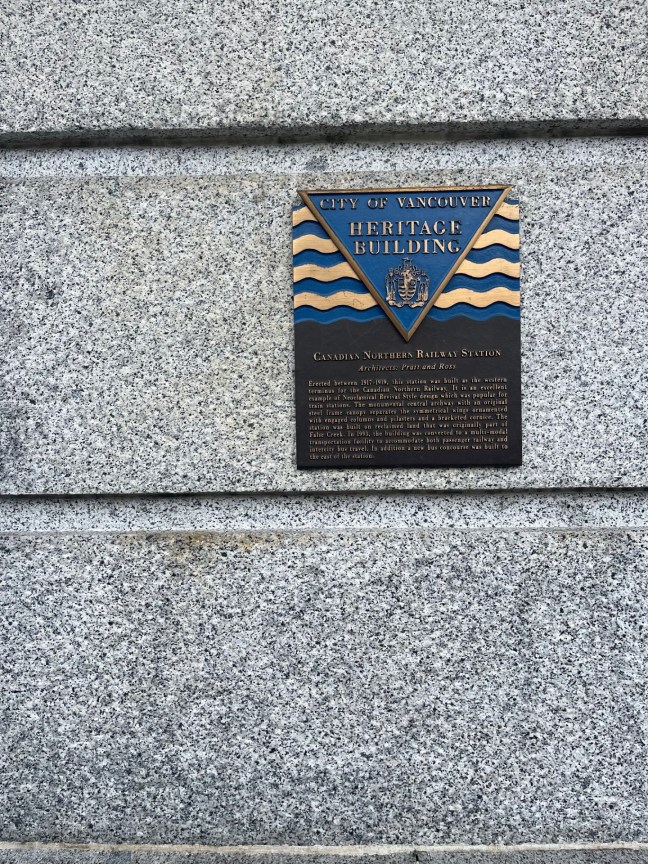
Erected between 1917-1919, this station was built as the western terminus for the Canadian Northern Railway. It is an excellent example of Neoclassical Revival Style design which was popular for train stations. The monumental central archway with an original steel frame canopy separates the symmetrical wings ornamented with engaged columns and pilasters and a bracketed cornice. The station was built on reclaimed land that was originally part of False Creek. In 1993, the building was converted to a multi-modal transportation facility to accommodate both passenger railway and intercity bus travel. In addition a new bus concourse was built to the east of the station.

Location

49° 16’ 25.350” N, 123° 5’ 57.500” W

Thornton Park, 1166 Main St, Vancouver BC V6A 4B6, Canada

Victory Square Historical Marker, Seattle, Washington

Victory Square Historical Marker, Seattle, WA

Victory Square was dedicated on May 2, 1942, as a place for citizens to gather and rally behind the World War II efforts. It featured a monument that listed the names of Washington citizens who had died during the war.  The square also had a speaker’s stand made in the shape of Thomas Jefferson’s home, Monticello.

During the war, many famous people visited Victory Square as part of the war effort. These included Bob Hope, Bing Crosby, Betty Grable, Lana Turner, and more. Many big bands also played for free here.

After the war, the speaker’s stage was torn down, and the monument was removed in 1949.

Historical Marker Inscription

Victory Square was created during World War II as a place for citizens to rally behind the war effort and to raise community morale. This plaque marks the site, which included a speaker’s stand and a replica of the Washington Monument inscribed with the names of Washington State citizens who lost their lives during the war. Patriotic rallies, war bond drives, and performances by Hollywood’s famous stars all took place at Victory Square. People flooded the streets to attend performances by Duke Ellington, Lana Turner, Bob Hope, Bing Crosby, and Betty Grable. After the war, the stage was torn down and the monument was eventually removed in 1949.

Location

47° 36’ 31.440” N, 122° 20’ 3.168” W
412 University St, Seattle, WA  98101, United States


Jennie Wade Historical Marker, Gettysburg, PA

Gettysburg Battlefield, Pennsylvania

Jennie Wade was born in Gettysburg on May 21, 1843. She lived on Breckenridge Street. While historical records aren’t clear, her nickname was either “Ginnie” or “Gin”. She and her mother worked as seamstresses.

Before the war, her sister, Georgia McClellan, married and moved to the house on Baltimore Street in 1862. This house would later be known as the Jennie Wade House.

Since the war was causing bullet holes to blow through houses and others were being confiscated for use as field hospitals, the mother and daughter fled from their home to Georgia’s house. This was both for their safety as well as to assist Georgia, who gave birth an hour before the Confederate Army came to Gettysburg.

To assist the troops, both the Wades and McClellands did their part by baking and serving bread and providing water to Union soldiers. On the morning of July 3rd, Jennie was kneading bread to create more for the soldiers.

It was also during this time that Confederate soldiers began firing on Union soldiers in the area. The McClellan house was hit by over 150 bullets, and one struck Jennie through the soldier, which passed into her heart. At about 8:30 a.m., she died from her wounds.

Jennie is buried in Evergreen Cemetery.

Jennie Wade House Historical Marker, Gettysburg, PA
Copyright Civil War Ghosts – https://gettysburgghosts.com/

Historical Marker Inscription

Jennie Wade, aged 20 years 2 months
Killed here—July 3, 1863
While making bread for the Union soldiers

Location

548 Baltimore Street, Gettysburg, PA 17325

39.82350373110324, -77.23069091876555

Drayton Hall Historical Marker, Charleston, South Carolina

Drayton Hall, Charleston, South Carolina

Drayton Hall was built in 1738 and is one of the earliest examples of Palladian architecture. It is also the oldest unrestored plantation house in the United States that is still open to the public. It required 360,000 hand-made bricks to build the house. The Draytons leveraged both slave labor and white craftsmen to construct the property. Drayton Hall was owned by seven generations of the Drayton Family before it became a historic site.

While not a working plantation, it was the commercial hub of John Drayton’s empire. The Drayton family’s wealth was founded upon cattle, rice and indigo.

Drayton Hall is an active archaeological site with an on-premise preservation department.

Historical Marker Inscription

Drayton Hall Historical Marker, Charleston, SC

Seat of the Drayton family for seven generations, this land was acquired in 1738 by John Drayton (c. 1759~1779) as the center of his extensive indigo and rice planting ventures. One of the finest examples of Georgian Palladian architecture in America, this is the only surviving colonial plantation house on the Ashley River.

Location

32° 51’ 54.720” N, 80° 4’ 57.840” W
3380 Ashley River Rd, Charleston, SC  29414, United States

Magnolia Plantation Historical Marker, Charleston, South Carolina

Magnolia Plantation Historical Marker, Charleston, South Carolina

Built in 1676, Magnolia Plantation is the oldest plantation in South Carolina. It also boasts the oldest estate garden in the United States. The first manor house was built by Thomas Drayton, Junior, in 1680. Later, the plantation was expanded to over 3,000 acres in 1760. This addition included five rice plantations.

The first manor house burned in 1811. The current main manor house was originally built in Summerville as the Drayton’s summer home. It was moved to its current location by barge in 1873. After the Civil War, the gardens were opened as a public space.

The plantation is still owned by a descendant of the original owners.

Historical Marker Inscription

Magnolia Plantation

1676

Fountainhead of the Drayton family, which played so important a part in America’s Colonial, Revolutionary, and Independence history. Its original plantation house, credited by contemporary historians as having been the earliest in the Carolina colony, along with its famous garden, now America’s oldest, were built by Thomas Drayton in the 1680’s. It remains a working plantation utilizing scores of workers, and is still owned and operated by a direct family descendent.

Location

32° 52’ 17.310” N, 80° 5’ 26.870” W
Magnolia Plantation & Gardens, Magnolia Plantation Rd, Charleston, SC  29414, United States

The First Austin Capitol of the Republic of Texas

The First Austin Capital of the Republic of Texas Historical Marker

When Austin was selected as the seat of the Republic of Texas in 1839, a log cabin with two main rooms and some smaller meeting rooms was built. To protect it from raids from Native Americans, a fence surrounded it. This building was located on what is now Colorado Street.

In 1853, a larger capitol building was built in a new location after the State of Texas joined the United States. The current location is known as Capitol Square.

Historical Marker Inscription

On this site in 1839, shortly after Austin was selected as the seat of government of the Republic of Texas, was built the first Austin capitol of the republic. The one-story building fronted east and had a broad hall extending from east to west at the back of which were the committee rooms. The Senate chamber was in the north front area and the hall of the House of Representatives in the South. After annexation to the United States, the building served as the capitol of the State of Texas until 1853, when a more substantial building was erected on the present capitol grounds.

Location

30° 16’ 13.398” N, 97° 44’ 36.210” W

801–849 Colorado St, Austin, TX  78701, United States

Pali Road Historical Marker, Honolulu, Hawaii

Pali Road Historical Marker, Honolulu, Hawaii

Pali Road is 11 miles long, located on Oahu Island, Honolulu, Hawaii. It is, in fact, the third roadway that had been constructed along the Koolaus and Nuuanu Valley. A trail along the cliffs (created during the early 1800s) was the original way (outside of canoeing) to transport goods between Honolulu and the windward side.

As this was a dangerous route, it was widened in 1845. Now, the road was six feet wide and paved with stones. This was perfect for the main form of transportation: carts and horses. While the road was safer, it was still dangerous.

In 1896, the road was widened with dynamite and repaved by order of the legislature. Johnny Wilson, a civil engineer, was the head of the project. Wilson would later be elected as mayor of Honolulu.

At the turn of the century, the road was further widened to allow for trucks and automobiles. While there were plans for a tunnel on the road before World War II, the tunnel didn’t get built until May 1957. This was opened to one-way traffic and later expanded to allow two-way traffic (August 1, 1961).

Historical Marker Inscription

Constructed in 1897 and opened for public traffic in 1898. The road has an average grade of eight percent and is 8800 feet long. The original survey was made by John H. Wilson under supervision of William E. Rowell Superintendent of Public Works, W.W. Bruner Highway Engineer both of the Republic of Hawaii. Completion of the job was due to the vision and ability of John H. Wilson and Louis M. Whitehouse. They did the work under contractor for the Republic of Hawaii. This tablet commemorates the Fiftieth Anniversary and is erected by the City and County of Honolulu January Twentieth, 1948.

Roy E. King Sculptor

Location

21° 22’ 1.830” N, 157° 47’ 35.682” W

Nuʻuanu Pali Tunnel, Kaneohe, HI  96744, United States