Johnny Graham and Graham’s Barber Shop Historical Marker

Johnny Graham and Graham's Barber Shop Dallas, TX

Johnny Graham was an influential Dallas barber who founded Graham’s Barber Shops and Graham’s Barber College. He opened his first barber shop in 1951. Graham would open several more barber shops across the Dallas area.

Johnny Graham was named Texas Businessman of the Year in 1969, and he was given the first Johny Graham Progressive Achievement Award from the Professional Barbers Committee (1984)

Johnny Graham died in 1990, but his legacy lives on through his employees and the students who graduated from the college. There is now a Johnny Graham Scholarship for those who want to learn how to be a barber.

Historical Marker Inscription

Texas Historical Commission

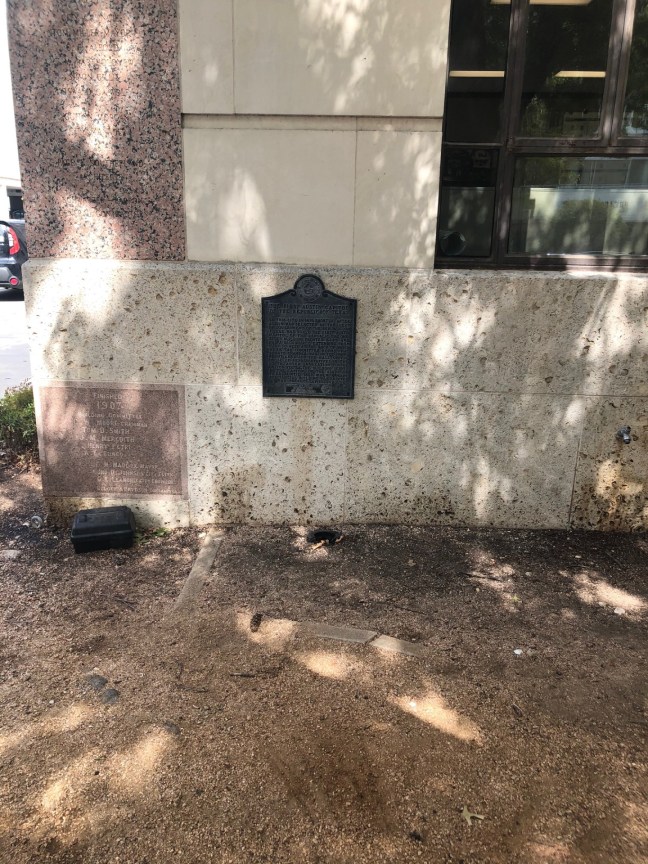
Johnny Graham and Graham’s Barber Shop

Born in Mayo, Florida, to Will and Bertha Graham, Johnny Graham (1918-1990) served in the United States Army from 1942-1945 and moved to Texas shortly after. In 1948, he began school at Fort Worth Barber College and passed the Texas State Board of Barber Examiners. Johnny cut hair in Lucy King’s Barber Shop and traveled to Kaufman on weekends to cut hair in the local barber shop. On one of these weekend trips, he met LaFrance Moody whom he married in 1949. In 1951, Johnny Graham opened his first barber shop on Southland Street in Dallas. The shop was a success and seven years later, he opened a second shop and a third in 1960. During this time, African American communities were growing with bustling business districts in many areas which often included barber shops and beauty salons. Because of this boom and his commitment to respect, fairness and courtesy, Johnn Graham’s holdings grew to include seven barber shops, a barber college (1965) and a shopping strip by 1969.

Beyond haircuts, Johnny Graham’s barber shops provided a unique space for social discussion and support. Customers could get barber service and also talk about important issues in the community. Johnny’s hard work and dedication to the profession, his employees and the community earned him several awards, including the Texas Small Businessman of the Year Award (1969) and the inaugural Johny Graham Progressive Achievement Award from the Professional Barbers Committee (1984). The barber shop donated barber services to clients in need, traveled to the St. Paul Industrial Training School near Malakoff to provide free haircuts and participated in back to school events, cementing its reputation as a significant fixture in Dallas history, business and culture.

Marker is Property of the State of Texas

2019

Location

32° 46’ 39.450” N, 96° 45’ 55.212” W
Grand Ave, Dallas, TX  75210, United States

The First Austin Capitol of the Republic of Texas

The First Austin Capital of the Republic of Texas Historical Marker

When Austin was selected as the seat of the Republic of Texas in 1839, a log cabin with two main rooms and some smaller meeting rooms was built. To protect it from raids from Native Americans, a fence surrounded it. This building was located on what is now Colorado Street.

In 1853, a larger capitol building was built in a new location after the State of Texas joined the United States. The current location is known as Capitol Square.

Historical Marker Inscription

On this site in 1839, shortly after Austin was selected as the seat of government of the Republic of Texas, was built the first Austin capitol of the republic. The one-story building fronted east and had a broad hall extending from east to west at the back of which were the committee rooms. The Senate chamber was in the north front area and the hall of the House of Representatives in the South. After annexation to the United States, the building served as the capitol of the State of Texas until 1853, when a more substantial building was erected on the present capitol grounds.

Location

30° 16’ 13.398” N, 97° 44’ 36.210” W

801–849 Colorado St, Austin, TX  78701, United States

The Ritz Theater, Austin, TX

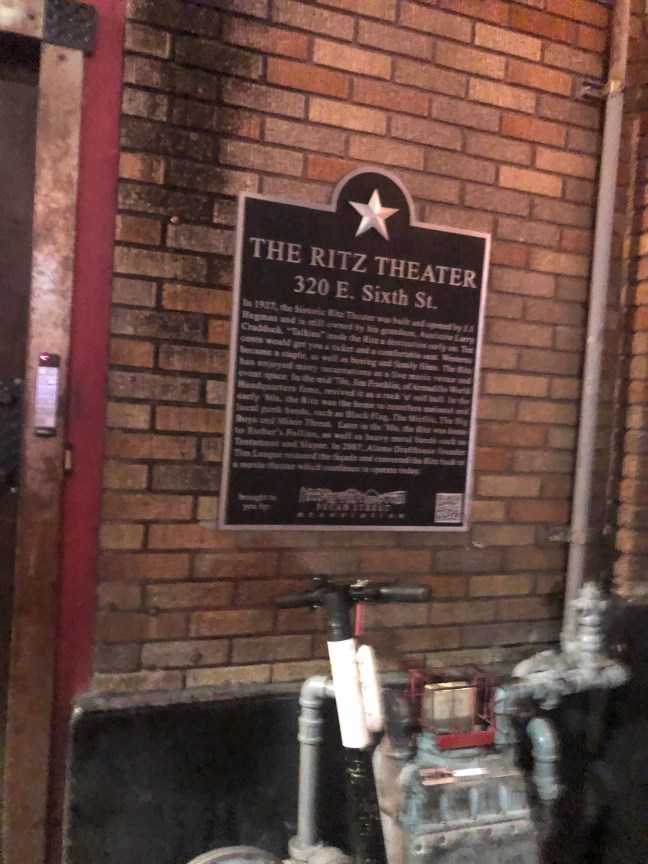
The Ritz Theater Historical Marker, Austin, TX

According to Judge Larry J. Craddock, whose family owns the The Ritz, the space opened two weeks before the stock market crashed in 1929. Because there was a hunger for escapism, the theater that was started by L.L. Hegman survived. As the first theater built for sound movies in Austin, it was successful from the start. In the early days, the cinema was a mecca for B-movie Westerns. The stars of the films often came to town and put on a show at the theater.

The theater passed to Hegman’s son Elmo in 1937. It was officially a movie theater until it was closed in 1964. In 1974, Jim Franklin and Bill Livinggood reopened the Ritz, becoming a stage for musical performances from the likes of Willie Nelson and others. It also hosted stage plays.

In 1975, Franklin closed shop. But in 1982, Craig Underwood, Shannon Sedwick and Michael Shelton converted the Ritz into a music venue, garnering the likes of Stevie Ray Vaughan, John Waters, Megadeth and the Red Hot Chili Peppers to play its stage. It would remain a music venue until 1987. Throughout the 1990s and until 2005, it was both a bar and a live music venue.

Alamo Drafthouse Cinema occupied the space from 2007 until 2021. It closed due to the COVID-19 pandemic.

Historical Marker Inscription

In 1927, the historic Ritz Theater was built and opened by J.J. Hegman and is still owned by his grandson, Austinite Larry Craddock. “Talkie” made the Ritz a destination early on. Ten cents would get you a ticket and a comfortable seat. Westerns became a staple, as well as boxing and family films. The Ritz has enjoyed many incarnations as a live music venue and event space. In the mid ’70s, Jim Franklin, of Armadillo World Headquarters fame, revived it as a rock ‘n’ roll hall. In the early ’80s, the Ritz was home to countless national and local punk bands, such as Black Flag, The Misfits, The Big Boys and Minor Threat. Later in the ’80s, the Ritz was home to Esther’s Follies, as well as heavy metal bands such as Testament and Slayer. In 2007, Alamo Drafthouse founder Tim League restored the façade and converted the Ritz back to a movie theater which continues to operate today.

Location

320 E 6th St, Austin, TX 78701

30.26731°N, 97.73961°W

First Gas Well in the Panhandle of Texas

The first gas well discovered in the Panhandle of Texas was found by Dr. Charles Newton Gould and his team. Gould was a geologist born near Lower Salem, Ohio, on July 22, 1868. Having received a masters degree in geology in 1900, he was tapped as a territorial geologist and geology instructor by the University of Oklahoma. While during the fall he taught classes, over the summer months, he worked in the Indian Territory (areas where the government relocated Native American populations) on federal geological surveys.

During the summer of 1903, Gould was commissioned by the Hydrographic Branch of the United States Geological Survey to survey the geology and try to find underground water sources west of the Indian Territory and east of the Rocky Mountains. Over the course of three seasons during 1903 through 1905, Gould and his compatriots mapped the geological features of the Texas Panhandle.

Historical Marker Text

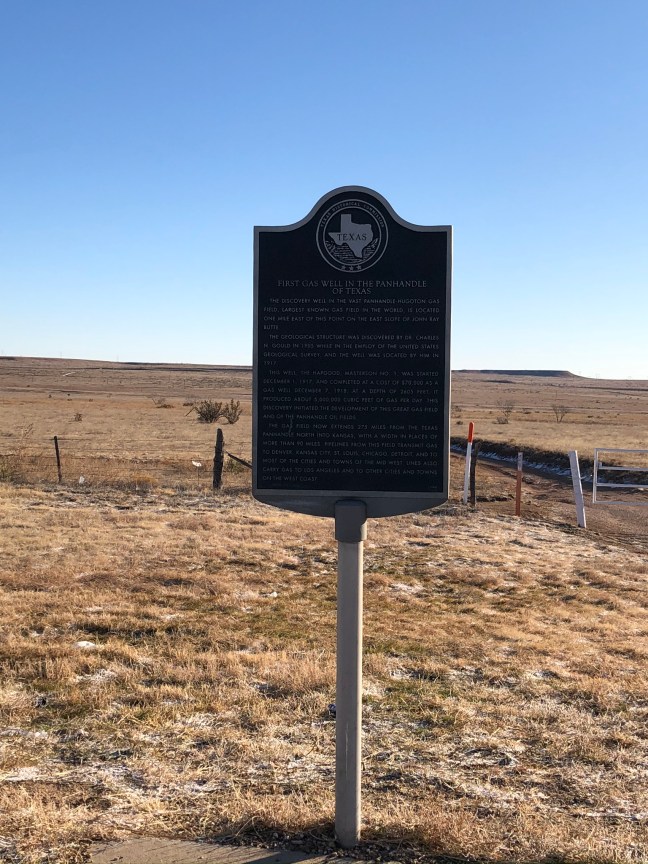
The discovery well in the vast Panhandle-Hugoton Gas Field, largest known gas field in the world, is located one mile east of this point on the east slope of John Ray Butte.

The geological structure was discovered by Dr. Charles N. Gould in 1905 while in the employ of the United States Geological Survey, and the well was located by him in 1917.

This well, the Hapgood, Masterson No. 1, was started December 1, 1917, and completed at a cost of $70,000 as a gas well December 7, 1918, at a depth of 2605 feet. It produced about 5,000,000 cubic feet of gas per day. This discovery initiated the development of this great gas field and of the Panhandle oil fields.

The gas field now extends 275 miles from the Texas Panhandle north into Kansas, with a width in places of more than 90 miles. Pipelines from this field transmit gas to Denver, Kansas City, St. Louis, Chicago, Detroit, and to most of the cities and towns of the mid-west. Lines also carry gas to Los Angeles and to other cities and towns on the west coast. (1965)

Location: 35.573383, -101.949463

Located 30 miles north of Amarillo off US 287

Headwaters of the Sabine River

The Sabine River is over 500 miles long and moves from Upper East Texas to the east and empties into the Gulf of Mexico. It starts in Hunt, Collin and Rockwall counties, and then flows towards Logansport, Louisiana, before it finally discharges near Orange, Texas. This river had served as the boundary between multiple territories, including the United States, Mexico, Spain and France.

The original name of the river was Sabinas, the Spanish name for red cedars, which are known to grow on its banks.

Historical Marker Text

A half mile to the west rises the Sabine River, lower channel of which separated New World empires of France and Spain and in 1836 became Republic of Texas – United States border. Fork here is called Cow Leach, for Indian chief who lived in the area. This marker is on a 3-way watershed: flow to the north goes into the Sulphur and to the Mississippi; the west drains to the Trinity; south goes into the Sabine, which forms Texas-Louisiana boundary and pours more water into Gulf of Mexico than any other Texas river (6,400,000 acre feet annually).

Location: Off Highway 69, Celeste, TX 75423
N 33° 19.366 W 096° 12.455

Littlefield Building, Austin

The Littlefied and Scarbrough buildings in Austin have lined the cityscape for over a century. In fact, these used to be the tallest buildings in Austin. The Littlefield Building actually as the tallest building between New Orleans and San Francisco during the early 1900s.

Littlefield was home to the American National Bank. Built by a former Confederate army major and president of the National Bank, George Littlefield started the groundwork for the new location of the bank in 1910. It was previously in the same location as the historic Driskill Hotel .

George Littlefield was a major player in the Austin area. During the first 50 years of the University of Texas, he was the college’s biggest financial contributor.

When the Littlefield building was completed in 1912, it was eight stories tall and had a garden rooftop for events. Then, he enclosed the top, creating a ninth story – effectively making it the tallest building in Austin.

To this day, the building is still home to office buildings.

Inscription

George Washington Littlefield (1842-1920) came to Texas from Mississippi in 1850. After serving in Terry’s Texas Rangers in the Civil War, he made his fortune ranching and driving cattle. He moved to Austin in 1883 and, in 1890, established the American National Bank, which included a ladies’ banking department. He hired architect C. H. Page, Jr., to design this Beaux Arts Classical building, which opened in 1912 with a rooftop garden. His bank was on the ground floor. For the corner entrance, he commissioned Tiffany’s of New York to cast bronze, Bas Relief doors by sculptor Daniel Webster. These were later donated to the University of Texas, of which Littlefield was a major benefactor.

Location

Latitude & Longitude: 30 15′ 58.043196″, -97° 44′ 31.835076″

Address: 601 North Congress, Austin, Texas