Pocahontas Mounds Historical Marker 1, Flora, Mississippi

Evolution of the Pocahontas Mounds Flora Mississippi

Consisting of two mounds (Mound A and Mound B), they were built by Native Americans from around 1000 to 1300 AD.  Atop the mounds would have been a building. On Mound A, it would have either been the chief’s residence or a temple. There was also a village that surrounded the mounds. It appears that the mounds were built over time, ranging from the Coles Creek to the Plaquemine periods.

While Mound A is maintained by the Mississippi Department of Transportation and is part of a park, Mound B is not part of the park. Both mounds are listed on the National Register of Historic Places.

Pocahontas Mounds Historical Marker 1 Flora, MS

Historical Marker Inscription

Built and used between A.D 1000 and 1300, this platform mound and a nearby burial mound mark the ceremonial and political seat of a regional chiefdom of the Plaquemine culture. A thatched, clay-plastered ritual temple or chief’s lodging stood atop this mound. Dwellings of villagers occupied surrounding fields.

Location

32° 28’ 14.112” N, 90° 17’ 17.598” W

US-49 N, Flora, MS  39071, United States

McAllister’s Mill Historical Marker

McAllister's Mill Historical Marker

A ruin located on the Gettysburg Battlefield, it was a significant stopping point on the Underground Railroad (UGRR). Said to have been built by James Getty and another person in 1790, in 1836, it became the meeting ground of a group of men whose fathers had fought in the War of Independence. They were there to celebrate the Fourth of July.

Here, the men organized, and James McAllister was named the mill owner and chair. The men passed several resolutions, including ones around freeing the slaves. The Star & Republican Banner, a Gettysburg newspaper, named the meeting the “Anti-Slavery Meeting at McAllister’s”. Over the years, the Anti-Slavery Society became more influential, and many members began helping slaves from Maryland to escape to the North.

During the Battle of Gettysburg, McAllister’s property was caught in the fighting, and many soldiers were buried on the grounds. Little remains of the mill, and it is privately owned.

Historical Marker Inscription

At their grist mill on nearby Rock Creek, James McAllister and his family provided temporary shelter to hundreds of fugitive slaves. Now in ruin, it was part of one of the earliest UGRR networks through which freedom seekers passed on their way north. It was the site of a significant gathering of abolitionists on July 4, 1836, that led to the formation of the Adams County Anti-Slavery Society, an early and influential abolitionist organization.

Location

39° 48’ 25.872” N, 77° 13’ 0.030” W

1382–1398 Baltimore Pike, Gettysburg, PA  17325, United States

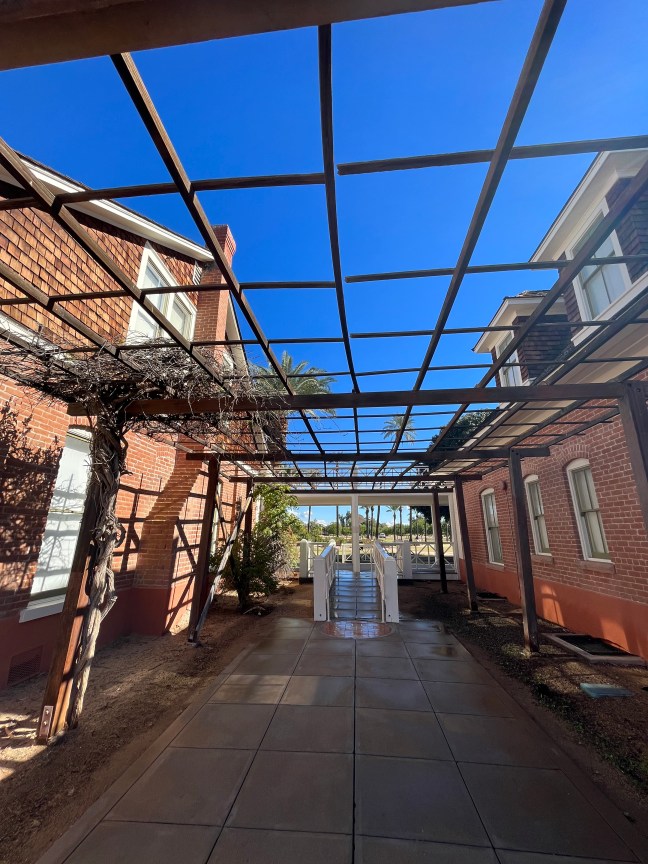
Sahuaro Ranch Historical Marker, Glendale, AZ

Sahuaro Ranch Glendale, AZ

Sahuaro Ranch is a 17-acre ranch that has been preserved by the City of Glendale. William Bartlett was 36 years old in 1886 when he came from Peoria, Illinois, to invest in the ranch located north of Phoenix. He and his brother Samuel purchased 640 acres under the Desert Land Act of 1877.

Being able to homestead in the area only became possible after the creation of the Arizona Canal, which was completed in 1885, opening up the Salt River Valley to agriculture. Bartlett was a successful rancher, growing everything from fruit to grain to cotton. The ranch itself was well-landscaped with rose bushes, palms and many other types of plants. The ranch also raised cattle, hogs and bulls.

By 1887,  the Adobe House, a horse barn and a blacksmith shop was on the property. The fruit orchard also expanded in 1890, including olives and oranges. These were some of the first grown in the area. The Guest House was built in 1898 by J. L. Silsbee, a Chicago architect who was an employer of Frank Lloyd Wright.

The ranch thrived throughout the 1900s, with other owners, including P.E. Bradshaw and Richard W. Smith. By the 1970s, much of the ranch had been sold off. The City of Glendale purchased the remaining 80 acres in 1972 and converted it into a park and historical area and other facilities.

Historical Marker Inscription

Sahuaro Ranch Historical Marker, Glendale, AZ

National Register of Historic Places
Listed March 7, 1980
United States Department of the Interior

Sahuaro Ranch was one of the first farms in the Glendale area and a reminder of Glendale’s agricultural beginnings. Started by wealthy Illinois businessman William H. Bartlett in 1886, the ranch was a commercial operation and became known as the “Showplace of the Valley.” Ranch owners, including Bartlett, produced fruit, grains and cotton, ranched cattle, raised horses and operated a dairy. As farms gave way to houses, the City of Glendale purchased the remaining parts of the ranch in 1977. The City preserved 17 acres of the original ranch along with 13 buildings and a historic landscape of trees and irrigation ditches.

Location

33° 34’ 31.488” N, 112° 11’ 18.870” W
Sahuaro Ranch Park, Glendale, AZ  85302, United States

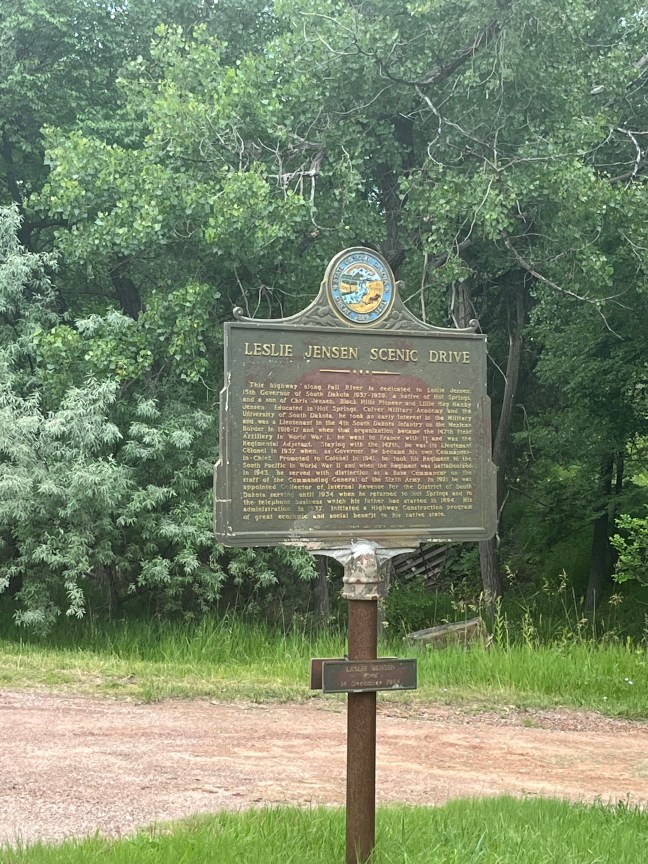
Leslie Jensen Scenic Drive Historical Marker, Hot Springs, SD

Leslie Jensen Scenic Drive Hot Springs SD Historical Marker

This highway along Fall River is dedicated to Governor Leslie Jensen. He was the Republican 15th Governor of South Dakota from January 5, 1937 to January 3, 1939.  He was a native of Hot Springs, South Dakota.  Jensen was known as the “father of the modern highway system in South Dakota”.

While successful in office, Jensen decided not to run for a second term as governor and instead ran for the U.S. Senate, but he was defeated in the primary. He served in World War I and World War II.  He was honorably discharged in 1945.

Historical Marker Inscription

This highway along Fall River is dedicated to Leslie Jensen, 15th Governor of South Dakota 1937-1939, a native of Hot Springs, and a son of Chris Jensen, Black Hills Pioneer and Lillie May Haxby Jensen. Educated in Hot Springs, Culver Military Academy and the University of South Dakota, he took an early interest in the Military and was a Lieutenant in the 4th South Dakota Infantry on the Mexican Border in 1916-17 and when that organization became the 147th Field Artillery in World War I, he went to France with it and was the Regimental Adjutant. Staying with the 147th, he was its Lieutenant Colonel in 1937 when, as Governor, he became his own Commander-in-Chief. Promoted to Colonel in 1941, he took his Regiment to the South Pacific in World War II and when the Regiment was battalionized in 1943, he served with distinction as a Base Commander on the staff of the Commanding General of the Sixth Army. In 1921 he was appointed Collector of Internal Revenue for the District of South Dakota serving until 1934 when he returned to Hot Springs and to the telephone business which his father had started in 1894. His administration, in 1937, initiated

Reverse Side

You Are Entering
Hot Springs,
Sites Of
National and State
Soldiers Homes

Location

1301 Fall River Rd, Hot Springs, SD  57747, United States
43° 25’ 8.892” N, 103° 27’ 31.680” W

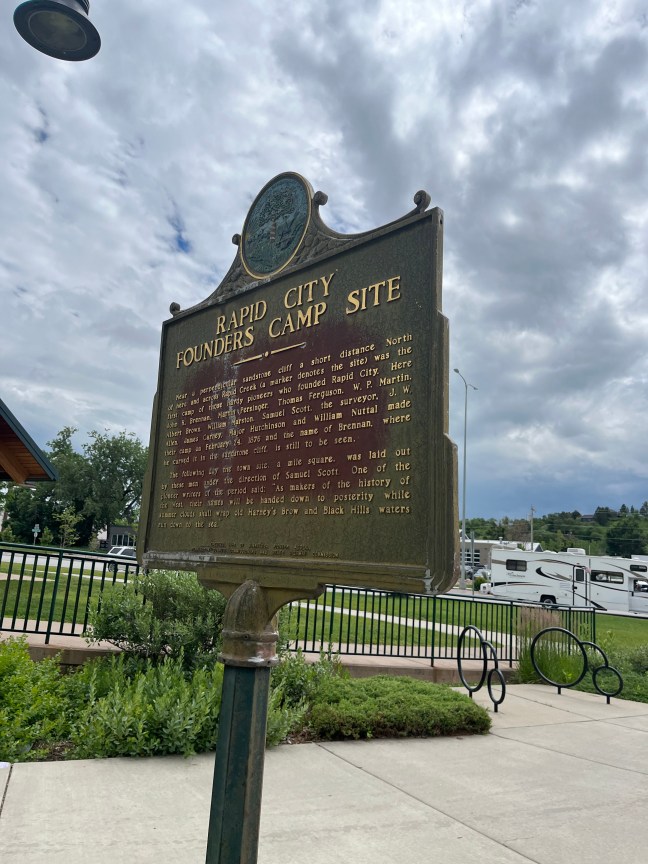
Rapid City Founders Camp Site, South Dakota

Rapid City Historical Marker South Dakota

The location of Rapid City was initially occupied by Native Americans before European American settlers arrived. White settlers started heading to this area in 1874 due to the discovery of gold in the Black Hills.

In 1876, a group of 11 settlers made camp at what would become known as Founder Rock. This is where these men laid out the original plan for Rapid City. The founders’ initials can still be located on the sandstone outcropping.

The men laid out a one-square-mile business district, originally called Hay Camp. It would later become Rapid City, naming it after the creek that ran through the town.  During the late 1800s, it became a transportation hub for stagecoaches, wagons and rail traffic. Later, Rapid City would be advertised as the “Gateway to the Black Hills”. The nickname is still used today.

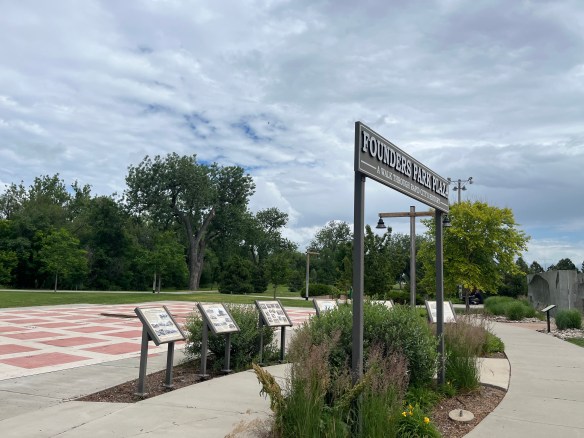
Rapid City Founders Park Historical Marker

Historical Marker Inscription

Near a perpendicular sandstone cliff a short distance North of here and across Rapid Creek (a marker denotes the site) was the first camp of those hardy pioneers who founded Rapid City. Here John R. Brennan, Martin Persinger, Thomas Ferguson, W. P. Martin, Albert Brown, William Marston, Samuel Scott, the surveyor, J. W. Allen, James Carney, Major Hutchinson and William Nuttal made their camp on February 24, 1876 and the name of Brennan, where he carved it in the sandstone cliff, is still to be seen.

The following day the town site, a mile square, was laid out by these men under the direction of Samuel Scott. One of the pioneer writers of the period said: “As makers of the history of the West, their names will be handed down to posterity while summer clouds shall wrap old Harney’s Brow and Black Hills waters run down to the sea.”

Location

Founders Park, 1236–1420 W Omaha St, Rapid City, SD  57701, United States

44° 5’ 4.690” N, 103° 14’ 34.788” W

Old Jacksonborough, Hardeeville, South Carolina

Old Jacksonborough, Hardeeville, South Carolina

Jacksonborough (later Jacksonboro) was originally the Native American settlement of Pon Pon. It was named after John Jackson who received a land grant in 1701. It later became the county seat of the Colleton District in 1799 and would remain the so until 1822. It had a school and Methodist and Episcopal churches.

When the British occupied Charlestown (now Charleston) in 1782, Jacksonborough became the provisional capital. The South Carolina General Assembly (the Senate and the House) met in a Masonic Lodge and Tavern that was owned by Peter Dubose.

On February 26th, the assembly passed the Confiscation Acts, which were later printed on March 20, 1782.

Historical Marker Inscription

Founded about 1735 on lands granted John Jackson in 1701. Seat of Colleton District from 1799 to 1822. Provisional Capital of State while Charleston under siege during the American Revolution. South Carolina Legislature met here Jan. – Feb. 1782. Sessions held in Masonic Lodge and Tavern. Passed Confiscation and  Amercement Acts.

Location

32° 46’ 8.538” N, 80° 27’ 8.670” W

16955 Ace Basin Pkwy, Round O, SC  29474, United States

An Indian Deed, Sharpsburg, Maryland

An Indian Deed Historical Marker, Sharpsburg, MD

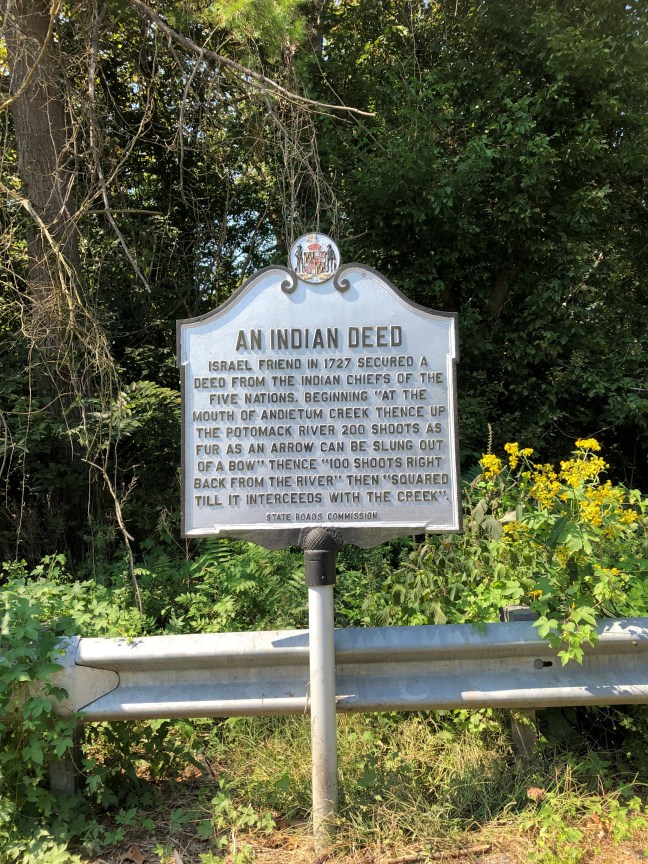
This marker commemorates one of the first recorded events in the area. It was a deed given to Israel Friend by local Native Americans in 1727. Friend had been a fur trader and was of Swedish ancestry. He and his family migrated to the American Colonies (at that point) in 1648.

According to legend, the deed was recorded on a piece of birch park. It was later recorded on the deed book for Prince George’s County.

The Native American signatures consisted of pictographs. One chief was from the Iroquois Nation, and five were from the Conestoga tribes. This deed marks one of the earliest incursions by white men into the area.

Friend didn’t hold the property for long. It was confiscated by the State of Maryland in 1734.

Historical Marker Inscription

Israel Friend in 1727 secured a deed from the Indian chiefs of the Five Nations. Beginning “at the mouth of Andietum Creek thence up the Potomack River 200 shoots as fur as an arrow can be slung out of a bow” thence “100 shoots right back from the river” then “squared till it interceeds with the creek.”

Location

39° 24’ 59.850” N, 77° 44’ 31.770” W
Harpers Ferry Rd, Sharpsburg, MD  21782, United States
Near Antietam at the intersection of Limekiln Road and Harpers Ferry Road.

The Berry Family Historical Marker, Glendale, UT

The Berry Family Historical Glendale, UT

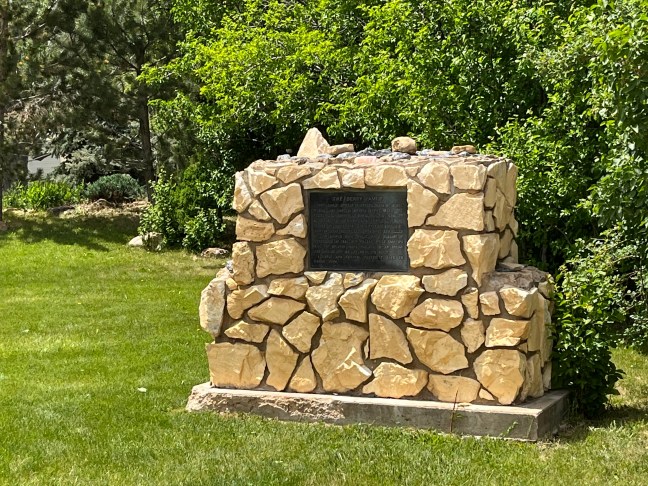
Originally called Berryville, Utah, the site had been settled in 1862. The first group was led by John and William Berry. Later the area came to be known as Glendale. While initially only a simple water power mill was developed on the site, due to Native American incursions, a stockade was built in 1865.

By 1866, all settlements throughout Kane County, including Berryville, were vacated due to conflicts with the Native Americans. Robert Berry, Isabella Berry, wife of Robert Berry, and Joseph Berry were killed by Native Americans on Short Creek.

The area was resettled in 1871 by settlers from the Muddy Mission in Nevada.

Historical Marker Inscription

Four early Church pioneers, sons of Jesse Woods and Amelia Shanks Berry, were the founders of Berryville, now Glendale, Utah. Joseph S. and Robert M. and his wife Isabelle Hale Berry, were killed by Indians April 2, 1856. They are buried in Grafton, near Rockville. A mob shot and killed William Shanks Berry while on a mission in Tennessee in 1884. John William, while carrying mail for Brigham Young, was shot by an Indian and carried the bullet until his death.

A large and faithful posterity live to honor them.

Location

37° 19’ 6.000” N, 112° 35’ 51.558” W
25 N Main St, Glendale, UT  84729, United States

Pipe Spring National Monument Historical Marker

Pipe Spring National Monument Windsor Castle Arizona

Located on the Arizona Strip, Pipe Spring National Monument lies on very arid land. But water exists here. The area benefits from the rain and snowmelt from central Utah’s high plateau. Water flows down into a hard shale layer and then moves to the base of Arizona’s Vermillion Cliffs. Here, it is pushed to the surface. Pipe Spring is one of the locations where this happens.

Because water is so vital to so many people, many different types of groups were sustained by this spring. For over 12,000 years, this area has been frequented by everyone from nomadic hunters to the Ancestral Puebloan people to the Church of Jesus Christ of Latter-Day Saints.

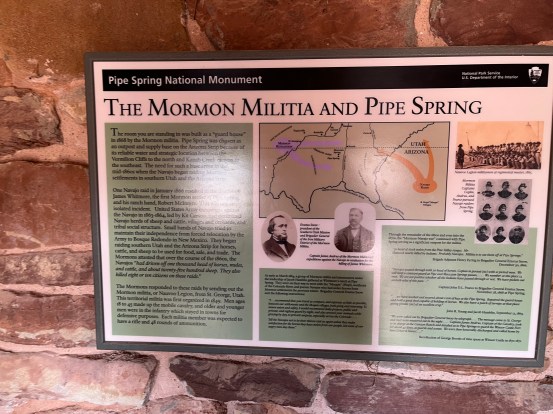
It was the Mormon pioneers who built the buildings in the national monument. They began occupying the area in the late 1850s. Their control of the springs brought them into conflict with the Paiute and Navajo Native American tribes. The Mormons had moved sheep and cattle into the area. This infuriated the Native peoples. The Navajo tribes raided the livestock, and in 1866, James Whitmore was killed trying to recover his lost livestock.

In 1868, Mormon militiamen built a stone cabin to protect against the raids. Later, under Brigham Young, they created a ranch here. It served as both a successful business and as a refuge for Mormon people seeking refuge against the anti-polygamy laws. The Mormons sold the ranch in 1895.

On May 31, 1923, Pipe Spring National Monument was created by President Warren G. Harding.

Pipe Spring National Monument Historical Marker Arizona

Historical Marker Inscription

PIPE SPRINGS NATIONAL MONUMENT
Established May 31, 1923
Through efforts of Stephen T. Mather and friends.

PIPE SPRINGS
Occupied in 1863, by Dr. James M Whitmore, who, with Robert McIntire was killed 4 miles S.E. of Pipe Springs January 8, 1866, by Navajo and Piute Indians.

WINDSOR CASTLE
Erected by direction of Brigham Young in 1869-70 by Anson Windsor for handling the Church tithing herds and as a frontier refuge from Indians. It became the first telegraph office in Arizona when the Deseret Telegraph Line reached here in December 1871.

Utah Pioneer Trails and Landmarks Association and Citizens of Kanab Stake
Pipe Spring National Monument

Location

36° 51’ 47.652” N, 112° 44’ 22.122” W

Pipe Spring National Monument, Ridge Trail, Valentine, AZ  86437, United States

Church of the Redeemer Biloxi, Mississippi Historical Marker

Church of the Redeemer Historical Marker, Biloxi, MS

The Church of the Redeemer was built in 1874 and initially sat on the corner of Howard Avenue and Nixon Street in Biloxi, MS. The congregation had received its charter from the Mississippi Legislature in 1853. It was officially admitted to the Diocese in 1859. After its construction, it was the first Protestant church in the area.

Later in 1891, the church was moved to Beach Boulevard on land donated by Harry T. Howard. Known as the new church, it was used for 78 years until it was destroyed by Hurricane Camille on August 17, 1969. Both the church and the rectory were taken out by the hurricane. The bell tower and original “old church” survived, the latter with significant damage.

The old church was later repaired, and service was held there on Christmas Eve 1969. The church survived until Hurricane Katrina hit the area on August 29, 2005. It destroyed the remaining church and bell tower.

Historical Marker Inscription

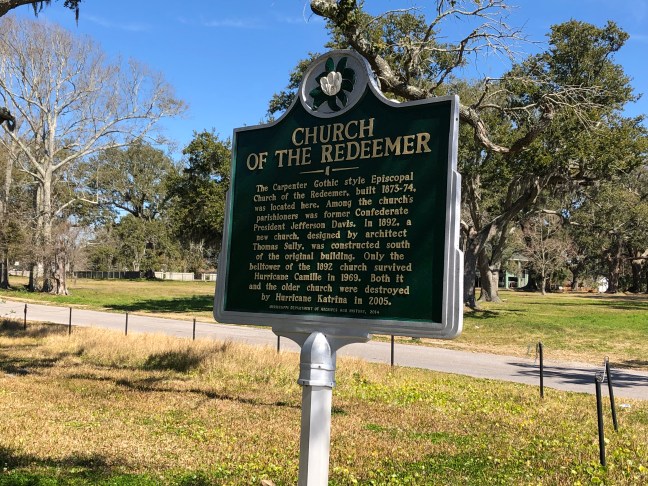
The Carpenter Gothic style Episcopal Church of the Redeemer, built 1873-74, was located here. Among the church’s parishioners was former Confederate President Jefferson Davis. In 1892, a new church, designed by architect Thomas Sully, was constructed south of the original building. Only the belltower of the 1892 church survived Hurricane Camille in 1969. Both it and the older church were destroyed by Hurricane Katrina in 2005.

Mississippi Department of Archives and History, 2014

Church of the Redeemer Historical Marker, Biloxi, MS

Location

30° 23’ 36.498” N, 88° 52’ 54.690” W

612 Beach Blvd, Biloxi, MS  39530, United States