New Mexico Highlands University

Located in Las Vegas, NM, New Mexico Highlands University was established by the Territorial Legislature in 1893 as the New Mexico Normal School. With the region booming due to the arrival of the Santa Fe Railroad in the 1870s, the area decided that it needed an institution of higher learning. It officially opened in 1898, and archaeologist Edgar Lee Hewett was the school’s first president.

What started as a school of 92 students and 6 faculty members quickly grew into a larger institution. Enrollment increased to over 300 in 1901. It’s name changed in 1902 to New Mexico Normal University and then again to New Mexico Highlands University in 1941.

By 1917, the school was offering four-year teacher training programs.

IMG_3894

New Mexico Highlands University Today

Today, the school has nearly 4,000 students, mainly from New Mexico and of Latino descent. The school is known for its multi-ethnic student body and offers programs in business, education, arts and sciences, and social work.

Location: 1005 Diamond St, Las Vegas, NM 87701 35.5933° N, 105.2223° W
Site of Santa Fe’s First Chapel

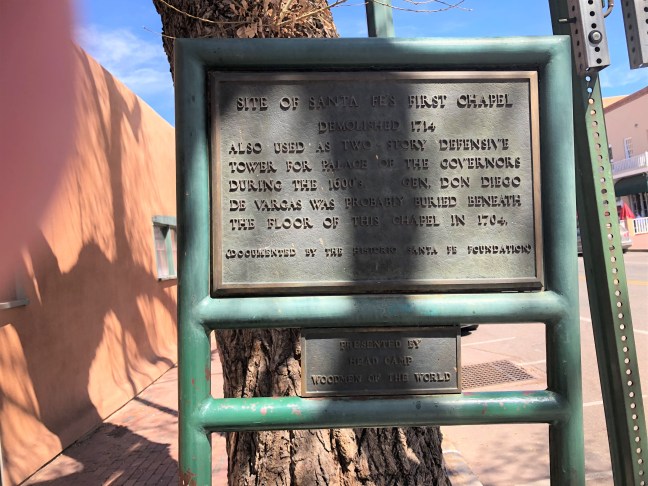
Santa Fe, New Mexico Historical Marker: First Chapel

Santa Fe is a mecca of history, so there are plenty of historical markers in the area. On the southeast corner of the Place of the Governors lies the historical marker for Santa Fe’s first chapel.

According to the marker, the chapel was “Also used as two story defensive tower for Palace of the Governors during the 1600’s. Gen. Don Diego de Vargas was probably buried beneath the floor of this chapel in 1704”. The chapel was demolished in 1774.

Don Diego de Vargas

Diego de Vargas Zapata y Luján Ponce de León y Contreras, better known as Don Diego de Vargas, was a Spanish Governor of the territory of Santa Fe from most of the 1690s until 1704. He was in charge of the reconquest of the New Mexico territory after the Pueblo Revolt in 1692.

The Pueblo Revolt started in August 1680, and involved Pueblo people from different pueblos. While traditional extremely peaceful people, the Pueblo people were treated cruelly by the Spanish rulers. They overthrew Spanish rule in New Mexico and held the area for more than 12 years.

Location: N 35° 41.261 W 105° 56.266

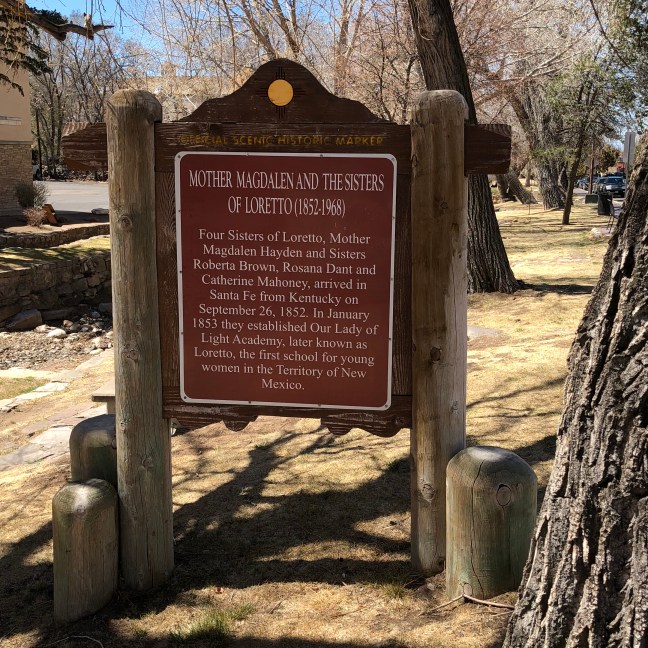
New Mexico Historical Marker: Mother Magdalen and the Sisters of Loretto


This marker is located in the downtown area of Santa Fe at the intersection of East Alameda Street and Old Santa Fe Trail. The marker commemorates Mother Magdalen Hayden and Sisters Roberta Brown, Rosana Dant and Catherine Mahoney, who established the Our Lady of Light Academy (which became known as Loretto). This was the first school for young women in the New Mexico Territory.

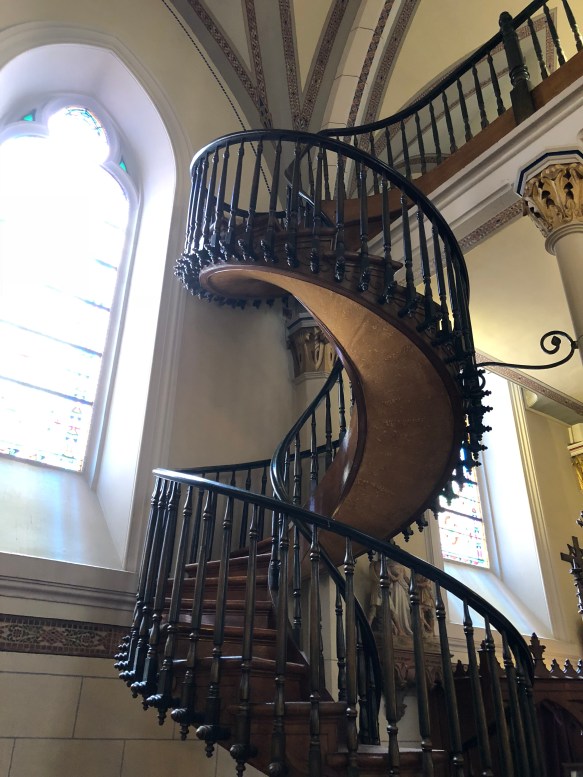
The Sisters also worked with the local people to raise funds from 1863 to 1879 to build the Loretto Chapel, which is known for its “miraculous staircase”, which is a marvel of construction because it has no visible means of support.

IMG_0031

Over the following century, hundreds of women, many who were of Hispanic decent, joined the Sisters of Loretto. The first native-born New Mexican superior of Loretto was Lucia Perea, who took over this position in 1896.

A note on the “A Catholic Mission” site provides a bit more information about Mother Magdalen:

“Joanna Hayden took on the name of Sister Magdalen Hayden when she took her vows to the Loretto Order in 1834. After spending time in Loretto, KY, Cape Girardeau and Bethlehem, MO, she entered the western missions.  In 1852, Sister Magdalen and a group of Loretto Sisters left the Kentucky Mother house for Santa Fe.  In route, the mother superior of the group died of cholera in Independence, MO.  Sister Magdalene became Mother Magdalene.  Mother Magdalene’s time in Santa Fe is well documented as the founder of several Catholic schools and the Superior of the Our Lady of Light Academy in Santa Fe, also known as the Loretto Academy.  The Loretto Academy in Santa Fe is very well known for the spiral staircase built during her time.”


Location: 35° 41.093′ N, 105° 56.279′ W