Department of Justice Santa Fe Internment Camp, New Mexico

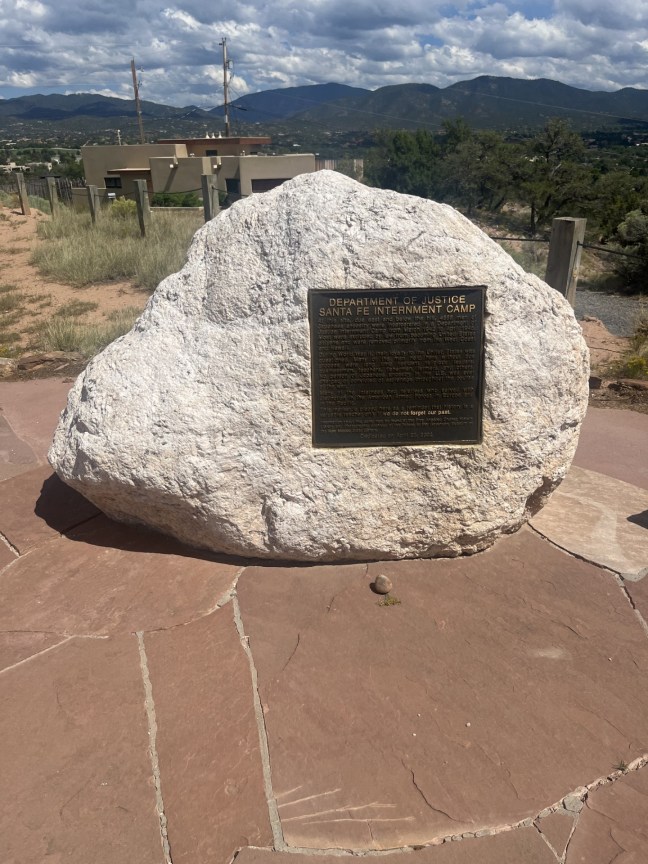
Department of Justice Santa Fe Internment Camp Historical Marker, New Mexico

Located within Frank S. Ortiz Park, this marker commemorates the Santa Fe Internment Camp (SFIC), which was once located here. The camp was created during World War II to house Japanese immigrant men. It was run by the Immigration and Naturalization Service (INS).

Starting in March 1942, over 4,500 Japanese men were moved here, mainly from the West Coast and Hawaii. This camp was one of the largest prison camps in America for resident aliens.

The camp initially housed Issei (Japanese immigrant) men who had been arrested right after Pearl Harbor. Soon after the camp opened, these men were allowed hearings and were either paroled to other camps or released. The camp closed in September 1942.

It was reopened in March 1943, and the INS began moving more civilian internees into the camp. By the time the camp was closed in May 1946, it had housed 4,555 Japanese Americans throughout its operation.

Historical Marker Inscription

Department of Justice
Santa Fe Interment Camp

At this site, due east and below the hill, 4555 men of Japanese ancestry were incarcerated in a Department of Justice Internment Camp from March 1942 to April 1946. Most were excluded by law from becoming United States citizens and were removed primarily from the West Coast and Hawaii.

During World War II, their loyalty to the United States was questioned. Many of the men held here without due process were long time resident religious leaders, businessmen, teachers, fishermen, farmers, and others. No person of Japanese ancestry in the U.S. was ever charged or convicted of espionage throughout the course of the war.

Many of the internees had relatives who served with distinction in the American Armed Forces in Europe and in the Pacific.

This marker is placed here as a reminder that history is a valuable teacher only if we do not forget our past.

Information about the camp may be found at the Fray Angélico ChávezHistory Library and Photographic Archives of the Palace at the Governors Museum or the New Mexico State Library.

Dedicated on April 20, 2002
Location

35° 41’ 47.238” N, 105° 57’ 46.020” W
The Frank S. Ortiz Dog Park, Santa Fe, NM  87501, United States

Site of Santa Fe’s First Chapel

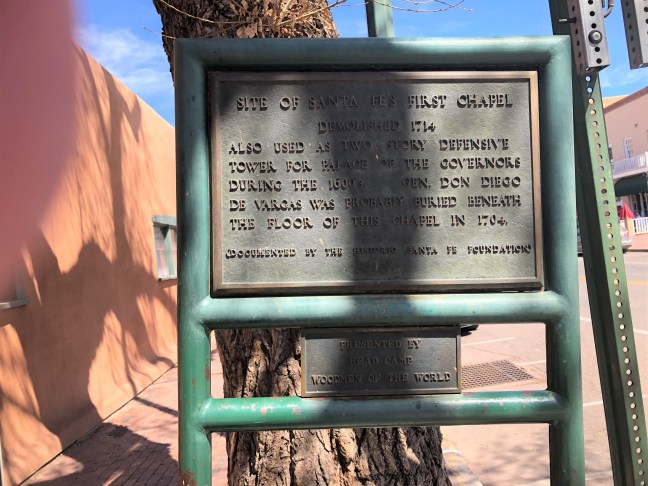
Santa Fe, New Mexico Historical Marker: First Chapel

Santa Fe is a mecca of history, so there are plenty of historical markers in the area. On the southeast corner of the Place of the Governors lies the historical marker for Santa Fe’s first chapel.

According to the marker, the chapel was “Also used as two story defensive tower for Palace of the Governors during the 1600’s. Gen. Don Diego de Vargas was probably buried beneath the floor of this chapel in 1704”. The chapel was demolished in 1774.

Don Diego de Vargas

Diego de Vargas Zapata y Luján Ponce de León y Contreras, better known as Don Diego de Vargas, was a Spanish Governor of the territory of Santa Fe from most of the 1690s until 1704. He was in charge of the reconquest of the New Mexico territory after the Pueblo Revolt in 1692.

The Pueblo Revolt started in August 1680, and involved Pueblo people from different pueblos. While traditional extremely peaceful people, the Pueblo people were treated cruelly by the Spanish rulers. They overthrew Spanish rule in New Mexico and held the area for more than 12 years.

Location: N 35° 41.261 W 105° 56.266

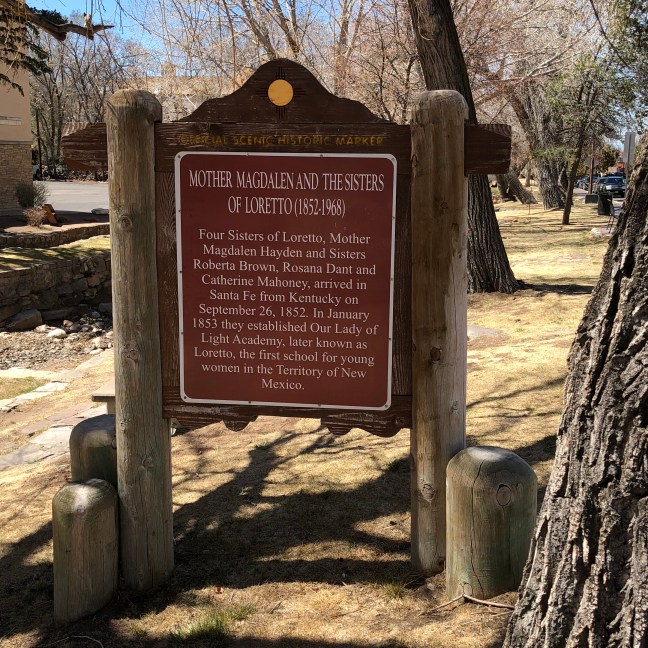
New Mexico Historical Marker: Mother Magdalen and the Sisters of Loretto


This marker is located in the downtown area of Santa Fe at the intersection of East Alameda Street and Old Santa Fe Trail. The marker commemorates Mother Magdalen Hayden and Sisters Roberta Brown, Rosana Dant and Catherine Mahoney, who established the Our Lady of Light Academy (which became known as Loretto). This was the first school for young women in the New Mexico Territory.

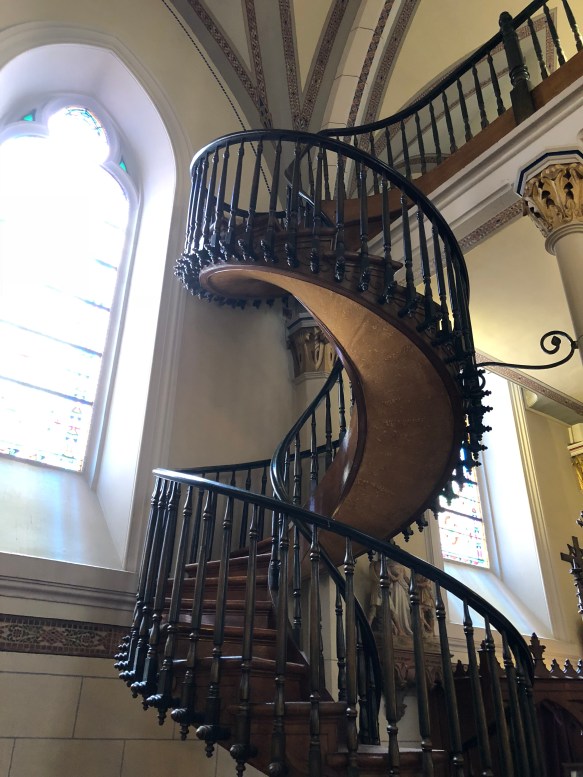
The Sisters also worked with the local people to raise funds from 1863 to 1879 to build the Loretto Chapel, which is known for its “miraculous staircase”, which is a marvel of construction because it has no visible means of support.

IMG_0031

Over the following century, hundreds of women, many who were of Hispanic decent, joined the Sisters of Loretto. The first native-born New Mexican superior of Loretto was Lucia Perea, who took over this position in 1896.

A note on the “A Catholic Mission” site provides a bit more information about Mother Magdalen:

“Joanna Hayden took on the name of Sister Magdalen Hayden when she took her vows to the Loretto Order in 1834. After spending time in Loretto, KY, Cape Girardeau and Bethlehem, MO, she entered the western missions.  In 1852, Sister Magdalen and a group of Loretto Sisters left the Kentucky Mother house for Santa Fe.  In route, the mother superior of the group died of cholera in Independence, MO.  Sister Magdalene became Mother Magdalene.  Mother Magdalene’s time in Santa Fe is well documented as the founder of several Catholic schools and the Superior of the Our Lady of Light Academy in Santa Fe, also known as the Loretto Academy.  The Loretto Academy in Santa Fe is very well known for the spiral staircase built during her time.”


Location: 35° 41.093′ N, 105° 56.279′ W