Drayton Hall Historical Marker, Charleston, South Carolina

Drayton Hall, Charleston, South Carolina

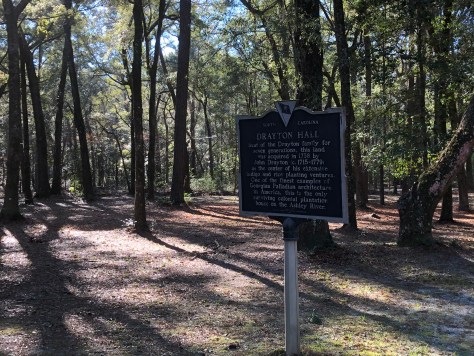
Drayton Hall was built in 1738 and is one of the earliest examples of Palladian architecture. It is also the oldest unrestored plantation house in the United States that is still open to the public. It required 360,000 hand-made bricks to build the house. The Draytons leveraged both slave labor and white craftsmen to construct the property. Drayton Hall was owned by seven generations of the Drayton Family before it became a historic site.

While not a working plantation, it was the commercial hub of John Drayton’s empire. The Drayton family’s wealth was founded upon cattle, rice and indigo.

Drayton Hall is an active archaeological site with an on-premise preservation department.

Historical Marker Inscription

Drayton Hall Historical Marker, Charleston, SC

Seat of the Drayton family for seven generations, this land was acquired in 1738 by John Drayton (c. 1759~1779) as the center of his extensive indigo and rice planting ventures. One of the finest examples of Georgian Palladian architecture in America, this is the only surviving colonial plantation house on the Ashley River.

Location

32° 51’ 54.720” N, 80° 4’ 57.840” W
3380 Ashley River Rd, Charleston, SC  29414, United States

Magnolia Plantation Historical Marker, Charleston, South Carolina

Magnolia Plantation Historical Marker, Charleston, South Carolina

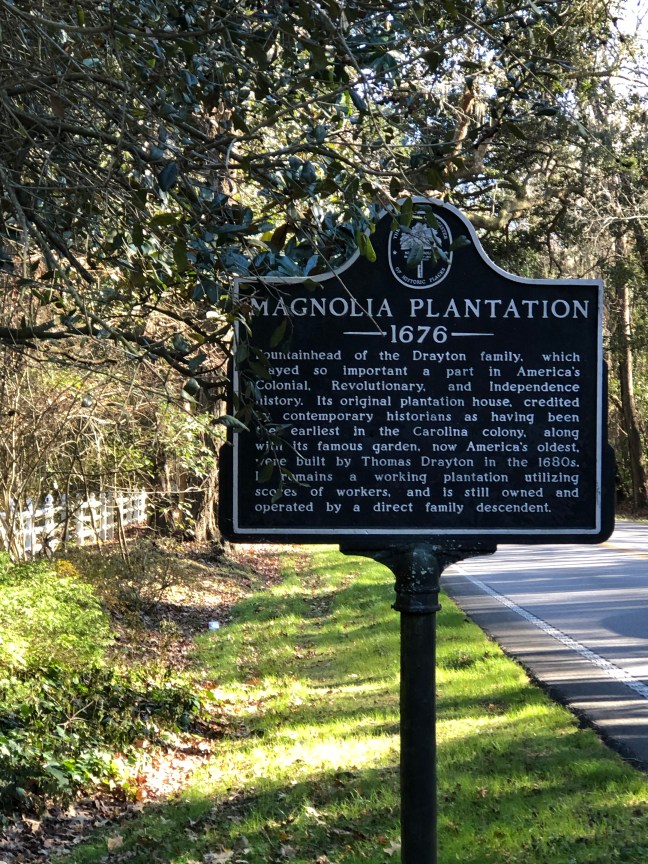
Built in 1676, Magnolia Plantation is the oldest plantation in South Carolina. It also boasts the oldest estate garden in the United States. The first manor house was built by Thomas Drayton, Junior, in 1680. Later, the plantation was expanded to over 3,000 acres in 1760. This addition included five rice plantations.

The first manor house burned in 1811. The current main manor house was originally built in Summerville as the Drayton’s summer home. It was moved to its current location by barge in 1873. After the Civil War, the gardens were opened as a public space.

The plantation is still owned by a descendant of the original owners.

Historical Marker Inscription

Magnolia Plantation

1676

Fountainhead of the Drayton family, which played so important a part in America’s Colonial, Revolutionary, and Independence history. Its original plantation house, credited by contemporary historians as having been the earliest in the Carolina colony, along with its famous garden, now America’s oldest, were built by Thomas Drayton in the 1680’s. It remains a working plantation utilizing scores of workers, and is still owned and operated by a direct family descendent.

Location

32° 52’ 17.310” N, 80° 5’ 26.870” W
Magnolia Plantation & Gardens, Magnolia Plantation Rd, Charleston, SC  29414, United States

St. Philip’s Church Historical Marker, Charleston, South Carolina

St. Philip's Church Historical Marker, Charleston, SC

Founded in 1681, St. Philip’s Church is an Anglican church and one of the oldest churches in South Carolina. It is also the oldest congregation in the state. It was the first Anglican church to be established south of Virginia.

The first church was a wooden building, located where St. Michael’s Episcopal Church currently stands. The next church building was erected in the 18th century and is in the latest church’s present location. This building was burnt down in 1835 and was replaced between 1835 and 1838. The architect was Joseph Hyde, but the steeple was designed by E.B. White, which was added later.

Many famous people lie in the church cemetery, including Charles Pinkney, famous for the Pickney Draught, and Edward Rutledge, South Carolina Legislator and Senator. Pickney was also a Signer of the United States Constitution while Rutledge was a Signer of the Declaration of Independence.

Historical Marker Inscription

Here in the churchyard of
St. Philip’s are buried
Charles Pinckney
(1757-1824)
Signer of the United
States Constitution
and author of the famous
“Pinckney Draught”
Governor of South Carolina
U.S. Senator & Congressman
Minister to Spain
Edward Rutledge
(1749-1800)
Signer of the Declaration
of Independence
Delegate to First & Second
Continental Congresses
S.C. Legislator & Senator
Governor of South Carolina.

Erected By

South Carolina Society Daughters of American Colonists

1969

Location

32° 46’ 44.052” N, 79° 55’ 45.168” W

154 Church St, Charleston, SC  29401, United States

Sheldon Union Academy

Sheldon Union Academy Historical Marker, Sheldon, SC

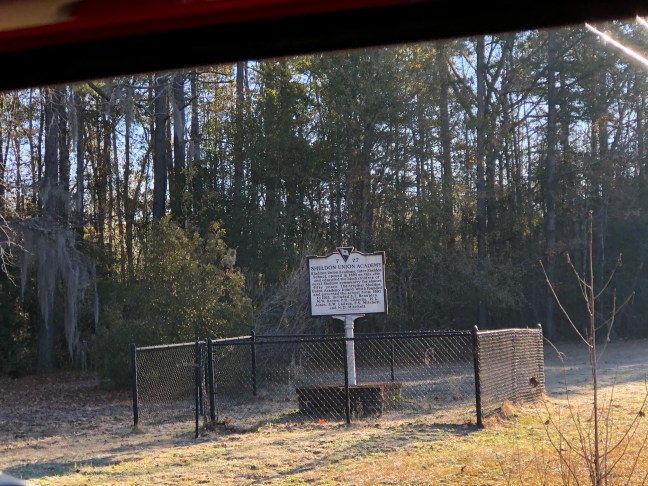
Sheldon Union Academy was founded in 1893. It was a school to teach rural black children living in Sheldon. It was opened after the American Civil War. It operated in the community for nearly 50 years until 1918.

At that time, the school board gave the property to Beaufort County. Since Sheldon Union Academy had been operating as a private school, it was converted to a public school, and a new school was built on the land.

Historical Marker Inscription

Front

Sheldon Union Academy, later Sheldon School, opened in 1893 on this site and educated the black children of rural Sheldon community for almost fifty years. The original Sheldon Union Academy board, which founded and governed the school from 1893 to 1918, included S.T. Beaubien, M.W. Brown, P.R. Chisolm, H.L. Jones, S.W. Ladson, F.S. Mitchell, and N.D. Mitchell.

Back

Sheldon Union Academy, founded by an independent group of community leaders, was a private school until 1918. That year its board deeded the property to Beaufort County, which built a new public school on this site. Sheldon School, which taught grades 1-7, closed in 1942 when the county consolidated its rural black schools.

Location

32° 36’ 11.088” N, 80° 48’ 2.460” W701–737 Trask Pkwy, Seabrook, SC  29940, United States

Old Jacksonborough, Hardeeville, South Carolina

Old Jacksonborough, Hardeeville, South Carolina

Jacksonborough (later Jacksonboro) was originally the Native American settlement of Pon Pon. It was named after John Jackson who received a land grant in 1701. It later became the county seat of the Colleton District in 1799 and would remain the so until 1822. It had a school and Methodist and Episcopal churches.

When the British occupied Charlestown (now Charleston) in 1782, Jacksonborough became the provisional capital. The South Carolina General Assembly (the Senate and the House) met in a Masonic Lodge and Tavern that was owned by Peter Dubose.

On February 26th, the assembly passed the Confiscation Acts, which were later printed on March 20, 1782.

Historical Marker Inscription

Founded about 1735 on lands granted John Jackson in 1701. Seat of Colleton District from 1799 to 1822. Provisional Capital of State while Charleston under siege during the American Revolution. South Carolina Legislature met here Jan. – Feb. 1782. Sessions held in Masonic Lodge and Tavern. Passed Confiscation and  Amercement Acts.

Location

32° 46’ 8.538” N, 80° 27’ 8.670” W

16955 Ace Basin Pkwy, Round O, SC  29474, United States

Middleton Place/Arthur Middleton Historical Marker, Summerville, South Carolina

Middleton Place Historical Marker, Summerville, SC

Home to America’s oldest landscaped garden, Middleton Place National Historic Landmark is an historic site that was home to many important people related to the Continental Congress and the Declaration of Independence. Begun in 1741,  the site is 110 acres, and it includes the gardens, house museum, stable yards and more.

One of the residents was Arthur Middleton, who was the son of Henry Middleton, who laid out the gardens. He was a signer of the Declaration of Independence. He helped draft the South Carolina state constitution, and he was also a delegate to the Continental Congress (1776-1777).

During the siege of Charleston during the Revolutionary War, he was taken prisoner by the British in 1780. In July 1781, he was exchanged as a prisoner and became a member of the Continental Congress from 1781 to 1783. He was also part of the South Carolina legislature from 1785 to 1786.

Historical Marker Inscription

Middleton Place

These famous gardens were laid out about 1741 by Henry Middleton (1717-84), President of Continental Congress. His son Arthur, Signer of the Declaration of Independence, lived here as did his son Henry (1770-1846), Governor of S.C. and Minister to Russia, who introduced the camellias. His son Williams (1809-83) planted the first azaleas. The original residence was looted and burned by Federal forces in 1865.

Arthur Middleton Historical Marker, Summerville, SC

(Reverse Side)

Arthur Middleton

Planter, Patriot, Signer of the Declaration of Independence. Born here June 26, 1742, Arthur Middleton, after receiving his education in England, returned to make his home here in 1763. He served in the Commons House of Assembly, the Provincial Congress, the Council of Safety, the Continental Congress, the militia, and the state legislature. He died Jan. 1, 1787, and is buried in the garden here.


Location

Middleton Place Road, Charleston, SC, 29414 United States

32° 54′ 0402″ N, 80° 8′ 24.770″ W

Combahee River Raid

Combahee River Raid Historical Marker, Beaufort, South Carolina

Harriet Tubman, famous for her assistance with the Underground Railroad to help slaves from the South travel to the North to freedom, worked with 150 black Union soldiers (members of the 2nd South Carolina Volunteers) to free more than 750 enslaved peopled on June 2, 1863. It became known as the Combahee River Raid. Under the command of Union Colonel James Montgomery, Tubman became the first woman to lead a “major military operation in the United States”.

Slaves along the Combahee River worked with Tubman to ensure that the Union vessels remained safe throughout the voyage. They provided information about the location of rebel torpedoes in the river in exchange for freedom. While the mission did help free many slaves, the main goal was to destroy estates owned by South Carolina secessionists, which they also achieved.

Tubman, often referred to as “the Moses of her people”, was a slave who had fled the South in 1849.

Historical Marker Inscription

Combahee River Raid
On June 1-2, 1863, a Federal Force consisting of elements of the 2nd S.C. Volunteer Infantry (an African- American unit) and the 3rd Rhode Island Artillery conducted a raid up the Confederate-held Combahee River. Col. James Montgomery led the expedition. Harriet Tubman, already famous for her work with the Underground Railroad, accompanied Montgomery on the raid.

(Other Side)

Freedom Along The Combahee
Union gunboats landed 300 soldiers along the river, and one force came ashore here at Combahee Ferry. Soldiers took livestock and supplies and destroyed houses, barns, and rice at nearby plantations. More than 700 enslaved men, women, and children were taken to freedom in perhaps the largest emancipation event in wartime S.C. Some freedmen soon enlisted in the U.S. Army.

Location

999, Charleston Highway, Beaufort County, South Carolina, 29945 United States

32° 39′ 6.94″ N, 80° 41′ 5.85″ W


Temple of Sport, Green Pond, SC

Temple of Sport Historical Marker, Green Pond, South Carolina

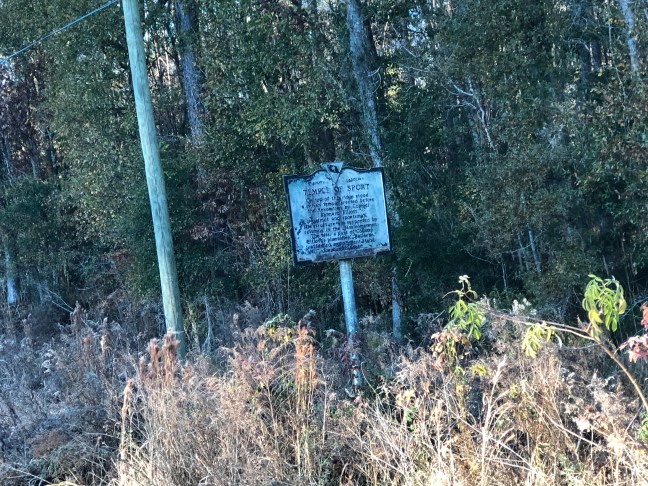
This site marks the location of a grandiose deer stand that had eight brick columns approximately two feet in diameter at the base. The deer stand stood at the headwaters of the Chehaw River, which attracted many animals to the area.

The structure was built by Colonel Barnard Elliott sometime after approximately 1768. Elliott was the first to read the American Declaration of Independence to the public in South Carolina, which happened on August 5, 1776.

Historical Marker Inscription

On top of this ridge stood a sylvan temple erected before the Revolution by Colonel Barnard Elliott, patriot and sportsman. The structure was supported by columns in the classic manor. The site, a part of Colonel Elliot’s plantation “Belleview,” afforded an excellent stand for hunting deer.

Location

Ace Basin Parkway, Green Pond, South Carolina, 29446, United States

32° 42′ 30.168″ N, 80° 36′ 41.220″ W

Jenkins Orphanage, North Charleston, SC

Jenkins Orphanage Historical Marker, North Charleston, South Carolina

The Jenkins Orphanage was founded by Rev. Daniel Joseph Jenkins, a former orphan himself, in 1891. The myth around the founding is that Jenkins stumbled upon four homeless boys in a freight car who had no one to care for them. The orphanage, which assisted African American children, was originally located next to the old jail in downtown Charleston until 1937. 

The main claim to fame for the orphanage is the Jenkins Orphanage Band, which was formed to help support the organization. The band played across American and Europe, and became the training ground for many top musicians and helping with the creation of jazz. The orphanage needed money beyond the $1,000 stipend it received from the City of Charleston. Jenkins got donations of instrument and old uniforms from the Citadel. P.M. “Hatsie” Logan and Francis Eugene Mikell were brought in to teach the children. 

The band played for the inaugurations for President Theodore Roosevelt’s in 1905 and President William Howard Taft in 1909. They also had their own stage at the St. Louis World’s Fair in 1904.

Jenkins had up to five bands tour in the summer and two in the winter. Over time, the orphanage became the place to go for Charleston musicians.

After Jenkins death in 1937, the orphanage moved to North Charleston and five dormitories were built. An elementary school was added for the African American children in the area.

Currently, the Jenkins Institute currently takes care of teenage girls ages 11 to 21.

Historical Marker Inscription

Front

Since 1937 this has been the campus of the Jenkins Orphanage, established in Charleston in 1891 by Rev. Daniel Joseph Jenkins (1862-1937). Jenkins, a Baptist minister, founded this orphanage for African American children with aid from the city. Housed in the old Marine Hospital on Franklin Street downtown 1892-1937, it also included an institute to teach and train children between the ages of 3 and 20. More than 500 lived there by 1896.
 

Jenkins Orphanage Historical Marker, North Charleston, South Carolina

Back

The Jenkins Orphanage Band played concerts across the U.S. and Europe for more than 30 years to help fund the orphanage. The band, taught by Hatsie Logan and Eugene Mikell, is prominent in the early history of jazz; alumni Cat Anderson, Freddie Green, and Jabbo Smith played for Duke Ellington, Count Basie, and others. The orphanage moved here in 1937, and its offices and dorms were built by the City of Charleston. Those historic buildings burned in the 1980s.

Erected 2008 by The Daniel Joseph Jenkins Institute for Children, a program of the Orphan Aid Society, Inc.

Location

Azalea Drive (State Highway 10-894), North Charleston, SC 29405

32° 50.816′ N, 79° 59.788′ W

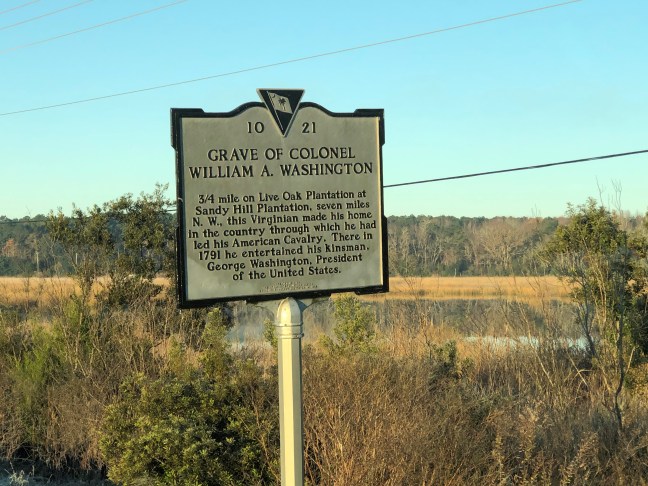
Grave of Colonel William A. Washington

Grave of Colonel William Washington Historical Marker

William Washington was a distant cousin of George Washington. He was an officer of the Continental Army during the American Revolution. Lord Cornwallis even respected Washington, saying after the surrender at Yorktown, “there could be no more formidable antagonist in a charge, at the head of his cavalry, than Colonel William Washington”.

Born on February 28, 1752, he grew up with three brothers and two sisters on the family’s 1,200 acre-Virginia plantation, which had been located in Stafford County. When the Revolution started, he was elected as a Captain of the Stafford County Minutemen on September 12, 1775, which then became part of the Third Virginia Regiment in 1776. By the end of summer, the regiment joined the main army in New York. They were part of the Battle of Trenton on December 26, 1776. Captain Washington led a successful charge against Hessian soldiers.

By 1779, William Washington would become a lieutenant colonel, overseeing the Third Regiment of Continental Light Dragoons. Washington was instrumental throughout the war. In January 17, 1781, he led the charge that routed the British cavalry at the Battle of Cowpens.

On September 8, 1871, Colonel Washington was wounded and captured, and would spend the rest of the war as a prisoner of war in Charleston, SC. There, he would marry Jane Reily Elliott and obtain Sandy Hill Plantation. He became a low country planter. He was also elected as a representative to the South Carolina state assembly from 1787 to 1791, and later as a senator from 1792 to 1794 and 1802 to 1804.

As hostilities heated between the newly formed United States and France in 1798, President John Adams appointed Washington as Brigadier General under General George Washington.

William Washington died on March 16, 1810 after a prolonged illness.

Historical Marker Inscription

3/4 mile on Live Oak Plantation at Sandy Hill Plantation, seven miles N.W., this Virginian made his home in the country through which he had led his American Cavalry. There in 1791 he entertained his kinsman, George Washington, President of the United States.

Location

Savannah Highway (U.S. 17) near Waldon Road, Johns Island, South Carolina.

32° 47’ 42.972” N, 80° 8’ 10.790” W