Valence Historical Marker, New Orleans, Louisiana

Valence Street Cemetery Historical Marker, New Orleans, LA

The Valence Cemetery, also known as the Valence Street Cemetery, was established in 1867. It is located on Valence Street between Daneel and S. Saratoga Streets. It served as the municipal cemetery for the City of Jefferson, which was a suburb of New Orleans at the time. This is why it was originally called City Cemetery or Jefferson City Cemetery.

The cemetery is broken up into four squares. It is mainly comprised of below-ground and coping burials. A coping grave has walls that are mainly made of stone, granite, or marble. This seals the coffin from rising water.

In 1870, Jefferson City was annexed into New Orleans (presently it’s the Uptown area). This was when the name of the cemetery was changed to Valence. In the cemetery, there are many society tombs, including St. Anthony of Padua Italian Mutual Benefit Society, the St. Joseph’s Sepulcher of the Male and Female Benevolent Association, and the Ladies and Gentlemen Perseverance Benevolent Association.

Valence Cemetery, New Orleans, LA

Historical Marker Inscription

The Jefferson City Cemetery, later called the Valence St. Cemetery, became a city cemetery in 1870 when Jefferson City was annexed by the City of New Orleans. The cemetery has a number of old society tombs such as the St. Anthony of Padua Italian Mutual Benefit Society, the St. Joseph’s Sepulcher of the Male and Female Benevolent Association, and the Ladies and Gentlemen Perseverance Benevolent Association. German philanthropist John David Fink’s remains were removed from the Girard Street Cemetery when it was demolished, and were buried in this cemetery.

Location

2000–2048 Valence St, New Orleans, LA  70115, United States

29° 55’ 50.202” N, 90° 6’ 21.940” W

Virgin Island, Pierre Part, Louisiana

Virgin Mary Island, Pierre Part, LA Historical Marker

29° 57’ 47.292” N, 91° 12’ 41.790” W

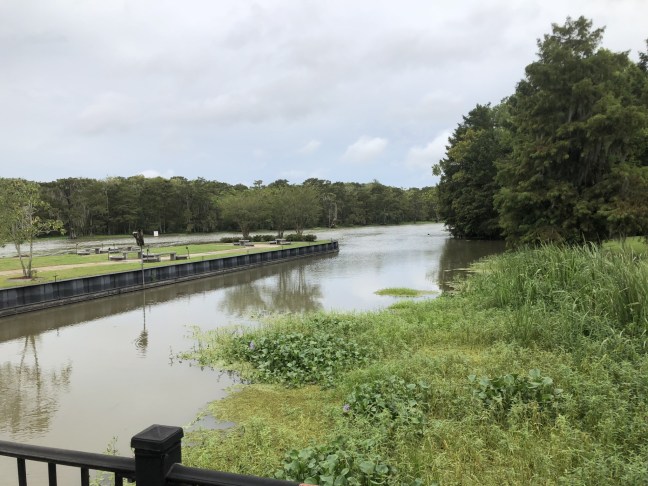
Located near the Atchafalaya Basin, Pierre Part, Louisiana, is located at Pierre Part Bay. It is only three feet above sea level. It is also nearly surrounded by water. During the 1800s, it was actually nearly destroyed by a flood.

But one thing survived. The St. Joseph the Worker Catholic Church sits on a small island. Within the ruins of this church, a statue of the Virgin Mary was found without any damage.

According to reports, in 1902, Father Pillian, a local priest, placed a small statue in a wooden cross on the island. He asked the Virgin Mary to protect the town. The local belief is that if water doesn’t reach the Virgin’s feet, Pierre Part will survive.

Later, the small statue was replaced by a larger one. Worshippers still come to the island to pray.

Pierre Part, Louisiana

Historical Marker Inscription

Commemorates The Blessed Virgin who the people of Pierre Part believe intervened to save lives in natural disasters from 1882-1976. Restored by the citizens during the Bicentennial Year 1976.

Location

3302 LA-70, Pierre Part, LA  70339, United States

William Kendrick Square Historical Marker, Greensburg, Louisiana

William Kendrick Square Historical Marker, Louisiana

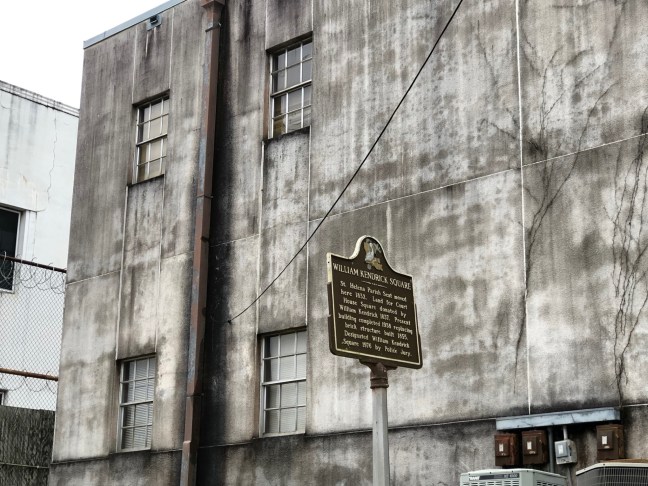
In 1837, William Kendrick donated the land on which the St. Helena Parish courthouse sits. The modern courthouse was completed in 1938, replacing the original building built in 1855. He was born in 1755 in Granville, North Carolina, but moved to Greensburg, Louisiana.

Kendrick participated in the Revolutionary War and the War of 1812. He was a slave owner in the parish and owned the Kendrick Plantation. He had a total of 14 children.

He stayed in Greensburg until his death in 1838. The location of the courthouse was named after him in 1976.

Historical Marker Inscription

St. Helena Parish seat moved here 1832. Land for Court House Square donated by William Kendrick 1837. Present building completed 1938 replacing brick structure built 1855. Designated William Kendrick Square 1976 by Police Jury.

Location

30° 49’ 45.828” N, 90° 40’ 2.682” W38 S Main St, Greensburg, LA  70441, United States

Avart-Peretti House, New Orleans, Louisiana

Avart-Peretti House Historical Marker, New Orleans, Louisiana

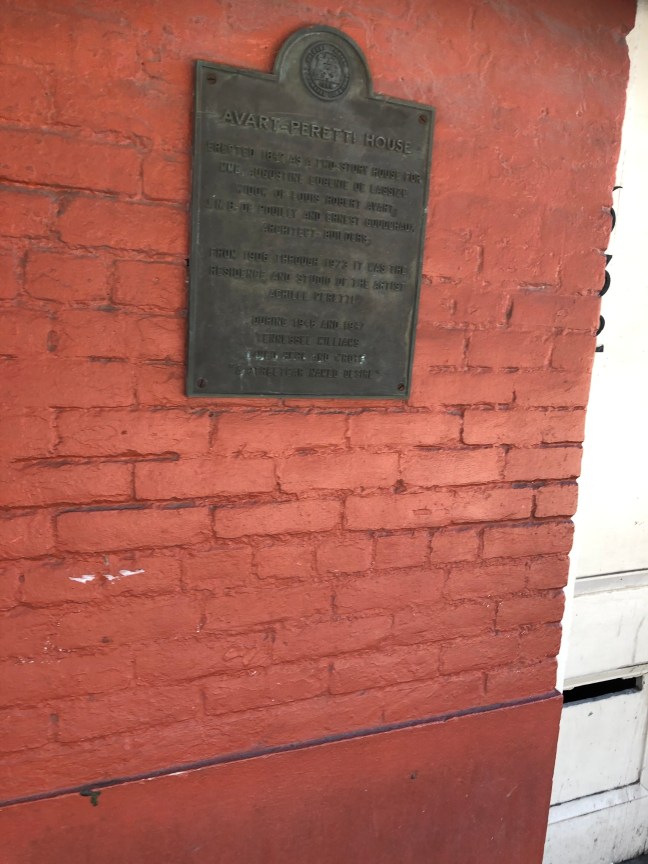
While built as a home in 1842 for Mme. Augustine Eugenie de Lassize, the Avart-Peretti House is most known as the location where Tennessee Williams wrote A Streetcar Named Desire. Williams made frequent visits to New Orleans, first coming to the city in 1938. And it was in New Orleans that he renamed himself Tennessee. 

According to reports, the Avart-Peretti House was said to be Williams’s favorite place to stay. In this location, he was close to the Desire streetcar line, and the house was even the inspiration for the fictional home in the play.

The house was also the home of sculptor Achille Peretti from 1906 to 1923. Hailing from Italy, the artist eventually became an American citizen.

The house is currently not open to the public.

Historical Marker Inscription

Erected 1842 as a two-story house for Mme. Augustine Eugenie de Lassize widow of Louis Robert Avart J.N.B. de Pouilly and Ernest Goudchauz architect-builders

From 1906 through 1923 it was the residence and studio of the artist Achille Peretti

During 1946 and 1947 Tennessee Williams lived here and wrote “A Steetcar Named Desire”

Jefferson Parish Historical Marker, Louisiana

Jefferson Parish Historical Marker, Louisiana

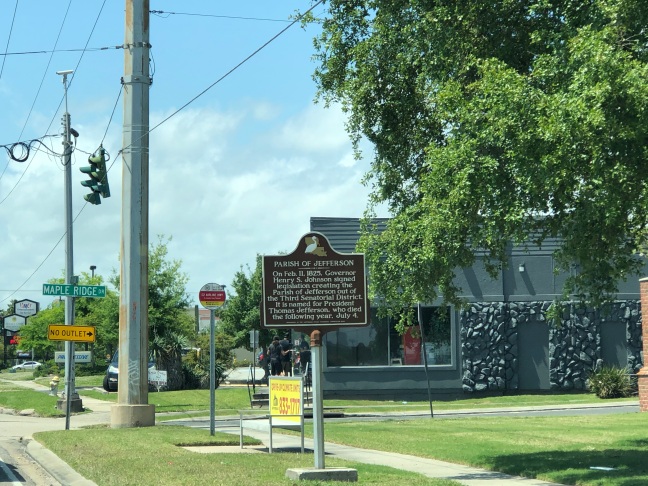
Established in 1825, Jefferson Parish, Louisiana, was named after Thomas Jefferson. Thomas Jefferson was instrumental in the Louisiana Purchase, where the burgeoning United States purchased the territory from France in 1803.

From at least the 1600s, the area was home to Native American tribes. Other groups that called the area home included the Germans, Spaniards, Africans, Italians, Acadians and more.

Prior to 1874, the parish borders stretched from St. Charles Parish to Felicity Street in New Orleans. As Orleans Parish grew, however, it annexed areas of Jefferson Parish. The current borders were redrawn to their current location in 1874.

Historical Marker Inscription

On Feb. 11, 1825, Governor Henry S. Johnson signed legislation creating the Parish of Jefferson out of the Third Senatorial District. It is named for President Thomas Jefferson, who died the following year, July 4.

Location

29° 58’ 23.988” N, 90° 8’ 26.030” W

1373–1379 Airline Dr, Metairie, LA  70001, United States

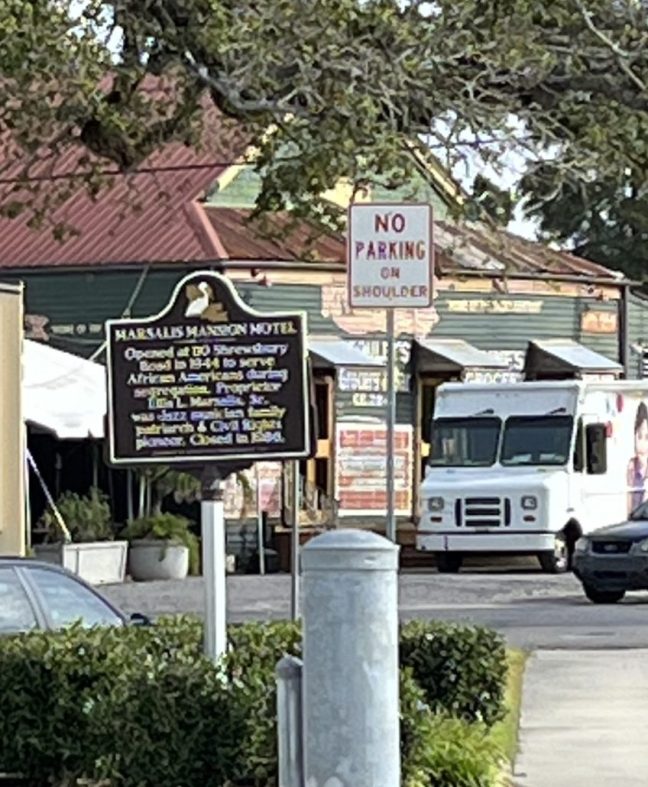
Marsalis Mansion Motel Historical Marker, Louisiana

Marsalis Mansion Motel Historical Marker, Louisiana

The Marsalis Mansion Motel opened in 1943 in a converted chicken barn. The motel was owned by Ellis Marsalis, Sr., the patriarch of the New Orleans jazz musical family. It offered luxury accommodations to African Americans during segregation. Located on River Road in Jefferson Parish, the motel hosted many famous guests, including Rev. Martin Luther King Jr., Ray Charles and Thurgood Marshall.

During the 1950s, the nightclub, the Music Haven, was located on the motel’s grounds. The motel closed in 1986 and was condemned in 1993 and razed. The historical marker was dedicated in 2015.

Historical Marker Inscription

Opened at 110 Shrewsbury Road in 1944 to serve African Americans during segregation. Proprietor Ellis L. Marsalis, Sr., was Jazz musician family patriarch & Civil Rights pioneer. Closed in 1986.

Location

3511 River Road, Jefferson, Louisiana 70121, United States

29° 57′ 28.350″ N, 90° 9′ 42.660″ W

Whitehall Plantation Home, Louisiana

Whitehall Plantation, Louisiana Historical Marker

Whitehall Plantation was built in 1857 for Francois Pascalis de la Barre and his family. Covering 8,000 acres, it extended from the Mississippi River to Lake Pontchartrain. It was a sugar plantation until 1891. During the American Civil War, it operated as the headquarters for Union troops.

Starting in 1919, it served as a gambling casino. Later in 1935, it was turned into the Magnolia School for those with special needs and intellectual and developmental challenges. The school still operates today.

Historical Marker Inscription

Built in 1857 for François Pascalis de Labarre IV. Occupied by Union Troops during the Civil War. After 1892 was a gambling casino, Jesuit retreat house and St. Agnes Church. Magnolia School since 1935.

Location

100 Central Avenue, Jefferson, Louisiana 70121, United States

29° 57′ 9.018″ N, 90° 10′ 7.158″ W

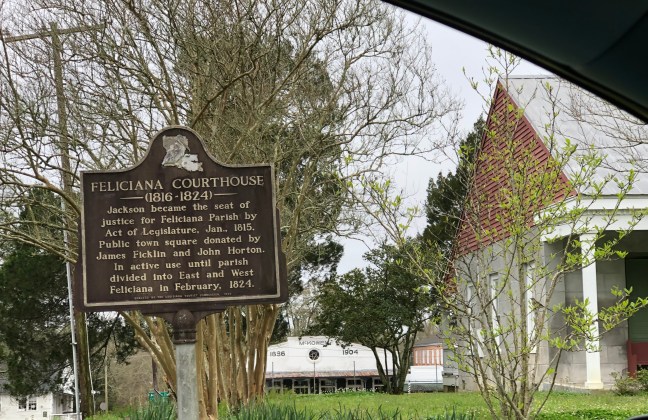
Feliciana Courthouse, Louisiana

Feliciana Courthouse Historical Marker, Louisiana

The Old Feliciana Parish Courthouse was built in 1816 and was placed on the National Register of Historic Places in 1980. It served as the courthouse from 1816 to 1824 when the parishes were split between West Feliciana (Saint Francisville current county seat) and East Feliciana Parish (Clinton current county seat).

Historical Marker Description

(1816-1864)

Jackson became the seat of justice for Feliciana Parish by Act of Legislature, Jan., 1815. Public town square donated by James Ficklin and John Horton. In active use until parish divided into East and West Feliciana in February, 1824.

Location

1734 High Street, Jackson, LA, 70148, United States

30° 50′ 16.680″ N, 91° 12.′ 50.388″ W

Boré Plantation – Audubon Park, New Orleans, LA

Bore Plantation - Audubon Park Historical Marker, New Orleans, LA

Audubon Park was the location of the Boré Plantation owned by Étienne de Boré, which started as an indigo plantation, but later converted into sugar cane. The process was assisted by chemist Antoine Morin, who was a free man of color originally from Saint-Domingue. Morin created a process that made sugar granulation possible in 1795.

This process not only assisted the financially struggling Boré, but the entire southern Louisiana region’s sugar industry. Many plantation owners became wealthy, and the domestic slave trade expanded due to the sugar industry and its need for more workers.

Boré was later selected to head the City Government and became the first Mayor of New Orleans, serving from 1803 to 184. He resigned on May 26, 1804. He died on February 1, 1820, and is buried in St. Louis Cemetery No. 1 in New Orleans.

Historical Marker Inscription

This site 1781-1820 plantation of Jean Etienne Boré (1741-1820) First Mayor of N.O. 1803-1804. Here Boré first granulated sugar in 1795. Purchased for park in 1871. Site of World’s Industrial & Cotton Centennial Exposition 1884-1885.

Location

Audubon Zoo, 6500 Magazine Street, New Orleans, LA 70118, United States

29° 55′ 22.158″ N, 90° 7′ 53.650″ W

The Opelousas Post Militia of 1779, Opelousas, Louisiana

The Opelousas Post Militia of 1779 Historical Marker

This marker recognizes the contribution of the volunteer Opelousas citizen militia. During 1779, the militia took action in Baton Rouge against the British. The Opelousas militia marched across swamps and marshes to eventually join the Spanish Governor, General Bernardo de Galvez. The goal was to defend Baton Rouge and to keep the British from controlling the lower Mississippi River, especially the area between Natchez and New Orleans.

The militia left Fort Hamilton in the east of Opelousas in groups, heading towards Baton Rouge. They had to content with everything from snakes to alligators to the marshy areas.

Many of the last names of the members would be familiar with anyone from Louisiana, especially St. Landry Parish. These include Bertrand, Brignac, Dupre, Lafleur, Prudhomme, Richard, Trahan and more.

Historical Marker Inscription

In late August of 1779, men of the Opelousas Post Militia left from this place to join other militia units to attack British forces in the lower Mississippi Valley. They crossed the Atchafalaya swamp to join Brig. General Bernardo de Gálvez, the Governor of the Spanish province of Louisiana. The O.P.M. met him at Fort San Gabriel a few miles below present-day Baton Rouge. Total forces under Gálvez numbered 175 Spanish army veterans, 330 Spanish recruits, 80 free men of color, 160 Choctaws, plus about 600 men from various militias along the Mississippi River and from throughout the far-flung posts of civilization in Louisiana. On September 22, 1779, Gálvez’s effective forces, numbering less than 900, laid siege to and captured Ft. New Richmond at Baton Rouge. This victory forced the surrender of Ft. Panmure at Natchez, British headquarters in the lower Mississippi Valley. This generally unknown military action in American history in which the Opelousas Post Militia took part greatly aided in the winning of the American Revolution of 1775-1783.

Location

Le Vieux Village, 828 East Landry Highway, Opelousas LA 70570, United States

30° 31.906′ N, 92° 4.432′ W