East Mississippi Female College, Meridian, MS

East Mississippi Female College, Meridian, MS Historical Marker

The East Mississippi Female College was built in 1869. It was comprised of three buildings: the Main (College) building, the Science Hall and the Conservatory for Music. About a quarter of a mile away was a college for boys. The college was active from 1869 to 1903 when it burned down due to a fire.

Historical Marker Inscription

The East Mississippi Female College was established here in 1869 by the Central Methodist Church and became recognized as one of the finest female colleges in the South under the leadership of John Wesley Beeson, President (1869-1903). The college was destroyed by fire on the morning of February 24, 1903.

Mississippi Department of Archives and History 1995

Location

32° 22’ 4.350” N, 88° 42’ 5.730” W

2300 11th St, Meridian, MS 39301, United States

Pocahontas Mounds Historical Marker 1, Flora, Mississippi

Evolution of the Pocahontas Mounds Flora Mississippi

Consisting of two mounds (Mound A and Mound B), they were built by Native Americans from around 1000 to 1300 AD.  Atop the mounds would have been a building. On Mound A, it would have either been the chief’s residence or a temple. There was also a village that surrounded the mounds. It appears that the mounds were built over time, ranging from the Coles Creek to the Plaquemine periods.

While Mound A is maintained by the Mississippi Department of Transportation and is part of a park, Mound B is not part of the park. Both mounds are listed on the National Register of Historic Places.

Pocahontas Mounds Historical Marker 1 Flora, MS

Historical Marker Inscription

Built and used between A.D 1000 and 1300, this platform mound and a nearby burial mound mark the ceremonial and political seat of a regional chiefdom of the Plaquemine culture. A thatched, clay-plastered ritual temple or chief’s lodging stood atop this mound. Dwellings of villagers occupied surrounding fields.

Location

32° 28’ 14.112” N, 90° 17’ 17.598” W

US-49 N, Flora, MS  39071, United States

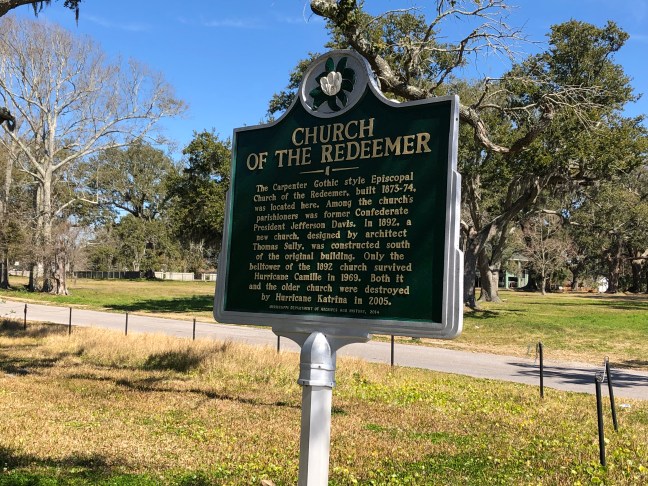
Church of the Redeemer Biloxi, Mississippi Historical Marker

Church of the Redeemer Historical Marker, Biloxi, MS

The Church of the Redeemer was built in 1874 and initially sat on the corner of Howard Avenue and Nixon Street in Biloxi, MS. The congregation had received its charter from the Mississippi Legislature in 1853. It was officially admitted to the Diocese in 1859. After its construction, it was the first Protestant church in the area.

Later in 1891, the church was moved to Beach Boulevard on land donated by Harry T. Howard. Known as the new church, it was used for 78 years until it was destroyed by Hurricane Camille on August 17, 1969. Both the church and the rectory were taken out by the hurricane. The bell tower and original “old church” survived, the latter with significant damage.

The old church was later repaired, and service was held there on Christmas Eve 1969. The church survived until Hurricane Katrina hit the area on August 29, 2005. It destroyed the remaining church and bell tower.

Historical Marker Inscription

The Carpenter Gothic style Episcopal Church of the Redeemer, built 1873-74, was located here. Among the church’s parishioners was former Confederate President Jefferson Davis. In 1892, a new church, designed by architect Thomas Sully, was constructed south of the original building. Only the belltower of the 1892 church survived Hurricane Camille in 1969. Both it and the older church were destroyed by Hurricane Katrina in 2005.

Mississippi Department of Archives and History, 2014

Church of the Redeemer Historical Marker, Biloxi, MS

Location

30° 23’ 36.498” N, 88° 52’ 54.690” W

612 Beach Blvd, Biloxi, MS  39530, United States

Robinson-Maloney Dantzler House, Biloxi, MS

Robinson-Maloney Dantzler House Historical Marker, Biloxi, MS

Built in 1849 by John Ghamm (J.G.) Robinson, the house was a two-story residence with a  two-tiered gallery. It was a Greek Revival mansion with extensive woodwork and windows, and formal gardens.

J.G. Robinson was an English planter. He was the owner of the house until 1873 when it was sold to Frederick Gaupp. It was bought by the Maloney family in 1884, which owned the house until 1912. It was sold a couple of more times, ending up with the Dantzler family in 1918.

It was later purchased by the Catholic Diocese in 1921, which used the house as the Notre Dame High School for boys and then the Sisters of the Little Flower Convent of Mercy.

The house was damaged during Hurricane Camille in 1969 and destroyed by Hurricane Katrina in 2005.

Historical Marker Inscription

Originally a raised-cottage Greek Revival mansion similar to Beauvoir, the house located here was built ca. 1849 by J. G. Robinson, a wealthy English cotton planter. It was the center of an estate that included a ten-pin bowling alley, billiard hall, bath house, thoroughbred stables, kennels, gardens and a wharf for docking two prized yachts. About 1908 the Maloney family enlarged the house with a second story addition and two-tiered wrap-around porches in the Neo-Classical style. Destroyed by Hurricane Katrina in 2005.

Location

1048 Beach Boulevard, Biloxi, MS 39530 United States

30° 23′ 41.088″ N, 88° 54′ 3.798″ W

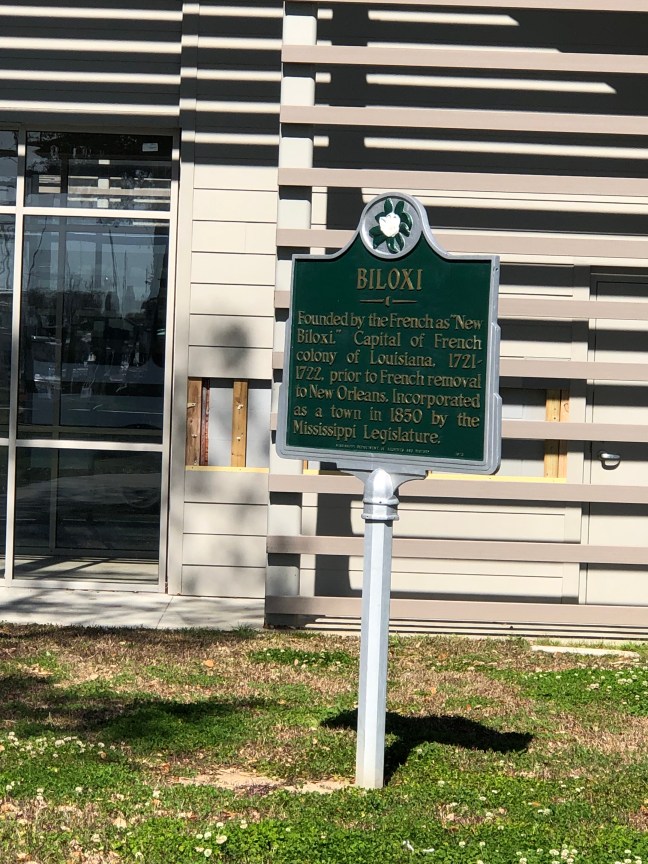
Biloxi, Mississippi Historical Marker

Biloxi, MS Historical Marker

From as early as 8,000 BC to the 1700s, Native Americans made Biloxi home. Then, in 1697, the Comte de Ponchartrain, French Minister of Marine, ordered Pierre Le Moyne, Sieur d’Iberville, to find the mouth of the Mississippi River. In the course of looking for it, Iberville and 14 men came to what would become Biloxi, named after the Biloxi Native Americans, who the crew met and befriended. These Native Americans might have only arrived at the coast a short while before the French.

Biloxi became the capital of the French territory from about 1719 to 1722 when the capital was moved to New Orleans. By 1779, the French had ceded the Mississippi Coast to Spain, and it briefly (in 1810) became a part of the Republic of West Florida. In fact, over the years, Biloxi was under the French, Spanish, British, West Florida Republic, Confederacy and the United States flags.

Mississippi officially became a state in 1817. By 1850, Biloxi was incorporated as a township and became a favorite summer resort.

Historical Marker Inscription

Founded by the French as “New Biloxi.” Capital of French colony of Louisiana, 1721-1722, prior to French removal to New Orleans. Incorporated as a town in 1850 by the Mississippi Legislature.

Location

Biloxi Small Craft Harbor, 679 Beach Boulevard, Biloxi, MS 39350 United States

30° 23′ 33.372″ N, 88° 53′ 3.840″ W

Boggsdale, Long Beach, Mississippi

Boggsdale, MS Historical Marker

Boggsdale is the area of the family home of Thomas Hale Boggs, the late U.S. Congressman from Louisiana who died in a plane crash in Alaska on December 29, 1972.

Seven acres of beachfront property was purchased by Georgian artist and writer, Robert Boggs, and wife, Eliza Jane, in 1875. The area would eventually become Long Beach. The house they built was named Breezydale. According to legend, Native Americans warned the family not to build so close to the Sound.

The property was inherited by the couple’s son, William, and wife, Claire Hale. The other son, Archibald, and his wife, Bessie, were given adjacent land. They built a home by the name of Driftwood, which was named after lumber that had washed ashore.

A major hurricane in 1947 destroyed both homes and killed Bessie. Breezydale was rebuilt 600 feet back from the water and was named Will-Stan, but that property was also destroyed during Hurricane Camille in 1969.

Hale Boggs had plans of rebuilding on Boggsdale before his plane disappeared in Alaska.

Historical Marker Inscription

Thomas Hale Boggs (1914-1972). U.S. Congressman from La. for 28 years, was born in the family home built on this site in 1875. The son of Wm. & Claire Hale Boggs, Rep. Boggs served as House Majority Leader, 1971-72.

Location

30° 20.291′ N, 89° 10.154′ W

Beach Boulevard West (intersection of Boggs Drive and U.S. 90), Long Beach, MS 39560

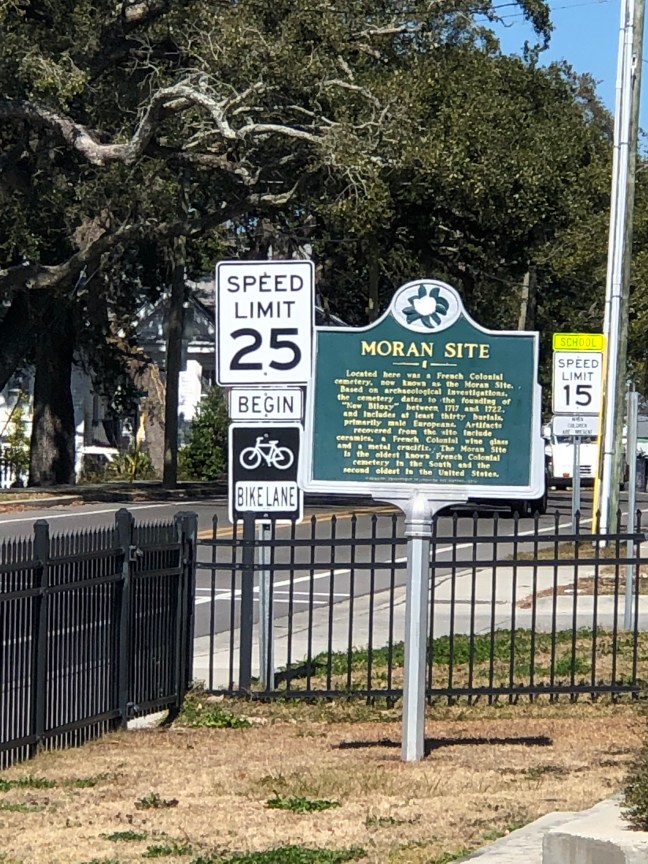
Moran Site, Biloxi, Mississippi

Moran Site, Biloxi, Mississippi

What was once a Colonial cemetery is now the French Colonial Memorial Garden, located at the Biloxi Visitors Center. The memorial park and garden commemorates the 1700s cemetery, which is the second oldest French Colonial cemetery in the United States.

The site dates back to the 1720s when Biloxi was a staging ground for European settlers and African slaves. From here, they would be relocated further into the French Louisiana Colony.

Found here were 32 graves of French Colonial settlers from the 1700s. The graves were mainly European men, and several artifacts were also discovered at this location. Remains were initially uncovered here in 1914, but it was unknown who they belong to. In 1969, Hurricane Camille unearthed more remains. A total of 12 burials were discovered at that time. Excavations post Hurricane Katrina in 2005 located an additional 20 graves.

The site is named after the Moran family who lived and worked at the site in 1952. The dedication of the memorial garden took place in 2017.

Historical Marker Inscription

Located here was a French Colonial cemetery, now known as the Moran Site. Based on archaeological investigations, the cemetery dates to the founding of “New Biloxi” between 1717 and 1722, and includes at least thirty burials, primarily male Europeans. Artifacts recovered from the site include ceramics, a French Colonial wine glass and a metal crucifix. The Moran Site is the oldest known French Colonial cemetery in the South and the second oldest in the United States.

Location

Biloxi Visitors Center, 1050 Beach Blvd, Biloxi, MS 39530

30° 23.719′ N, 88° 54.101′ W

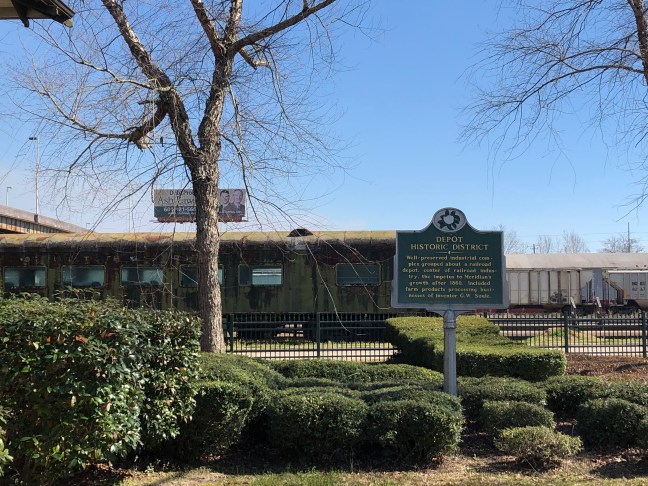
Depot Historic District, Meridian, MS

Union Stations, Meridian, MS

According to the 1907 handbook of Meridian, Mississippi, the city is called the “child of the railroad”. Starting in the 1850s, railroads starting popping up in Meridian. The Mobile and Ohio, and the Southern Railroad of Mississippi formed a junction here. The railroad was so ubiquitous to the city that even native country music star Jimmie Rodgers worked on the railroad in Meridian.

With 5 major rail lines and 44 trains running through the city on a daily basis, Meridian rose to become the largest city in the state in the 20th century. A passenger depot was completed in August 1906. The original depot was demolished in the 1940s. All that remains of the original passenger depot is the eastern wing since the rest was demoed in 1966.

The historic district takes up four city blocks along Front Street. The site is listed on the National Register of Historic Place.

Historical Marker Inscription

Well-preserved industrial complex grouped about a railroad depot, center of railroad industry, the impetus to Meridian’s growth after 1860. Included farm products processing businesses of inventor G.W. Soule.

Location

Union Station, 1901 Front St, Meridian, MS 39301

32° 21.876′ N, 88° 41.737′ W

The Natchez Burning Historical Marker – Mississippi Blues Trail

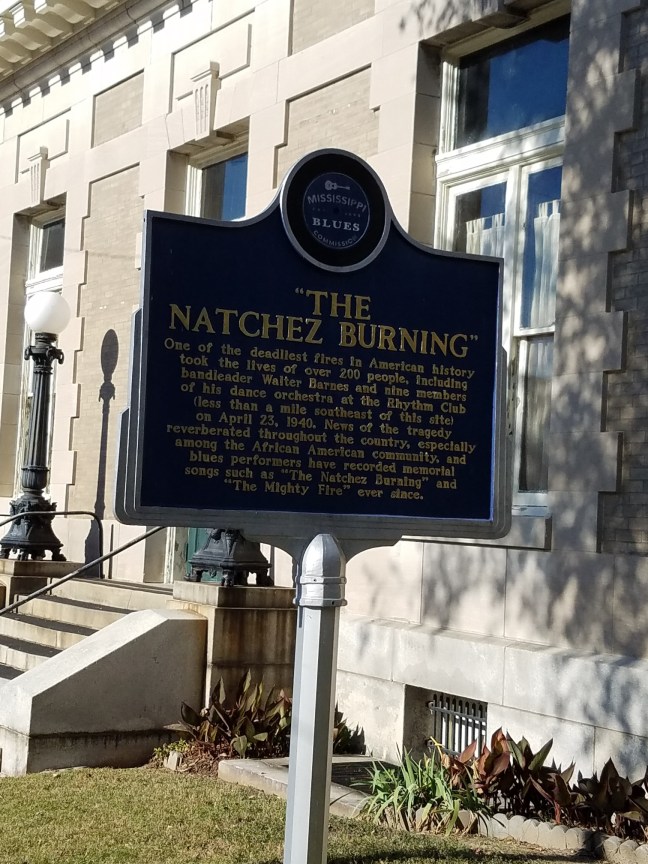
Natchez Burning Historical Marker

The Rhythm Club was a dance hall that was a central part of life for African Americans in Natchez, MS. The Rhythm Club Fire occurred on April 23, 1940, killing 209 people.  All the people who died in the club were African American.

While this has become a case study for firefighters, and it ranks in the top five of deadliest fires, few in the public actually know about the tragedy.

On the night of the fire, band leader Walter Barnes and His Royal Creolians added an additional stop on their tour in Natchez. Since Walter Barnes was extremely popular, the club was packed, with over 700 people paying the cover to hear them.

At some time near midnight, a fire broke out at the club’s entrance. It quickly spread, helped by flammable insecticide that had been put on the Spanish moss.

With boarded-up exits, and the front doors the only way out, the crowd rushed to the front. Since the doors swung inwards, the rush of the crowd prevented the doors from opening. Hundreds were trapped inside with the band still played to try and calm the crowd.

Many who died were teens. Many deaths were caused by asphyxiation or from being scalded to death when the water from the fire hoses came in contact with the corrugated metal, which caused deadly steam. Others were trampled to death as people tried to reach the exit. The rest were burned.

The club owner and Walter Barnes and many of his band members were among the dead.

Historical Marker Inscription

One of the deadliest fires in American history took the lives of over 200 people, including bandleader Walter Barnes and nine members of his dance orchestra at the Rhythm Club (less than a mile southeast of this site) on April 23, 1940. News of the tragedy reverberated throughout the country, especially among the African-American community, and blues performers have recorded memorial songs such as “The Natchez Burning” and “The Mighty Fire” ever since.

Location

Intersection of Main Street and North Wall Street, Downtown, Natchez, Mississippi

N31° 33.651′, W 91° 24.249′

Gainesville Volunteers, Gainesville, MS

Gainesville Volunteers Historical Marker, Gainesville, MS

Located on the Louisiana and Mississippi border is the town of Gainesville, located in Hancock County. In the past, the town was an active port on the Pearl River, but declined during the 1800s. Later in 1962, the land was acquired by NASA and is now home to the Stennis Space Center.

The Gainesville Volunteers served the Confederate States of America during the American Civil War. It was organized in 1860 and served at Vicksburg and Atlanta. It made up the Company G of the Third Mississippi Infantry.

Historical Marker Inscription

GAINESVILLE VOLUNTEERS

In 1860, John Deason, a Mexican War veteran, organized a militia company here. The “Gainesville Volunteers” entered Confederate service in 1861 as Co. G of the Third Mississippi Infantry. During the Civil War, the unit served in the Gulf Coast region and fought in the Vicksburg, Atlanta, Middle Tennessee, and Carolina campaigns.

Location

Mississippi Welcome Center, Interstate 10, Mile Marker 2, Gainesville, MS – Border of Louisiana and Mississippi

30° 18.789′ N, 89° 36.002′ W