Combahee River Raid

Combahee River Raid Historical Marker, Beaufort, South Carolina

Harriet Tubman, famous for her assistance with the Underground Railroad to help slaves from the South travel to the North to freedom, worked with 150 black Union soldiers (members of the 2nd South Carolina Volunteers) to free more than 750 enslaved peopled on June 2, 1863. It became known as the Combahee River Raid. Under the command of Union Colonel James Montgomery, Tubman became the first woman to lead a “major military operation in the United States”.

Slaves along the Combahee River worked with Tubman to ensure that the Union vessels remained safe throughout the voyage. They provided information about the location of rebel torpedoes in the river in exchange for freedom. While the mission did help free many slaves, the main goal was to destroy estates owned by South Carolina secessionists, which they also achieved.

Tubman, often referred to as “the Moses of her people”, was a slave who had fled the South in 1849.

Historical Marker Inscription

Combahee River Raid
On June 1-2, 1863, a Federal Force consisting of elements of the 2nd S.C. Volunteer Infantry (an African- American unit) and the 3rd Rhode Island Artillery conducted a raid up the Confederate-held Combahee River. Col. James Montgomery led the expedition. Harriet Tubman, already famous for her work with the Underground Railroad, accompanied Montgomery on the raid.

(Other Side)

Freedom Along The Combahee
Union gunboats landed 300 soldiers along the river, and one force came ashore here at Combahee Ferry. Soldiers took livestock and supplies and destroyed houses, barns, and rice at nearby plantations. More than 700 enslaved men, women, and children were taken to freedom in perhaps the largest emancipation event in wartime S.C. Some freedmen soon enlisted in the U.S. Army.

Location

999, Charleston Highway, Beaufort County, South Carolina, 29945 United States

32° 39′ 6.94″ N, 80° 41′ 5.85″ W
 

Temple of Sport, Green Pond, SC

Temple of Sport Historical Marker, Green Pond, South Carolina

This site marks the location of a grandiose deer stand that had eight brick columns approximately two feet in diameter at the base. The deer stand stood at the headwaters of the Chehaw River, which attracted many animals to the area.

The structure was built by Colonel Barnard Elliott sometime after approximately 1768. Elliott was the first to read the American Declaration of Independence to the public in South Carolina, which happened on August 5, 1776.

Historical Marker Inscription

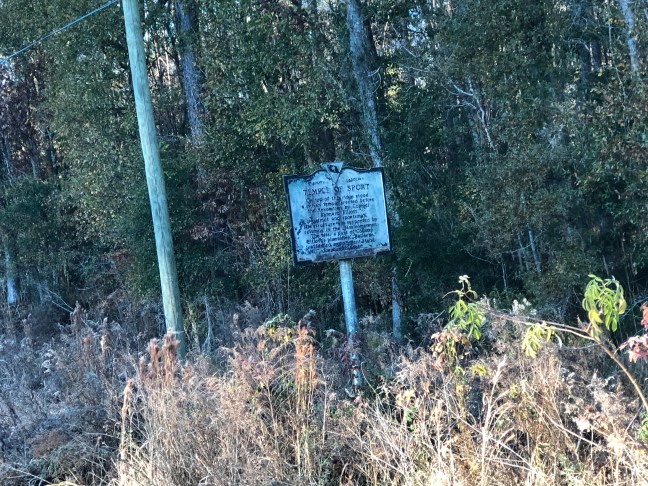
On top of this ridge stood a sylvan temple erected before the Revolution by Colonel Barnard Elliott, patriot and sportsman. The structure was supported by columns in the classic manor. The site, a part of Colonel Elliot’s plantation “Belleview,” afforded an excellent stand for hunting deer.

Location

Ace Basin Parkway, Green Pond, South Carolina, 29446, United States

32° 42′ 30.168″ N, 80° 36′ 41.220″ W

Jenkins Orphanage, North Charleston, SC

Jenkins Orphanage Historical Marker, North Charleston, South Carolina

The Jenkins Orphanage was founded by Rev. Daniel Joseph Jenkins, a former orphan himself, in 1891. The myth around the founding is that Jenkins stumbled upon four homeless boys in a freight car who had no one to care for them. The orphanage, which assisted African American children, was originally located next to the old jail in downtown Charleston until 1937. 

The main claim to fame for the orphanage is the Jenkins Orphanage Band, which was formed to help support the organization. The band played across American and Europe, and became the training ground for many top musicians and helping with the creation of jazz. The orphanage needed money beyond the $1,000 stipend it received from the City of Charleston. Jenkins got donations of instrument and old uniforms from the Citadel. P.M. “Hatsie” Logan and Francis Eugene Mikell were brought in to teach the children. 

The band played for the inaugurations for President Theodore Roosevelt’s in 1905 and President William Howard Taft in 1909. They also had their own stage at the St. Louis World’s Fair in 1904.

Jenkins had up to five bands tour in the summer and two in the winter. Over time, the orphanage became the place to go for Charleston musicians.

After Jenkins death in 1937, the orphanage moved to North Charleston and five dormitories were built. An elementary school was added for the African American children in the area.

Currently, the Jenkins Institute currently takes care of teenage girls ages 11 to 21.

Historical Marker Inscription

Front

Since 1937 this has been the campus of the Jenkins Orphanage, established in Charleston in 1891 by Rev. Daniel Joseph Jenkins (1862-1937). Jenkins, a Baptist minister, founded this orphanage for African American children with aid from the city. Housed in the old Marine Hospital on Franklin Street downtown 1892-1937, it also included an institute to teach and train children between the ages of 3 and 20. More than 500 lived there by 1896.


Jenkins Orphanage Historical Marker, North Charleston, South Carolina

Back

The Jenkins Orphanage Band played concerts across the U.S. and Europe for more than 30 years to help fund the orphanage. The band, taught by Hatsie Logan and Eugene Mikell, is prominent in the early history of jazz; alumni Cat Anderson, Freddie Green, and Jabbo Smith played for Duke Ellington, Count Basie, and others. The orphanage moved here in 1937, and its offices and dorms were built by the City of Charleston. Those historic buildings burned in the 1980s.

Erected 2008 by The Daniel Joseph Jenkins Institute for Children, a program of the Orphan Aid Society, Inc.

Location

Azalea Drive (State Highway 10-894), North Charleston, SC 29405

32° 50.816′ N, 79° 59.788′ W

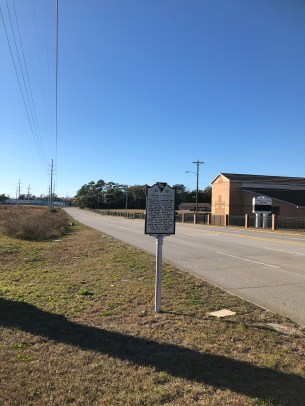
Grave of Colonel William A. Washington

Grave of Colonel William Washington Historical Marker

William Washington was a distant cousin of George Washington. He was an officer of the Continental Army during the American Revolution. Lord Cornwallis even respected Washington, saying after the surrender at Yorktown, “there could be no more formidable antagonist in a charge, at the head of his cavalry, than Colonel William Washington”.

Born on February 28, 1752, he grew up with three brothers and two sisters on the family’s 1,200 acre-Virginia plantation, which had been located in Stafford County. When the Revolution started, he was elected as a Captain of the Stafford County Minutemen on September 12, 1775, which then became part of the Third Virginia Regiment in 1776. By the end of summer, the regiment joined the main army in New York. They were part of the Battle of Trenton on December 26, 1776. Captain Washington led a successful charge against Hessian soldiers.

By 1779, William Washington would become a lieutenant colonel, overseeing the Third Regiment of Continental Light Dragoons. Washington was instrumental throughout the war. In January 17, 1781, he led the charge that routed the British cavalry at the Battle of Cowpens.

On September 8, 1871, Colonel Washington was wounded and captured, and would spend the rest of the war as a prisoner of war in Charleston, SC. There, he would marry Jane Reily Elliott and obtain Sandy Hill Plantation. He became a low country planter. He was also elected as a representative to the South Carolina state assembly from 1787 to 1791, and later as a senator from 1792 to 1794 and 1802 to 1804.

As hostilities heated between the newly formed United States and France in 1798, President John Adams appointed Washington as Brigadier General under General George Washington.

William Washington died on March 16, 1810 after a prolonged illness.

Historical Marker Inscription

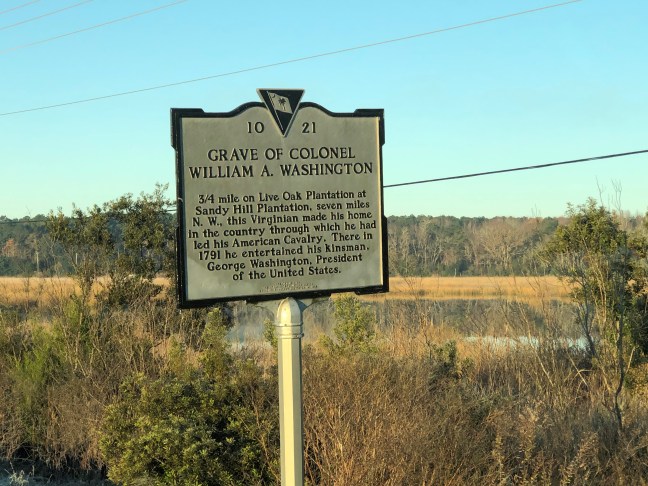
3/4 mile on Live Oak Plantation at Sandy Hill Plantation, seven miles N.W., this Virginian made his home in the country through which he had led his American Cavalry. There in 1791 he entertained his kinsman, George Washington, President of the United States.

Location

Savannah Highway (U.S. 17) near Waldon Road, Johns Island, South Carolina.

32° 47’ 42.972” N, 80° 8’ 10.790” W

Site of St. Andrew’s Hall

St. Andrew's Hall Historical Marker

The St. Andrew’s Society was founded in Charleston, South Carolina, on November 30, 1729. Currently active, it is a social organization founded by men who were mainly of Scottish descent, but membership wasn’t limited to Scottish descendants. The purpose of the organization was to celebrate St. Andrew’s Day.

During the 1700s, the organization was extremely popular, and membership grew to include many of South Carolina’s most prominent people, including lawyers, planters, merchants and more. Through dues, gifts, admissions fees and bequests, it generated a substantial revenue and, through these, provided relief to the poor.

Officially incorporated in 1798, it opened a school for the poor on January 9, 1804, and began constructing its own hall in 1814. The hall was completed in 1815.

Throughout its history, the hall hosted many events, including social activities as well as being the meeting place for the Secession Convention. As the first state to secede from the Union, the Ordinance of Secession was officially passed at St. Andrew’s Hall on December 20, 1860.

The building burned on December 11, 1861, which was part of The Great Fire of 1861. This fire burned throughout Charleston, destroying vast extents of the city.

St. Andrew's Hall Historical Marker

Historical Marker Inscription

Site of the St. Andrew’s Hall
Designed by Hugh Smith
for
the St. Andrew’s Society of Charleston, S.C.
founded in 1729,
the oldest benevolent organization in the
State of South Carolina
corner stone laid July 4, 1814,
building destroyed by fire December 11, 1861.

Here such societies as the South Carolina Jockey Club, the St. Cecilia society, and the Hebrew Benevolent Association also held their meetings: Here President James Monroe and the Marquis de Lafayette were lodged as guest of the city; and here on December 20, 1860, was passed the South Carolina Ordinance of Secession.

Jonathan Jasper Wright Law Office

Jonathan Jasper Wright Law Office Historical Marker

From 1879 until 1885, a two-story stucco building that was built around 1876 served as the law office for Justice Jonathan Jasper Wright. He was the first African American State Supreme Court Justice.

Wright’s parents were slaves that had escaped to Springville, Pennsylvania. Wright was born on February 11, 1840, and studied law at the Lancasterian Academy in Ithaca, New York. In 1866, he passed the Pennsylvania bar exam.

At the end of the Civil War, he first traveled to Beaufort, South Carolina, to teach newly freed slaves. Wright began practicing law in South Carolina in the late 1860s and was elected to the Supreme Court of South Carolina as an Associate Justice in 1870.

He eventually resigned from the court in 1877. He did this in protest of the election of Governor Wade Hampton III in 1877, a campaign that was marked by violence and known for suppressing black votes in parts of the state by Hampton supporters known as “Red Shirts”. This year was also the end of Reconstruction as federal troops were removed from the South, and Jim Crow laws began reversing much of the gains made by African Americans during the previous time period.

In 1879, Wright opened his law office at 84 Queen Street. He died on February 18, 1885 and is buried at the Calvary Episcopal Church cemetery.

Historical Marker Inscription

Jonathan Jasper Wright Law Office Historical Marker

Front:

Jonathan Jasper Wright (1840-1885), the first African American in the U.S. to sit as a justice on a state supreme court, practiced law here from 1877 until his death in 1885. Wright, a native of Pa., was educated at Lancasterian Academy in Ithaca, N.Y. He came to S.C. in 1865 as a teacher for the American Missionary Association and was later a legal advisor to freedman for the Freedmen’s Bureau.

Back:

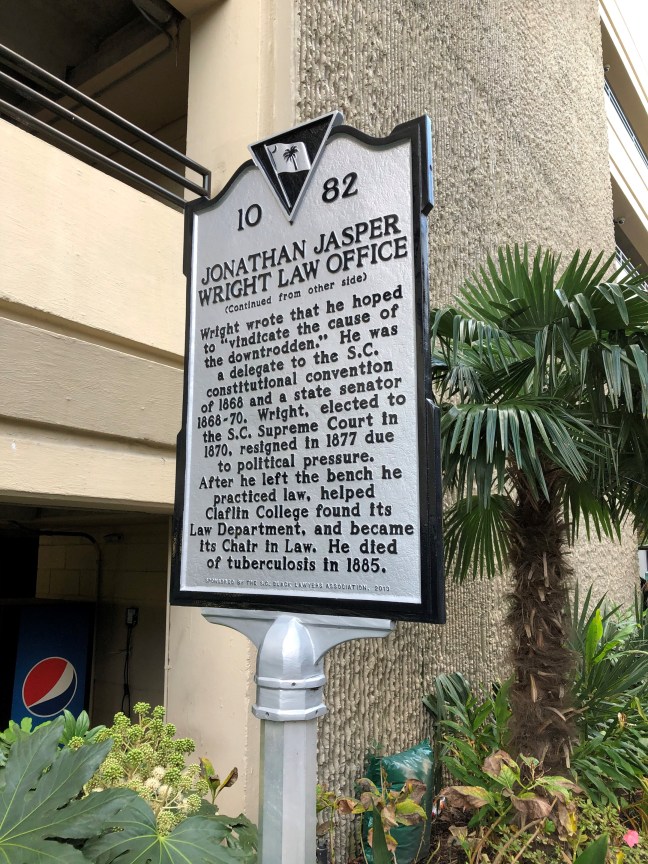
Wright wrote that he hoped to “vindicate the cause of the downtrodden.” He was a delegate to the S.C. constitutional convention of 1868 and a state senator from 1868-70. Wright, elected to the S.C. Supreme Court in 1870, resigned in 1877 due to political pressure. After he left the bench he practiced law, helped Claflin College found its Law Department, and became is Chair in Law. He died or tuberculosis in 1885.

Location:

84 Queen Street, Charleston, SC 29401
32.77817277207629, -79.93254871534323