The Town of Occoquan, whose name means “Head of the Waters” in Native American, is a historic district filled with small shops. The town was founded by Nathaniel Ellicott who built the first bridge here in around 1800.
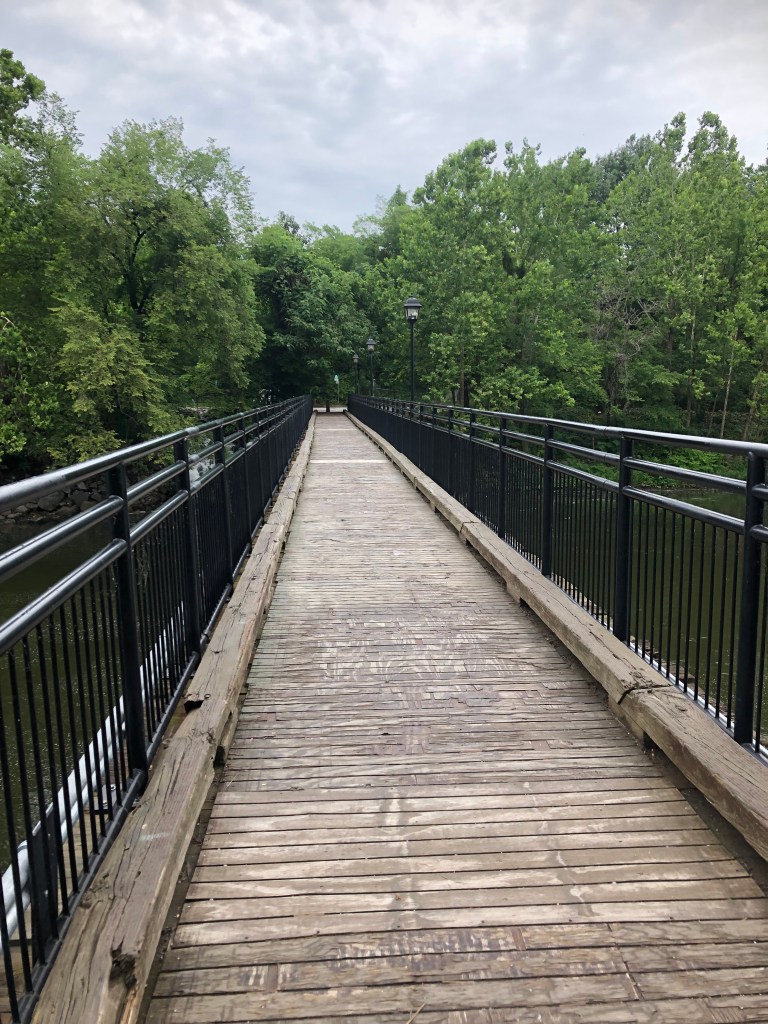
The historical marker marks the bridge located downstream from Occoquan Dam, and it connects Old Ox Road with the small town. The original bridge was destroyed in 1972, and now there is a footbridge here.
Historical Marker Inscription
Occoquan founder Nathaniel Ellicott built the first bridge here c. 1800. The “Great Mail Route” from Washington to the south crossed here. In 1878 an iron Pratt Truss Bridge was erected. This bridge was on the main east coast north-south highway until 1928. Hurricane Agnes destroyed the bridge in 1972. Today’s foot bridge replaced it.
Location
River Mill Park, 458 Mill Street, Occoquan, Virginia, 22125 United States
After the end of the war, he walked back to Northern Virginia so he could reunite with his family and organized the creation of the church.
The original church burned down in 1923. It was rebuilt in 1924.
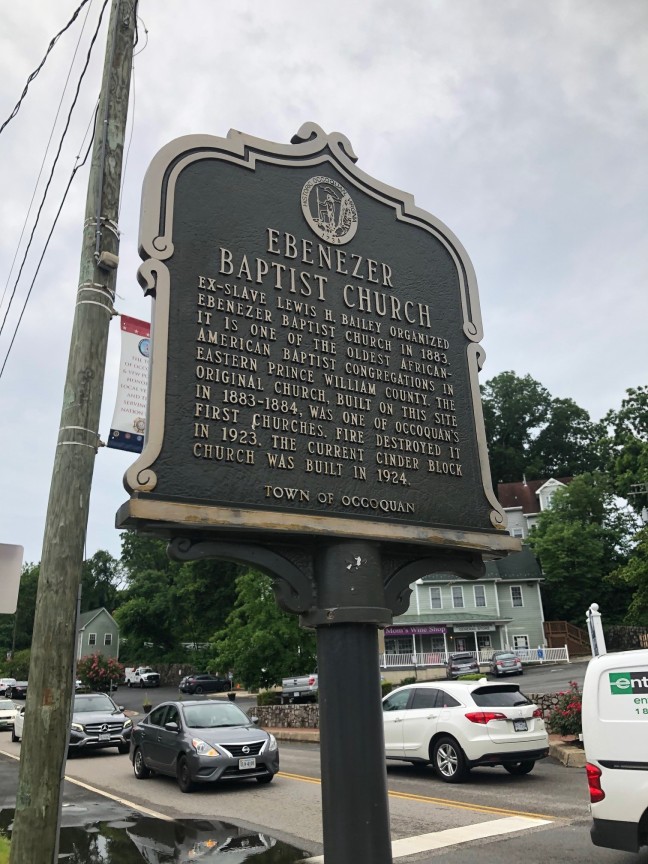
Historical Marker Inscription
Ex-slave Lewis H. Bailey organized Ebenezer Baptist Church in 1883. It is one of the oldest African-American Baptist congregations in Eastern Prince William County. The original church, built on this site in 1883–1884, was one of Occoquan’s first churches. Fire destroyed it in 1923. The current cinder block church was built in 1924.
Town of Occoquan
Location
209 Washington Street, Occoquan, VA, 22125 United States
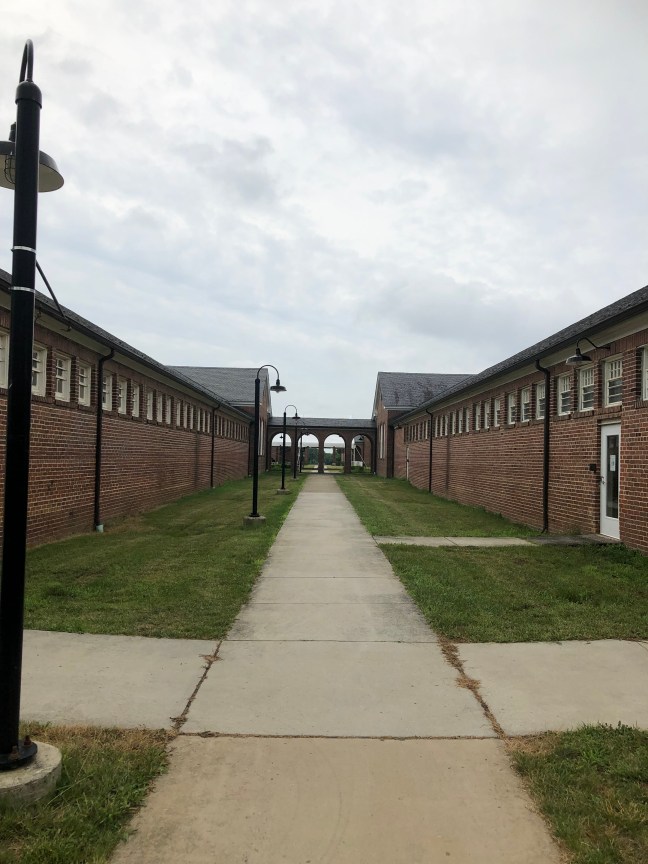
The historical marker commemorates the imprisonment of 70 suffragists during 1917. The women had been peacefully picketing on the White House sidewalk and were known as the Silent Sentinels.
The Washington, D.C., police arrested the women with the charge of obstructing traffic. They were given the choice of paying a $25 fine or going to jail. They refused to pay the fine since they considered it an admission of guilt. So, the women were jailed at the Occoquan Workhouse.
The suffragists were treated poorly at the workhouse, housed in rat-infested cells and given food that had maggots. They were forced to suffer physical and psychological violence.
In the nearby Occoquan Workhouse, from June to December, 1917, scores of women suffragists were imprisoned by the District of Columbia for picketing the White House demanding their right to vote. Their courage and dedication during harsh treatment aroused the nation to hasten the passage and ratification of the 19th Amendment in 1920. The struggle for woman’s suffrage had taken 72 years.
Location
9518 Workhouse Way Lorton, VA 22079 (intersection of Ox Road and Workhouse Way)
The Town of Occoquan is a suburb of Washington, DC, located in Prince William County, Virginia. The name of the town of derived from the Algonquian Doeg Native American’s word for “at the end of the water”. Long before Europeans settled the Americas, the area was used by indigenous people, using the river for transportation and trade.
During the 1600s, Captain John Smith sailed alone the river, exploring the area. By 1734, the town had public warehouses for tobacco, and by 1749, iron furnaces were put in place along the river by Charles Ewell and John Ballendine. The first automated grist mill in the nation (Merchant’s Mill) operated in the area from 1759 to 1924 when it was destroyed by a fire.
In 1804, Town of Occoquan was formally established – located on the 31 acres that was owned by Nathaniel Ellicott, Luke Wheeler and James Campbell. It became an industrial town with the mills, forges, mercantile shops and shipping of railroad ties. During the 1890s, excursion boats from DC would bring tourists to admire the natural beauty of the area. The town, however, had begun to decline as an industrial town by the mid-19th century. Presently, the Occoquan is known as a destination for ghost walks, antiques, art, dining and more.
Bridge over Occoquan River
Historical Marker Inscription
Nathaniel Ellicott formally established the town in 1804. Bringing to fruition industrial and commercial developments. Begun ‘at or near the falls of Occoquan’ by John Ballendine c. 1750 the estuary of the Occoquan has attracted the attention of travelers since the time of John Smith. Adjacent lands were patented by the 1850s; copper was being shipped from ‘King’ Carter’s Landing, and tobacco from a publish warehouse by the 1780s.
Prince William County Historical Commission – 1978


 The historical marker commemorates the imprisonment of 70 suffragists during 1917. The women had been peacefully picketing on the White House sidewalk and were known as the Silent Sentinels.
 Historical Markers of the World