Occoquan River Bridges, Occoquan, Virginia

Occoquan River Bridges Historical Marker, Virginia

The Town of Occoquan, whose name means “Head of the Waters” in Native American, is a historic district filled with small shops. The town was founded by Nathaniel Ellicott who built the first bridge here in around 1800.

The historical marker marks the bridge located downstream from Occoquan Dam, and it connects Old Ox Road with the small town. The original bridge was destroyed in 1972, and now there is a footbridge here.

Historical Marker Inscription

Occoquan founder Nathaniel Ellicott built the first bridge here c. 1800. The “Great Mail Route” from Washington to the south crossed here. In 1878 an iron Pratt Truss Bridge was erected. This bridge was on the main east coast north-south highway until 1928. Hurricane Agnes destroyed the bridge in 1972. Today’s foot bridge replaced it.

Location

River Mill Park, 458 Mill Street, Occoquan, Virginia, 22125 United States

38° 41′ 8.460″ N, 77° 15′ 45.180″ W

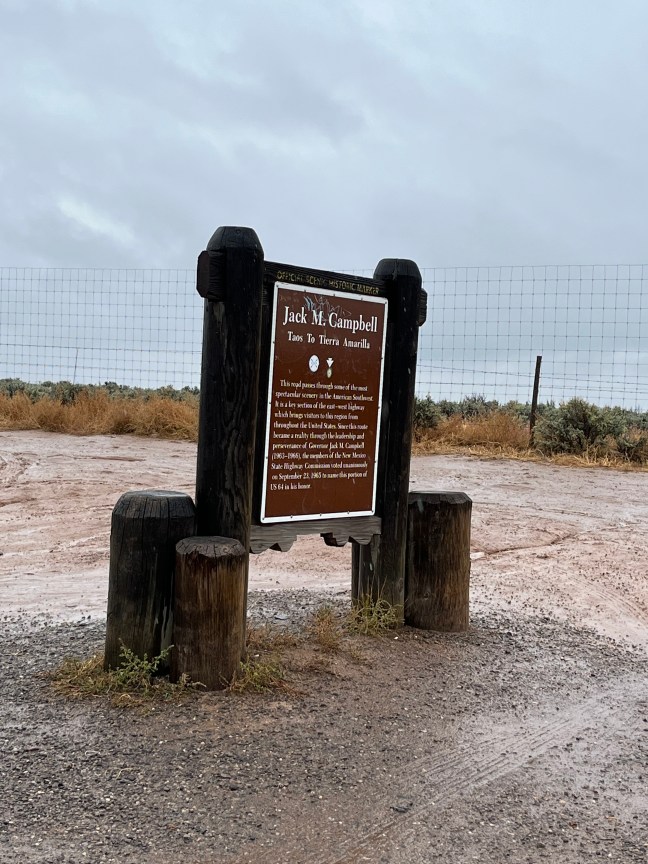
Jack M. Campbell Historical Marker, Taos, NM

Jack M Campbell Historical Marker

Governor Jack M. Campbell was a Democratic governor of New Mexico from 1963 to 1966. He was elected as governor on November 6, 1962, and again in 1964. He was also part of the New Mexico House of Representatives from 1955 to 1962, serving the last two years as speaker.

This stretch of U.S. 64 was named in honor of him by the members of the New Mexico State Highway Commission on September 23, 1965.

Historical Marker Inscription

Taos to Tierra Amarilla

This road passes through some of the most spectacular scenery in the American Southwest. It is a key section of the east – west highway which brings visitors to this region from throughout the United States. Since this route became a reality through the leadership and perseverance of Governor Jack M. Campbell (1963-1966), the members of the New Mexico State Highway Commission voted unanimously on September 23, 1965 to name this portion of U.S. 64 in his honor.

Location

El Prado, New Mexico 87571, United States

36° 30′ 38.400″ N, 105° 39′ 24.642 W

Middleton Place/Arthur Middleton Historical Marker, Summerville, South Carolina

Middleton Place Historical Marker, Summerville, SC

Home to America’s oldest landscaped garden, Middleton Place National Historic Landmark is an historic site that was home to many important people related to the Continental Congress and the Declaration of Independence. Begun in 1741,  the site is 110 acres, and it includes the gardens, house museum, stable yards and more.

One of the residents was Arthur Middleton, who was the son of Henry Middleton, who laid out the gardens. He was a signer of the Declaration of Independence. He helped draft the South Carolina state constitution, and he was also a delegate to the Continental Congress (1776-1777).

During the siege of Charleston during the Revolutionary War, he was taken prisoner by the British in 1780. In July 1781, he was exchanged as a prisoner and became a member of the Continental Congress from 1781 to 1783. He was also part of the South Carolina legislature from 1785 to 1786.

Historical Marker Inscription

Middleton Place

These famous gardens were laid out about 1741 by Henry Middleton (1717-84), President of Continental Congress. His son Arthur, Signer of the Declaration of Independence, lived here as did his son Henry (1770-1846), Governor of S.C. and Minister to Russia, who introduced the camellias. His son Williams (1809-83) planted the first azaleas. The original residence was looted and burned by Federal forces in 1865.

Arthur Middleton Historical Marker, Summerville, SC

(Reverse Side)

Arthur Middleton

Planter, Patriot, Signer of the Declaration of Independence. Born here June 26, 1742, Arthur Middleton, after receiving his education in England, returned to make his home here in 1763. He served in the Commons House of Assembly, the Provincial Congress, the Council of Safety, the Continental Congress, the militia, and the state legislature. He died Jan. 1, 1787, and is buried in the garden here.


Location

Middleton Place Road, Charleston, SC, 29414 United States

32° 54′ 0402″ N, 80° 8′ 24.770″ W

Robinson-Maloney Dantzler House, Biloxi, MS

Robinson-Maloney Dantzler House Historical Marker, Biloxi, MS

Built in 1849 by John Ghamm (J.G.) Robinson, the house was a two-story residence with a  two-tiered gallery. It was a Greek Revival mansion with extensive woodwork and windows, and formal gardens.

J.G. Robinson was an English planter. He was the owner of the house until 1873 when it was sold to Frederick Gaupp. It was bought by the Maloney family in 1884, which owned the house until 1912. It was sold a couple of more times, ending up with the Dantzler family in 1918.

It was later purchased by the Catholic Diocese in 1921, which used the house as the Notre Dame High School for boys and then the Sisters of the Little Flower Convent of Mercy.

The house was damaged during Hurricane Camille in 1969 and destroyed by Hurricane Katrina in 2005.

Historical Marker Inscription

Originally a raised-cottage Greek Revival mansion similar to Beauvoir, the house located here was built ca. 1849 by J. G. Robinson, a wealthy English cotton planter. It was the center of an estate that included a ten-pin bowling alley, billiard hall, bath house, thoroughbred stables, kennels, gardens and a wharf for docking two prized yachts. About 1908 the Maloney family enlarged the house with a second story addition and two-tiered wrap-around porches in the Neo-Classical style. Destroyed by Hurricane Katrina in 2005.

Location

1048 Beach Boulevard, Biloxi, MS 39530 United States

30° 23′ 41.088″ N, 88° 54′ 3.798″ W

Howard’s Lick/Jackson Home Historical Marker, Mathias, WV

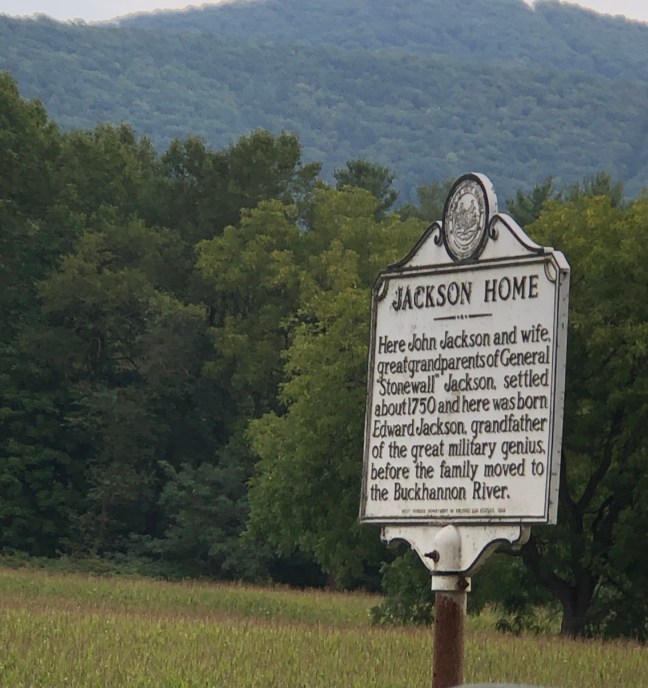
Jackson Home / Howard's Lick Historical Marker, Mathias, WV

This site features two historical markers: Howard’s Lick and Jackson Home.

Currently known as Lee White Sulphur Springs, the first sign refers to what was originally called Howard’s Lick, which is a spring that has become a health resort. The Commonwealth of Virginia gave a portion of the area around the spring to General Henry Lee in 1796, who was a Revolutionary War hero.

When Lee died in 1818, four sons inherited his property, including the property located in Hardy County. Charles Carter Lee eventually took possession of all this land. Charles was the older brother of General Robert E. Lee of American Civil War fame.

The area was also the location of the Jackson home, where John Jackson and his wife lived starting in 1750. These were the great grandparents of another Confederate war general, General Thomas Jonathan “Stonewall” Jackson.

Historical Marker Inscription

Side 1

Howard’s Lick

Howard’s Lick, also known as Lee White Sulphur Springs, was once owned by General Henry “Light Horse Harry” Lee of Revolutionary War fame. It was owned later by Charles Carter Lee, brother of the beloved General Robert E. Lee.

Side 2

Jackson Home

Here John Jackson and wife, great grandparents of General “Stonewall” Jackson, settled about 1750 and here was born Edward Jackson, grandfather of the great military genius before the family moved to Buckhannon River.

Location

13208 WV-259, Mathias, West Virginia 26812, United States

38° 52′ 48.132″ N, 78° 51′ 54.930″ W

Combahee River Raid

Combahee River Raid Historical Marker, Beaufort, South Carolina

Harriet Tubman, famous for her assistance with the Underground Railroad to help slaves from the South travel to the North to freedom, worked with 150 black Union soldiers (members of the 2nd South Carolina Volunteers) to free more than 750 enslaved peopled on June 2, 1863. It became known as the Combahee River Raid. Under the command of Union Colonel James Montgomery, Tubman became the first woman to lead a “major military operation in the United States”.

Slaves along the Combahee River worked with Tubman to ensure that the Union vessels remained safe throughout the voyage. They provided information about the location of rebel torpedoes in the river in exchange for freedom. While the mission did help free many slaves, the main goal was to destroy estates owned by South Carolina secessionists, which they also achieved.

Tubman, often referred to as “the Moses of her people”, was a slave who had fled the South in 1849.

Historical Marker Inscription

Combahee River Raid
On June 1-2, 1863, a Federal Force consisting of elements of the 2nd S.C. Volunteer Infantry (an African- American unit) and the 3rd Rhode Island Artillery conducted a raid up the Confederate-held Combahee River. Col. James Montgomery led the expedition. Harriet Tubman, already famous for her work with the Underground Railroad, accompanied Montgomery on the raid.

(Other Side)

Freedom Along The Combahee
Union gunboats landed 300 soldiers along the river, and one force came ashore here at Combahee Ferry. Soldiers took livestock and supplies and destroyed houses, barns, and rice at nearby plantations. More than 700 enslaved men, women, and children were taken to freedom in perhaps the largest emancipation event in wartime S.C. Some freedmen soon enlisted in the U.S. Army.

Location

999, Charleston Highway, Beaufort County, South Carolina, 29945 United States

32° 39′ 6.94″ N, 80° 41′ 5.85″ W


Temple of Sport, Green Pond, SC

Temple of Sport Historical Marker, Green Pond, South Carolina

This site marks the location of a grandiose deer stand that had eight brick columns approximately two feet in diameter at the base. The deer stand stood at the headwaters of the Chehaw River, which attracted many animals to the area.

The structure was built by Colonel Barnard Elliott sometime after approximately 1768. Elliott was the first to read the American Declaration of Independence to the public in South Carolina, which happened on August 5, 1776.

Historical Marker Inscription

On top of this ridge stood a sylvan temple erected before the Revolution by Colonel Barnard Elliott, patriot and sportsman. The structure was supported by columns in the classic manor. The site, a part of Colonel Elliot’s plantation “Belleview,” afforded an excellent stand for hunting deer.

Location

Ace Basin Parkway, Green Pond, South Carolina, 29446, United States

32° 42′ 30.168″ N, 80° 36′ 41.220″ W

Feliciana Courthouse, Louisiana

Feliciana Courthouse Historical Marker, Louisiana

The Old Feliciana Parish Courthouse was built in 1816 and was placed on the National Register of Historic Places in 1980. It served as the courthouse from 1816 to 1824 when the parishes were split between West Feliciana (Saint Francisville current county seat) and East Feliciana Parish (Clinton current county seat).

Historical Marker Description

(1816-1864)

Jackson became the seat of justice for Feliciana Parish by Act of Legislature, Jan., 1815. Public town square donated by James Ficklin and John Horton. In active use until parish divided into East and West Feliciana in February, 1824.

Location

1734 High Street, Jackson, LA, 70148, United States

30° 50′ 16.680″ N, 91° 12.′ 50.388″ W

Menominee River Historical Marker, Marinette, Wisconsin

Menominee River Historical Marker, Marinette, Wisconsin

Named after the Menominee Indians of Wisconsin, the Menominee River is about 120 miles long and is the border between Wisconsin and Michigan’s Upper Peninsula. It eventually drains into Lake Michigan at Green Bay.

The river is important to the Native American tribe it’s named after, considering there is a creation myth about how their people’s came into existence at the river’s mouth.

It is a destination for fishing, hiking and water activities, and it is crucial for drinking water.

Historical Marker Inscription

This river is named after the Menominees who lived here until they moved to the Wolf River in the 1850’s. The Menominee River served as the main artery of commerce until the 1850’s. Indians and fur traders moved their furs downriver in canoes to a fur trading post on the river run by Marinette, a French Indian woman and her partner, William Farnsworth. The decline of the fur trade in the late 1820’s led Farnsworth to turn to lumbering in 1831.

The Menominee River became one of the most important lumbering rivers in the Upper Great Lakes during the years 1865–1895. Trees cut upstream were floated downriver and sawed into lumber on both sides of the river from this bridge down to the bay. During the summer months the river above this island was choked with logs; below, schooners and barges lay anchored while being loaded with finished lumber before sailing to Chicago. The decline of lumbering started in the 1890’s, with the last log drive in 1917, and the last sawmill in Marinette closing on July 31, 1931.

This highway bridge continues to divide industrial and residential Marinette; downriver, foundries, factories and shipyards have replaced sawmills; upriver, impressive homes of lumbermen’s families remain on Marinette’s Riverside Avenue.

The Menominee River continues to be a vital waterway. Its source is only 12 miles from Lake Superior. The Menominee is formed by the confluence of the Brule and Michigamme Rivers a little over 100 miles upstream. Before the Menominee reaches this island it falls nearly 700 feet. Ten hydroelectric dams (two in Marinette) harness its power and create reservoirs, and four papermills draw on its water in converting wood into a variety of household necessities. Many of its tributaries and parts of the Menominee remain wild and continue to flow untamed.

Location

Stephenson Island Park, 499 Bridge Street, Marinette, WI 54143 United States

45° 6′ 6.820″ N, 87° 37′ 44.940″ W

Boré Plantation – Audubon Park, New Orleans, LA

Bore Plantation - Audubon Park Historical Marker, New Orleans, LA

Audubon Park was the location of the Boré Plantation owned by Étienne de Boré, which started as an indigo plantation, but later converted into sugar cane. The process was assisted by chemist Antoine Morin, who was a free man of color originally from Saint-Domingue. Morin created a process that made sugar granulation possible in 1795.

This process not only assisted the financially struggling Boré, but the entire southern Louisiana region’s sugar industry. Many plantation owners became wealthy, and the domestic slave trade expanded due to the sugar industry and its need for more workers.

Boré was later selected to head the City Government and became the first Mayor of New Orleans, serving from 1803 to 184. He resigned on May 26, 1804. He died on February 1, 1820, and is buried in St. Louis Cemetery No. 1 in New Orleans.

Historical Marker Inscription

This site 1781-1820 plantation of Jean Etienne Boré (1741-1820) First Mayor of N.O. 1803-1804. Here Boré first granulated sugar in 1795. Purchased for park in 1871. Site of World’s Industrial & Cotton Centennial Exposition 1884-1885.

Location

Audubon Zoo, 6500 Magazine Street, New Orleans, LA 70118, United States

29° 55′ 22.158″ N, 90° 7′ 53.650″ W