Blog

Valence Historical Marker, New Orleans, Louisiana

Valence Street Cemetery Historical Marker, New Orleans, LA

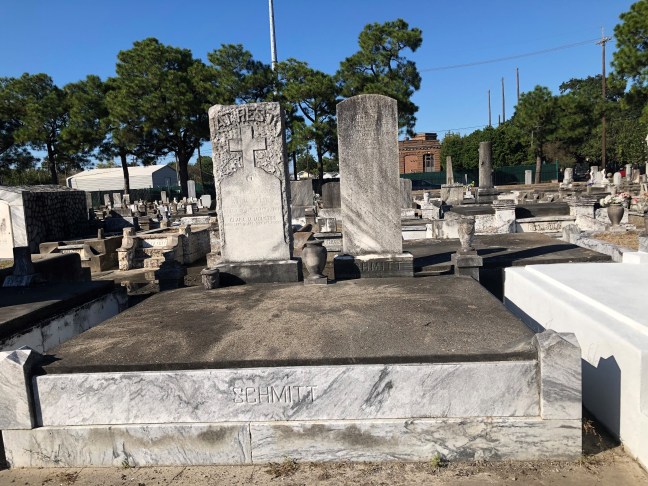
The Valence Cemetery, also known as the Valence Street Cemetery, was established in 1867. It is located on Valence Street between Daneel and S. Saratoga Streets. It served as the municipal cemetery for the City of Jefferson, which was a suburb of New Orleans at the time. This is why it was originally called City Cemetery or Jefferson City Cemetery.

The cemetery is broken up into four squares. It is mainly comprised of below-ground and coping burials. A coping grave has walls that are mainly made of stone, granite, or marble. This seals the coffin from rising water.

In 1870, Jefferson City was annexed into New Orleans (presently it’s the Uptown area). This was when the name of the cemetery was changed to Valence. In the cemetery, there are many society tombs, including St. Anthony of Padua Italian Mutual Benefit Society, the St. Joseph’s Sepulcher of the Male and Female Benevolent Association, and the Ladies and Gentlemen Perseverance Benevolent Association.

Valence Cemetery, New Orleans, LA

Historical Marker Inscription

The Jefferson City Cemetery, later called the Valence St. Cemetery, became a city cemetery in 1870 when Jefferson City was annexed by the City of New Orleans. The cemetery has a number of old society tombs such as the St. Anthony of Padua Italian Mutual Benefit Society, the St. Joseph’s Sepulcher of the Male and Female Benevolent Association, and the Ladies and Gentlemen Perseverance Benevolent Association. German philanthropist John David Fink’s remains were removed from the Girard Street Cemetery when it was demolished, and were buried in this cemetery.

Location

2000–2048 Valence St, New Orleans, LA  70115, United States

29° 55’ 50.202” N, 90° 6’ 21.940” W

Virgin Island, Pierre Part, Louisiana

Virgin Mary Island, Pierre Part, LA Historical Marker

29° 57’ 47.292” N, 91° 12’ 41.790” W

Located near the Atchafalaya Basin, Pierre Part, Louisiana, is located at Pierre Part Bay. It is only three feet above sea level. It is also nearly surrounded by water. During the 1800s, it was actually nearly destroyed by a flood.

But one thing survived. The St. Joseph the Worker Catholic Church sits on a small island. Within the ruins of this church, a statue of the Virgin Mary was found without any damage.

According to reports, in 1902, Father Pillian, a local priest, placed a small statue in a wooden cross on the island. He asked the Virgin Mary to protect the town. The local belief is that if water doesn’t reach the Virgin’s feet, Pierre Part will survive.

Later, the small statue was replaced by a larger one. Worshippers still come to the island to pray.

Pierre Part, Louisiana

Historical Marker Inscription

Commemorates The Blessed Virgin who the people of Pierre Part believe intervened to save lives in natural disasters from 1882-1976. Restored by the citizens during the Bicentennial Year 1976.

Location

3302 LA-70, Pierre Part, LA  70339, United States

East Mississippi Female College, Meridian, MS

East Mississippi Female College, Meridian, MS Historical Marker

The East Mississippi Female College was built in 1869. It was comprised of three buildings: the Main (College) building, the Science Hall and the Conservatory for Music. About a quarter of a mile away was a college for boys. The college was active from 1869 to 1903 when it burned down due to a fire.

Historical Marker Inscription

The East Mississippi Female College was established here in 1869 by the Central Methodist Church and became recognized as one of the finest female colleges in the South under the leadership of John Wesley Beeson, President (1869-1903). The college was destroyed by fire on the morning of February 24, 1903.

Mississippi Department of Archives and History 1995

Location

32° 22’ 4.350” N, 88° 42’ 5.730” W

2300 11th St, Meridian, MS 39301, United States

The Valley of a Thousand Haystacks

The Valley of a Thousand Haystacks Historical Marker, Avon, MT

This historical marker commemorates the beaver slide, a wooden device used for stacking hay. It was originally called the Beaverhead Country Slide Stacker. It was invented in 1908 by two Big Hole Valley (located in Southwest Montana) residents: Dade Stephens and H. Armitage.

The device can stack hay up to 30 feet high, and the piles can last anywhere from 2 to 6 years. The body is a 30-foot wood frame with an inclined plane. Hay is pulled up to about 20 feet in the air before it’s launched through a gap at the top of the machine. The machine is portable so it could be moved from field to field.

While modern technology has largely replaced this device, it’s still in use in many places today.

Historical Marker Inscription

The Little Blackfoot Valley is filled with lush hay fields. You already may have noticed the rounded haystacks and commented on the strange lodgepole structures standing in many of the fields. This contraption that looks like a cross between a catapult and a cage is a hay-stacker that actually acts like a little of both. It was invented before 1910 by Dade Stephens and H. Armitage in the Big Hole Valley about sixty miles south of here. The device, called a beaver slide, revolutionized haying in Montana. It helped keep the wind from blowing the hay away and cut stacking time considerably.

To work the beaver slide, a large rake piled high with hay is run up the arms of the slide (the sloping portion of the “catapult”). At the top the hay dumps onto the stack. The side gates (the cage part) keep the stack in a neat pile and make it possible to stack higher. The sides were added to the system in the late 1940s. Although the lifting of the rake is usually powered by a take-off from a tractor, truck or car axle, on some operations horse teams still provide the rpm’s to muscle the hay up the slide.

Aside from minor improvements, the beaver slide has remained unchanged since its inception. Once used throughout a good portion of the northern west, modern technology that can shape hay into bales, loaves or huge jelly rolls have replaced it in many areas. The Little Blackfoot is one of several valleys in Montana where you can still see the beaver slide and its distinctive haystacks.

Location

46° 35’ 27.780” N, 112° 39’ 25.218” W
US-12, Avon, MT  59713, United States

William Kendrick Square Historical Marker, Greensburg, Louisiana

William Kendrick Square Historical Marker, Louisiana

In 1837, William Kendrick donated the land on which the St. Helena Parish courthouse sits. The modern courthouse was completed in 1938, replacing the original building built in 1855. He was born in 1755 in Granville, North Carolina, but moved to Greensburg, Louisiana.

Kendrick participated in the Revolutionary War and the War of 1812. He was a slave owner in the parish and owned the Kendrick Plantation. He had a total of 14 children.

He stayed in Greensburg until his death in 1838. The location of the courthouse was named after him in 1976.

Historical Marker Inscription

St. Helena Parish seat moved here 1832. Land for Court House Square donated by William Kendrick 1837. Present building completed 1938 replacing brick structure built 1855. Designated William Kendrick Square 1976 by Police Jury.

Location

30° 49’ 45.828” N, 90° 40’ 2.682” W38 S Main St, Greensburg, LA  70441, United States

Osceola Ghost Town Historical Marker, Ely, Nevada

Osceola Historical Marker, Ely, Nevada

The Osceola mine was one of the most successful mining camps in Nevada. In 1872, a 12-mile gold-bearing quartz vein was discovered in the area. The rush didn’t really begin until 1877 when more gold was found in the canyon. But Osceola really didn’t take off until the 1880s when hydraulic mining was used. This type of mining uses water to remove sediment.

Osceola was not the most forgiving place to live. So, miners had to create two 18-mile-long pipelines to haul in water. Yet, the amount of water needed was not provided. Mining had actually started dropping off in the area until a massive gold nugget – valued at $6,000 – was found. This kept people motivated to continue mining until the 20th century.

Three fires hurt the town, but it was a massive fire during the 1940s that wiped out the town. By that point, the town had gone from a high population of 1,500 down to 100.

A few people still live in Osceola, but not many, and there are no services.

Historical Marker Inscription

Osceola

1872-1940

Osceola, most famous of the White Pine County gold producers, was one of the longest-lived placer camps in Nevada.

The gold-bearing quartz belt found in 1872 was 12 miles long by 7 miles wide.  Placer gold was found in 1877 in a deep ravine indenting the area.  Miners first used the simple process of the common 49” rocker.  Hydraulic monitors later were used to mine the gold from the 10’ to 200’ thick gravel beds.  One gold nugget found was valued at $6,000.

Osceola was a good business town because of its location near the cattle and grain ranches and gardens in the Spring and Snake Valleys.

Famous district mines were the Cumberland, Osceola, Crescent and Eagle, Verde, Stem-Winder, Guilded Age, Grandfather Snide, Red Monster, and the Saturday Night.

The camp produced nearly $5 million, primarily in gold, with some silver, lead, and tungsten.

STATE HISTORICAL MARKER NO.  98

STATE HISTORIC PRESERVATION OFFICE

WHITE PINE PUBLIC MUSEUM, INC.

Location

39° 4’ 16.830” N, 114° 26’ 58.482” W

US-6, Ely, NV  89301, United States

Beclabito Dome Historical Marker

Beclabito Dome Historical Marker

Located in the Four Corners area on First Nations Diné (Navajo) Nation Land, the geological dome was created due to volcanic activity. Deep in the earth, extremely hot temperatures liquified the rocks. When they reached the surface, they cooled and hardened again. The hot magma beneath these re-hardened rocks kept pushing to the surface. This created this unique dome.

Historical Marker Inscription

Colorful red rocks of Entrada Sandstone are domed up by deep seated igneous intrusions to be exposed by erosion. The same igneous activity created the Carrizo Mountains to the west. Uranium deposits in the Morrison Formation just above the Entrada created New Mexico’s first uranium boom in the East Carrizo south of here in the 1950’s. Elevation 5,600 feet.

Location

36° 49’ 51.912” N, 109° 0’ 53.090” W498 US-64, Shiprock, NM  87420, United States

Sheldon Union Academy

Sheldon Union Academy Historical Marker, Sheldon, SC

Sheldon Union Academy was founded in 1893. It was a school to teach rural black children living in Sheldon. It was opened after the American Civil War. It operated in the community for nearly 50 years until 1918.

At that time, the school board gave the property to Beaufort County. Since Sheldon Union Academy had been operating as a private school, it was converted to a public school, and a new school was built on the land.

Historical Marker Inscription

Front

Sheldon Union Academy, later Sheldon School, opened in 1893 on this site and educated the black children of rural Sheldon community for almost fifty years. The original Sheldon Union Academy board, which founded and governed the school from 1893 to 1918, included S.T. Beaubien, M.W. Brown, P.R. Chisolm, H.L. Jones, S.W. Ladson, F.S. Mitchell, and N.D. Mitchell.

Back

Sheldon Union Academy, founded by an independent group of community leaders, was a private school until 1918. That year its board deeded the property to Beaufort County, which built a new public school on this site. Sheldon School, which taught grades 1-7, closed in 1942 when the county consolidated its rural black schools.

Location

32° 36’ 11.088” N, 80° 48’ 2.460” W701–737 Trask Pkwy, Seabrook, SC  29940, United States

Greenhill Community/Greenhill Farming

Greenhill Community Historical Marker, Mount Pleasant, SC

Originally called Spark Hill, the location would later be called Greenhill. It was one of several African American communities in the Greater Mount Pleasant area. Freedman Hardy Green bought 30 acres in the area in 1870. Children from the neighboring Old Village community would walk to the town to attend the Laing School. The community was sustained by farming.

Now, the area is a residential community.

Historical Marker Inscription

Greenhill Community

In 1870, freedman Hardy Green purchased 30 acres of land along Mathis Ferry Road. The area was called Spark Hill, but was later named Greenhill by the Moultrie School District. Children walked several miles to Laing School, then in the Old Village of Mount Pleasant. Greenhill received electricity in 1942, paved roads in 1951, and was annexed into Mount Pleasant in 1983.

Greenhill Farming

Farming was the major source of income in Greenhill. People, produce and livestock were carried aboard boats from a dock behind Somerset Point to the Charleston City Market. In the 1920s and ‘30s, mules and wagons transported goods to a ferry at Shem Creek. The LOOP Bus became a major source of transportation in the 1940s. Greenhill continues to thrive as a residential community.

Location

32° 48’ 52.128” N, 79° 52’ 6.900” W

932–940 Mathis Ferry Rd, Mount Pleasant, SC  29464, United States

James Stuart Cain Historical Marker, Bodie, California

James Stuart Cain House Historical Marker, Bodie, California

Bodie ghost town is located in California off Highway 395. The reason that the town still stands today is largely due to James Stuart Cain. Cain moved to Bodie in 1879. He was only 25 but quickly made his fortune by investing in lumber, mining, freighting and banking. He brought lumber across Mono Lake, which helped build the town properties and mines.

Later, he would be the owner of the town bank as well as the Standard Mill. Cain and his family would own most of the town by the time he passed away in 1938. He and his family were dedicated to preserving the town, hiring security to guard it and caretakers to maintain the vacant buildings.

In 1962, the family gave the ghost town to the State of California. It is run by the California Department of Parks and Recreation. It is preserved in a state of “arrested decay” so that it looks exactly the same as it did during its heyday period. It was named a National Historic Landmark in 1961. The state legislature created the Bodie State Historic Park in 1962.

Historical Marker Inscription

Pioneer banker and mining man born in 1854 and moved to Carson City, Nevada, in 1875. Shortly thereafter he and Martha D. Wells of nearby Genoa were married and moved to Bodie where he engaged in lumber, freighting, banking, and mining operations. At one time he owned Mono County’s only bank. In 1938 Mr. Cain passed away at 84 years of age. Through his faith and efforts Bodie remains today.

Dedicated September 12, 1964.

Location

38° 12’ 47.892” N, 119° 0’ 42.430” W

Main St, Bridgeport, CA  93517, United States