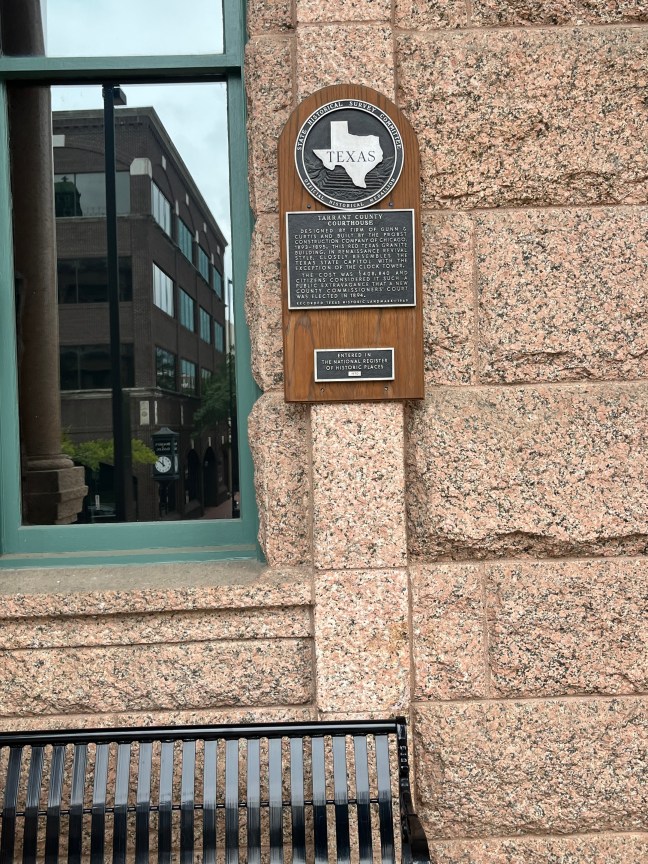
Tarrant County Courthouse Historical Marker, Fort Worth

Tarrant County Courthouse Historical Marker

Since the establishment of Tarrant County, there have been three permanent courthouses. The first burned in 1876. The second was quickly outgrown by the 1890s due to the increasing population of Tarrant County.

In 1893, the County Commissioners voted to provide $500,000 to build a new courthouse. The building was designed by architects Frederick C. Gunn and Louis S. Curtiss, who were based in Kansas City. Probst Construction Co. out of Chicago was the general contractor.
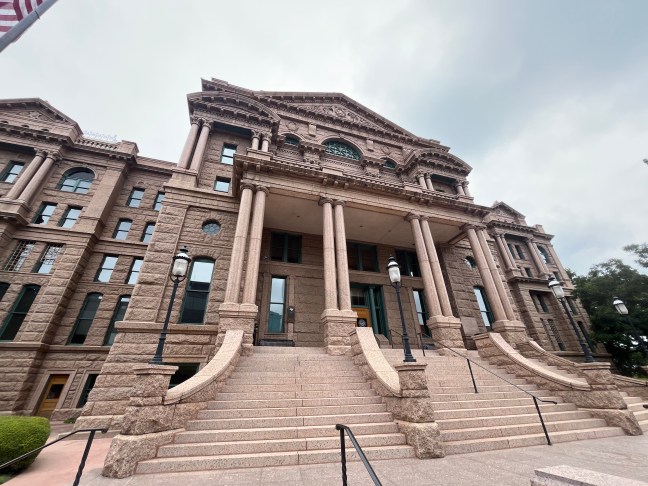
Tarrant County Courthouse, Fort Worth, Texas

The building was built with red Texas granite in the American Beaux Arts Eclecticism style. It was completed in 1895 at a cost of $408,840. Even though this was within the allocated funds, Tarrant County citizens were upset. They voted out all the County Commissioners during the next election.

The building was designated a Recorded Texas Historic Landmark in 1969, listed in the National Register of Historic Places in 1970 and designated a State Archaeological Landmark in 1981.

Historical Marker Inscription

Designed by firm of Gunn & Curtis and built by the Probst Construction Company of Chicago, 1893-1895. This red Texas granite building, in Renaissance Revival style, closely resembles the Texas State Capitol with the exception of the clock tower.

The cost was $408,840 and citizens considered it such a public extravagance that a new County Commissioners’ Court was elected in 1894.

Recorded Texas Historic Landmark – 1969

Entered in the National Register of Historic Places – 1970
Location

32° 45’ 25.998” N, 97° 19’ 58.968” W
100 W Weatherford St, Fort Worth, TX  76196, United States

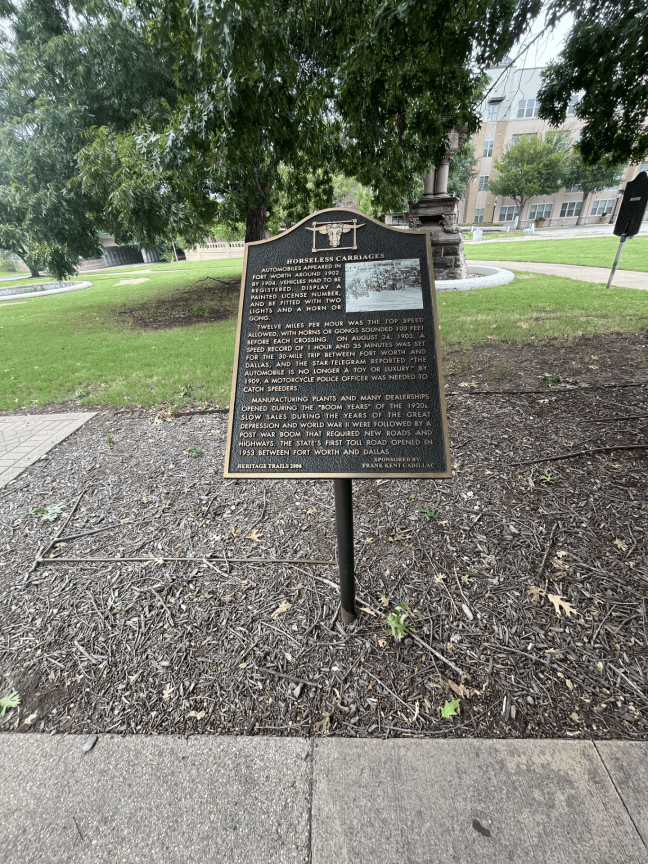
Horseless Carriages Historical Marker, Fort Worth, Texas

32° 45’ 29.178” N, 97° 19’ 57.948” W 186–198 E Belknap St, Fort Worth, TX 76102, United States

Horseless carriages (automobiles) came to Fort Worth sometime between 1900 and 1902. There is debate as to whether the first was driven by Lew Dockstader, a minstrel, or H.R. Cromer, who owned a bike store.

Automobile owners were required to drive at a maximum speed of 12 miles per hour. All cars were required to have a license number painted on the vehicle. They had to have two lights and a horn or gong. And they had to be registered with the government.

Historical Marker Inscription

Automobiles appeared in Fort Worth around 1902. By 1904, vehicles had to be registered, display a painted license number, and be fitted with two lights and a horn or gong.

Twelve miles per hour was the top speed allowed, with horns or gongs sounded 100 feet before each crossing. On August 24, 1903, a speed record of 1 hour and 35 minutes was set for the 30-mile trip between Fort Worth and Dallas, and the Star-Telegram reported “The automobile is no longer a toy or luxury.” By 1909, a motorcycle police officer was needed to catch speeders.

Manufacturing plants and many dealerships opened during the “Boom Years” of the 1920s. Slow sales during the years of the Great Depression and World War II were followed by a post war boom that required new roads and highways. The state’s first toll road opened in 1953 between Fort Worth and Dallas.

Heritage Trails 2006

Sponsored by: Frank Kent Cadillac

Location

32° 45’ 29.178” N, 97° 19’ 57.948” W
186–198 E Belknap St, Fort Worth, TX  76102, United States