Valence Historical Marker, New Orleans, Louisiana

Valence Street Cemetery Historical Marker, New Orleans, LA

The Valence Cemetery, also known as the Valence Street Cemetery, was established in 1867. It is located on Valence Street between Daneel and S. Saratoga Streets. It served as the municipal cemetery for the City of Jefferson, which was a suburb of New Orleans at the time. This is why it was originally called City Cemetery or Jefferson City Cemetery.

The cemetery is broken up into four squares. It is mainly comprised of below-ground and coping burials. A coping grave has walls that are mainly made of stone, granite, or marble. This seals the coffin from rising water.

In 1870, Jefferson City was annexed into New Orleans (presently it’s the Uptown area). This was when the name of the cemetery was changed to Valence. In the cemetery, there are many society tombs, including St. Anthony of Padua Italian Mutual Benefit Society, the St. Joseph’s Sepulcher of the Male and Female Benevolent Association, and the Ladies and Gentlemen Perseverance Benevolent Association.

Valence Cemetery, New Orleans, LA

Historical Marker Inscription

The Jefferson City Cemetery, later called the Valence St. Cemetery, became a city cemetery in 1870 when Jefferson City was annexed by the City of New Orleans. The cemetery has a number of old society tombs such as the St. Anthony of Padua Italian Mutual Benefit Society, the St. Joseph’s Sepulcher of the Male and Female Benevolent Association, and the Ladies and Gentlemen Perseverance Benevolent Association. German philanthropist John David Fink’s remains were removed from the Girard Street Cemetery when it was demolished, and were buried in this cemetery.

Location

2000–2048 Valence St, New Orleans, LA  70115, United States

29° 55’ 50.202” N, 90° 6’ 21.940” W
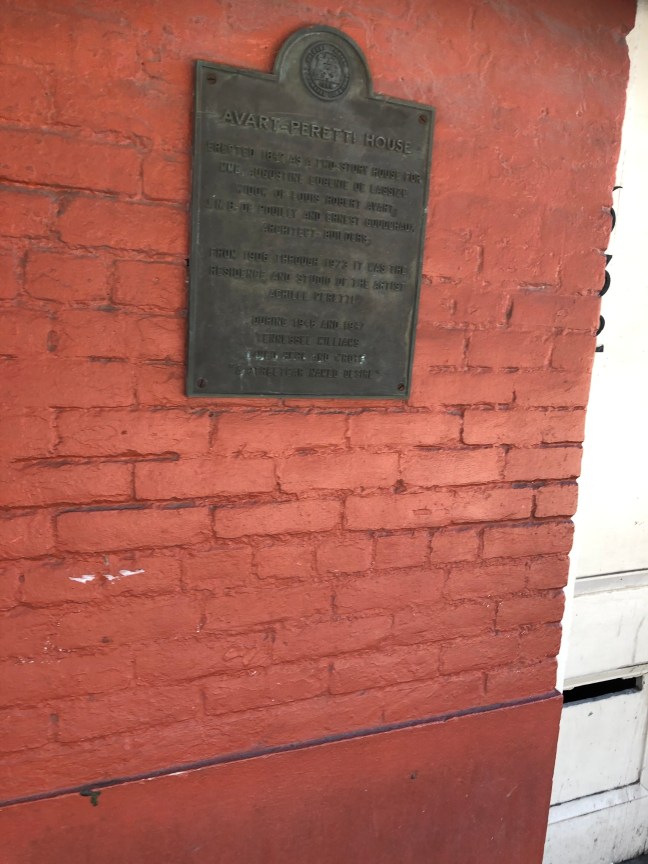
Avart-Peretti House, New Orleans, Louisiana

Avart-Peretti House Historical Marker, New Orleans, Louisiana

While built as a home in 1842 for Mme. Augustine Eugenie de Lassize, the Avart-Peretti House is most known as the location where Tennessee Williams wrote A Streetcar Named Desire. Williams made frequent visits to New Orleans, first coming to the city in 1938. And it was in New Orleans that he renamed himself Tennessee. 

According to reports, the Avart-Peretti House was said to be Williams’s favorite place to stay. In this location, he was close to the Desire streetcar line, and the house was even the inspiration for the fictional home in the play.

The house was also the home of sculptor Achille Peretti from 1906 to 1923. Hailing from Italy, the artist eventually became an American citizen.

The house is currently not open to the public.

Historical Marker Inscription

Erected 1842 as a two-story house for Mme. Augustine Eugenie de Lassize widow of Louis Robert Avart J.N.B. de Pouilly and Ernest Goudchauz architect-builders

From 1906 through 1923 it was the residence and studio of the artist Achille Peretti

During 1946 and 1947 Tennessee Williams lived here and wrote “A Steetcar Named Desire”

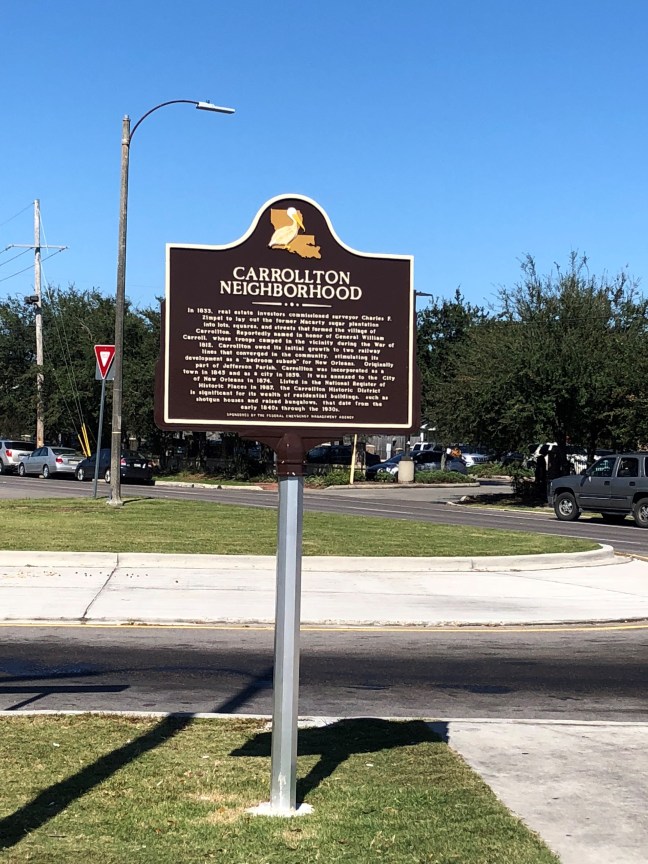
Carrollton Neighborhood Historical Marker, New Orleans

Carrollton Neighborhood Historical Marker, New Orleans

The Carrollton Historic District is approximately two and a half square miles with buildings that date from around 1880 to 1937. The town of Carrollton began on the site of the former Macarty sugar plantation, which was originally located in Jefferson Parish. The property had been acquired by Laurent Millaudon, Samuel Kohn and John Slidell, real estate investors, as well as the New Orleans Canal and Banking Company. The land was subdivided in 1833, and the town of Carrollton was born.

The town was connected to New Orleans via the New Orleans and Carrollton Railroad, which would take passengers between the two areas two hours a day, seven days a week. Later in 1851, the Jefferson and Lake Ponchartrain Railroad was started. The ease of transportation created a real estate boom. The number of houses in the town went from 36 in 1841 to 1,470 within 10 years. People in the middle and upper classes lived in the area.

Incorporated on March 10, 1845, the town of Carrollton eventually became a city on March 17, 1859. It was even the parish seat from 1852 to 1874. It was finally annexed by City of New Orleans in 1874.

Historical Marker Inscription

In 1833, real estate investors commissioned surveyor Charles F. Zimpel to lay out the former Macarty sugar plantation into lots, squares, and streets that formed the village of Carrollton. Reportedly named in honor of General William Carroll, whose troops camped in the vicinity during the War of 1812, Carrollton owed its initial growth to two railway lines that converged in the community, stimulating its development as a “bedroom suburb” for New Orleans. Originally part of Jefferson Parish, Carrollton was incorporated as a town in 1845 and as a city in 1859. It was annexed to the City of New Orleans in 1874. Listed in the National Register of Historic Places in 1987, the Carrollton Historic District is significant for its wealth of residential buildings, such as shotgun houses and raised bungalows, that date from the early 1840s through the 1930s.

Location

Intersection of South Claiborne Avenue and South Carrollton Avenue

29° 57.362′ N, 90° 7.245′ W