Underground Railroad Historical Marker, Sandusky, Ohio

Underground Railroad Historical Marker, Sandusky, OH

Sandusky, Ohio, was active in the Underground Railroad both before and during the Civil War. The Underground Railroad was a network of people who aiding in helping escaped enslaved people get to freedom. These people often provided food, shelter and transportation.

Ohio’s southern river boundary was over 450 miles long, creating an extremely long border between the anti-slavery State of Ohio and slave-holding areas of Virginia and Kentucky. If slaves were able to cross the Ohio River, then they could be funneled to cities like Sandusky or Cleveland, or even escape to Canada since slavery had been outlawed in Great Britain since 1833.

Many of the residents of Sandusky were anti-slavery since a good portion of the people who lived there had come from New England and often sympathized with the slaves. Ohio’s railway lines helped bring freedom-seekers to Sandusky, where they could escape aboard vessels.

Sandusky actually played a major role in Harriet Beecher Stowe’s Uncle Tom’s Cabin since it was many times the final stop to freedom.

Historical Marker Inscription

Many homes in Sandusky and other parts of Erie County were stations on the Underground Railroad before and during the Civil War. Residents provided food, shelter, clothing and transportation to Canada. Harriet Beecher Stowe used Sandusky as the gate to freedom for the run-away slaves in her book “Uncle Tom’s Cabin”.

Location

Jackson Street Pier, 233 West Shoreline Drive, Sandusky, Ohio 44879

41° 27′ 26.562″ N, 82° 42′ 49.020″ W
St. Mary’s German Catholic Parish Historical Marker

St. Mary's German Catholic Parish, Sandusky, OH

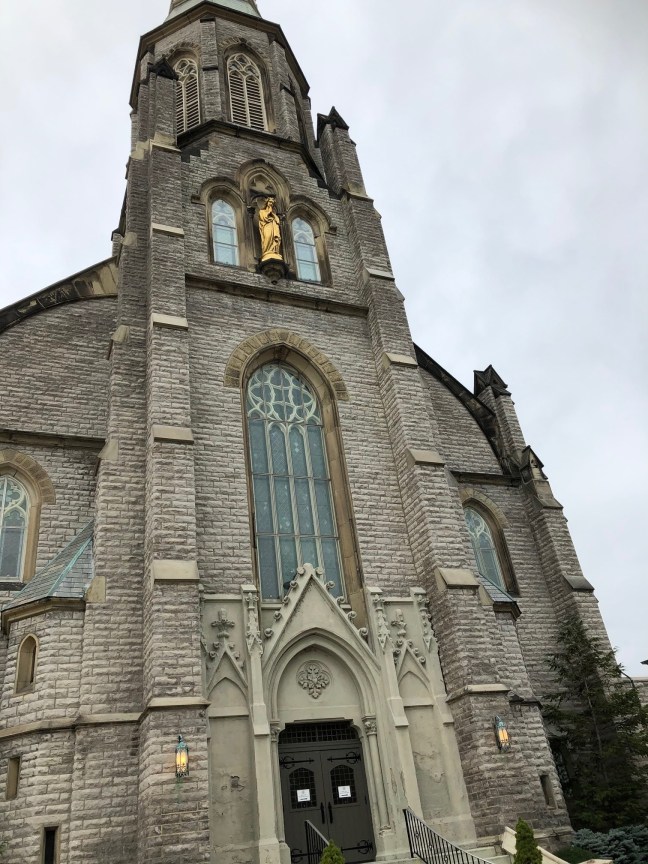
St. Mary’s Catholic Church was founded by German immigrants who had been worshiping at Holy Angels. Holy Angels had been originally comprised of both English and German immigrants, but the German immigrants broke off from the English group to form their own congregation and the second Catholic Parish in Sandusky, OH. The property for the parish was purchased on June 20, 1855. The original church itself was finished in 1856.

Originally, the Germans who had come to America were led by Father John P. Dolweck, who had been appointed by the Right Reverend Louis Amadeus Rappe, Bishop of the Diocese of Cleveland. He was succeeded by Father James J. Hamene. He helped complete the first church and rectory.

By 1857, St. Mary’s also had a school. In 1873, the parish began building a new church under the direction of Father Nicholas Moes, who hired Franz George Himpler to oversee the construction. Seven years later the new church was completed and dedicated to Mary, Mother of Sorrows. It is the largest church in the City of Sandusky.

St. Mary's German Catholic Parish, Sandusky, OH Historical Marker

Historical Marker Inscription

Side A:

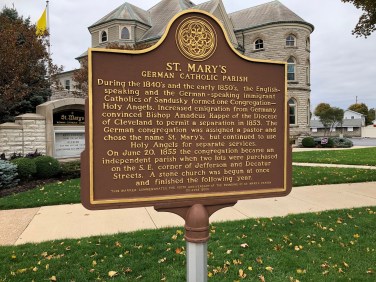
During the 1840’s and the early 1850’s, the English-speak and the German-speaking immigrant Catholics of Sandusky formed on Congregation – Holy Angels. Increased emigration from Germany convinced Bishop Amadeus Rappe of the Diocese of Cleveland to permit a separation in 1853. The German congregation was assigned a pastor and chose the name St. Mary’s, but continued to use Holy Angels for separate services.

On June 20, 1855 the congregation became an independent parish when two lots were purchased on the S.E. corner of Jefferson and Decatur Streets. A stone church was begun at once and finished the following year.

This marker commemorates the 150th anniversary of the founding of St. Mary’s Parish

20 June 2005

St. Mary's German Catholic Parish, Sandusky, OH Historical Marker

Side B:

Architect: Francis George Himpler – 1833-1916

In 1867 six lots on Central Avenue and on Fulton Street were purchased as the site for a new and larger church. The architect based his plans for St. Mary’s on the first pure Gothic ecclesiastical structure in Germany the ELISABETHKIRCHE in Marburg. Begun in 1235 A. D. by the Knights of the Teutonic Order, the church was for centuries a pilgrimage site to the tomb of St. Elizabeth.

The cornerstone for the new St. Mary’s was laid on Sept. 28, 1873. Seven years later it was completed. On Nov. 28, 1880 Bishop Richard Gilmour, D. D. of the Diocese of Cleveland dedicated the church to Mary, the Mother of Sorrows.

The dimensions are: 76 feet wide by 184 feet long.

The spire is 200 feet high.

This marker commemorates the 125th anniversary of the dedication of the church

28 September 2005

Location

429 Central Ave, Sandusky, OH 44870

41.45231960171621, -82.7138909

Old Sandusky Post Office

Old Sandusky Post Office in Ohio

On a corner near the heart of Sandusky, Ohio, a town founded in 1817, sits the old post office. Located on Jackson Street, this imposing Neoclassical structure served as the third post office for the town. The first post office in the town was built in 1820 on Water Street.

While traveling to get mail from the post office was common during the early years, on December 1, 1882, Sandusky began offering free mail delivery. As the needs of the town grew so did the need of a larger post office, which was why the new one was built on the corner of West Washington and Jackson Street between 1925 and 1927. This one took the place of a smaller post office that had been located at Columbus Avenue and Market Street.

Located at the highest point above sea level in Sandusky, this building served as the main post office for 60 years. Besides the post office, the building also housed the National Weather Service, U.S. Customs, FBI and armed forces recruiting.

This location also became too small, and the post office was once again moved to a new space (2220 Caldwell Street) in 1986. Now, the old post office is home to the Merry-Go-Round Museum, which has occupied the space since 1990.

Historical Marker Inscription

Old Sandusky Post Office Historical Marker

The U.S. Post Office building, Sandusky’s third, opened in 1927, replacing the smaller building at Columbus Avenue and Market Street. It is notable for its fine Neoclassical-style architecture and its unusual curved portico. It was added to the National Register of Historical Places in 1982. For sixty years it served as Sandusky’s business center, where merchants shipped and received goods and banks transferred money. During this time it also housed offices for several federal agencies, including U.S. Customs, the National Weather Service, armed forces recruiting, and the Federal Bureau of Investigation. The U.S. Geological Survey disk embedded in the front steps serves as a benchmark for surveyors and scientists. Closed in 1987, the historic Sandusky Post Office building reopened as a museum in 1990.

The Ohio Bicentennial Commission, The Longaberger Company
Huron City Schools
The Merry Go Round Museum
The Ohio Historical Society
2001

Location:
301 Jackson St, Sandusky, OH 44870
41.4539° N, 82.7129° W