Boré Plantation – Audubon Park, New Orleans, LA

Bore Plantation - Audubon Park Historical Marker, New Orleans, LA

Audubon Park was the location of the Boré Plantation owned by Étienne de Boré, which started as an indigo plantation, but later converted into sugar cane. The process was assisted by chemist Antoine Morin, who was a free man of color originally from Saint-Domingue. Morin created a process that made sugar granulation possible in 1795.

This process not only assisted the financially struggling Boré, but the entire southern Louisiana region’s sugar industry. Many plantation owners became wealthy, and the domestic slave trade expanded due to the sugar industry and its need for more workers.

Boré was later selected to head the City Government and became the first Mayor of New Orleans, serving from 1803 to 184. He resigned on May 26, 1804. He died on February 1, 1820, and is buried in St. Louis Cemetery No. 1 in New Orleans.

Historical Marker Inscription

This site 1781-1820 plantation of Jean Etienne Boré (1741-1820) First Mayor of N.O. 1803-1804. Here Boré first granulated sugar in 1795. Purchased for park in 1871. Site of World’s Industrial & Cotton Centennial Exposition 1884-1885.

Location

Audubon Zoo, 6500 Magazine Street, New Orleans, LA 70118, United States

29° 55′ 22.158″ N, 90° 7′ 53.650″ W
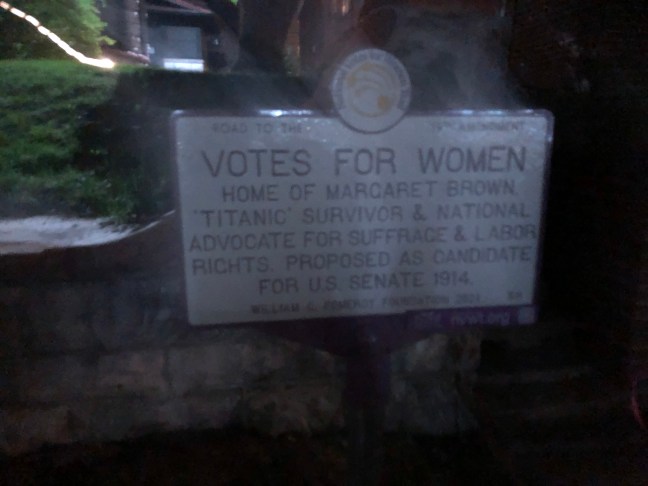
Votes for Women, Molly Brown House, Denver, CO

Votes for Women Historical Marker Denver Colorado

Women received the right to vote in Colorado in 1893. After this momentous occasion, Colorado suffragists strived to get women the right to vote on a national level. A member of this movement was Margaret “Molly” Brown, who became famous because she was a Titanic survivor, the doomed ocean liner that sunk in 1912.

She joined the Congressional Union for Woman Suffrage in 1914 and attended the suffrage convention in Rhode Island. Later, Brown was proposed as a U.S. Senate Candidate by the Congressional Union for Woman Suffrage. She was also involved with different labor issues and was part of the Red Cross in France during World War I.

The marker is part of the National Votes for Women Trail. It sits in front of the Molly Brown House Museum, which was Brown’s old home.

Historical Marker Description

Road to the 19th Amendment

Home of Margaret Brown, ‘Titanic’ survivor & national advocate for Suffrage & Labor Rights. Proposed as candidate for U.S. Senate 1914.

William C. Pomeroy Foundation 2021 58

Location

1320 North Pennsylvania Street, Denver, Colorado 80203, United States

39° 44′ 14.310″ N, 104° 58′ 51.720″ W

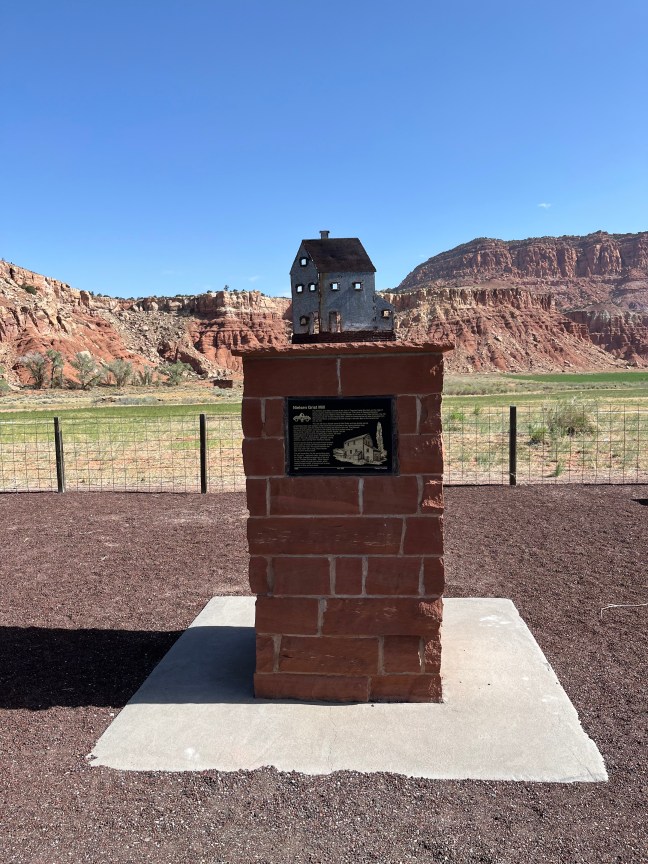
Nielsen Grist Mill Historical Marker, Utah

Nielsen Grist Mill, Teasdale, Utah Historical Marker

Located in Wayne County, Utah, the 120-year-old Nielsen Grist Mill is still standing. It is the only mill left in the state that still has the original water-powered equipment.

Built by Danish miller, Hans Peter Nielsen, in the late 1800s, it was a two and half story mill that operated until 1935. It was destroyed by fire in the late 1800s and rebuilt, and then it was remodeled in 1910.

The mill is currently being restored, and it is located on private property on Highway 24 west of Torrey, heading towards Capitol Reef National Park. It was listed on the National Register of Historic Places in 1975.

Historical Marker Inscription

The Nielsen Grist Mill is located at the foot of Thousand Lake Mountain on the edge of scenic country referred to by ancient Indians as “The Land of Sleeping Rainbow.” Constructed around 1893 for Hans Peter Nielsen by his son-in-law, Niels Hansen, the mill was known as the Thurber Rolling Mills. Water for powering the mill was channeled from the Fremont River and dropped 22 feet through a-wooden pipe to the turbine that ran the mill.

The mill still has a double stand of Wolf Rolls and two double stands of McNalley Rolls with scalpers under each that are spouted to the various elevator legs. Sixteen elevators with five reels for flour milling are found in the mill. The Barnard and Leas dust collector and turbine with belting still have pulleys made of native wood, ready for use. Old models of Howe Scales, one for weighing wheat and one for weighing flour sacks, still exist. All equipment is in good shape, including the cash register. The mill produced flour, germade, shorts, and bran, each coming from individual spouts.

Farmers would receive one sack of flour for each three sacks of wheat. All 48-pound bags of flour were sewn by hand. The space between the ears was sewn with a long, sharp needle with a built-in thread cutter.

The mill made flour for the surrounding area for 40 years. Improved roads, constructed in the 1930s, spelled the beginning of the end for the Thurber Rolling Mills. Since Wayne County could not grow hard wheat, which made the best bread, it became just as easy to truck in flour as hard wheat.

1999 No. 522 Camp Thurber

Location

SR-24, Teasdale, Utah 84773, United States

38° 18′ 25.350″ N, 111° 30′ 28.980″ W

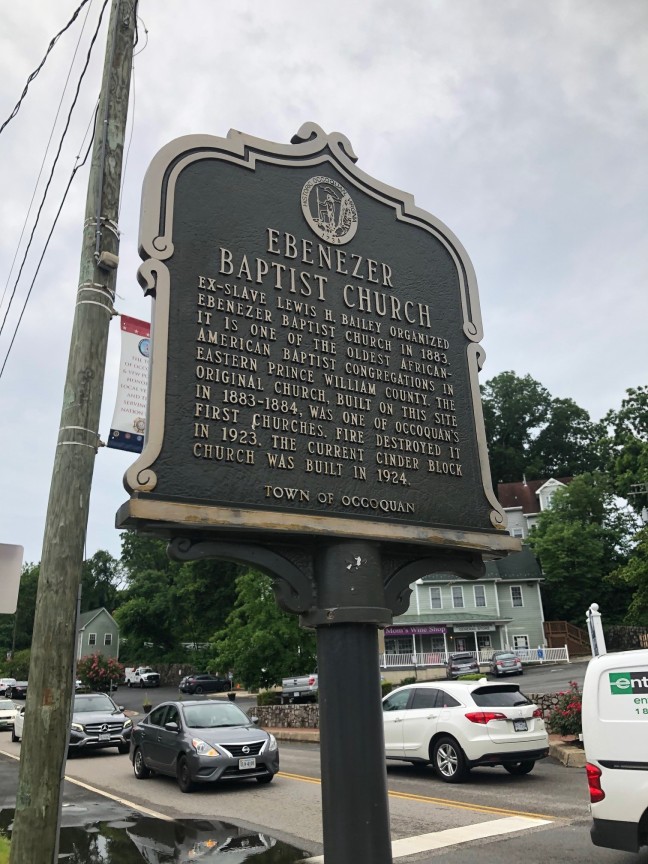
Ebenezer Baptist Church, Occoquan, VA

Ebenezer Baptist Church Historical Marker, Occoquan, VA

Founded by Lewis Bailey in 1883, who was born a slave in Virginia, the Ebenezer Baptist Church is one of the oldest African American Baptist in Eastern Prince William County. Bailey had been separated from his family before the start of the American Civil War. He had been sold to a Texas slave owner.

After the end of the war, he walked back to Northern Virginia so he could reunite with his family and organized the creation of the church.

The original church burned down in 1923. It was rebuilt in 1924.

Historical Marker Inscription

Ex-slave Lewis H. Bailey organized Ebenezer Baptist Church in 1883. It is one of the oldest African-American Baptist congregations in Eastern Prince William County. The original church, built on this site in 1883–1884, was one of Occoquan’s first churches. Fire destroyed it in 1923. The current cinder block church was built in 1924.

Town of Occoquan

Location

209 Washington Street, Occoquan, VA, 22125 United States

38° 40′ 58.260″ N, 77° 15′ 36.642″ W

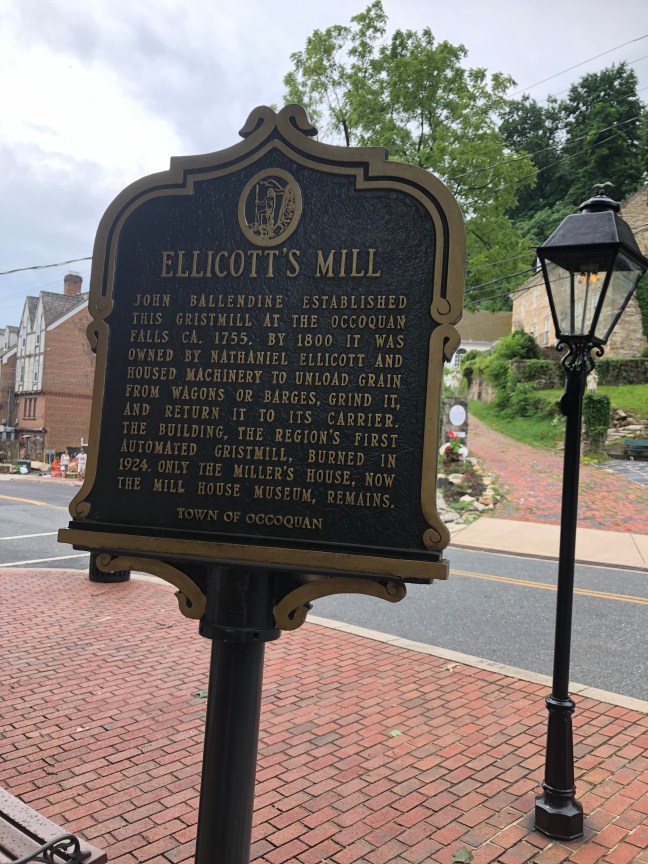
Ellicott’s Mill, Occoquan, Virginia

Ellicott's Mill, Occoquan, Virginia Historical Marker

In 1755, John Ballendine had purchased 20 acres of land in Occoquan Town, and he developed different commercial enterprises, including an iron works. By the end of the 18th century, Nathaniel Ellicott, a Quaker, buys what’s left of the iron works and turns it into a milling operation. It would become the first automated gristmill in the United States.

The mill would remain in operation until 1924. A generator fire in the Occoquan Electric and Power Company resulted in the destruction of the building. The Mill House, which had been connected to the mill, did survive, but it collapsed due to neglect.

The Mill House, however, would be restored in the 20th century, first for office space during the construction of the Occoquan dams and later as a museum. The Town of Occoquan owns the Mill House, and it is leased to the Occoquan Historical Society who runs the museum.

Historical Marker Inscription

John Ballendine established this gristmill at the Occoquan Falls ca. 1755. By 1800 it was owned by Nathaniel Ellicott and housed machinery to unload grain from wagons or barges, grind it, and return it to its carrier. The building, the region’s first automated gristmill, burned in 1924. Only the Miller’s House, now the Mill House Museum, remains.

Town of Occoquan

Location

River Mill Park, 458 Mill Street, Occoquan, VA, 22125 United States

38° 41′ 7.692″ N, 77° 15′ 43.842″ W

Tullis-Toledano House Historical Marker, Mississippi

Tullis-Toledano House Historical Marker, Biloxi, MS

The Tullis-Toledano Manor was once listed on the U.S. National Register of Historic Places. It was built around 1856 and was a red-clay brick Greek Revival home. The property also went by the name Toledano-Philbrick-Tullis House.

The property was built by Christoval Sebastian Toledano, who was a wealthy sugar and cotton broker in New Orleans of Spanish descent. The house was built as a vacation property for his second wife, Matilda Pradat. The property also included a servant’s quarter.

Matilda Toledano sold the home in 1886. It was sold a number of times before Garner H. Tullis of New Orleans bought it in 1939. Tullis was president of the New Orleans Cotton Exchange. He later sold the manor to the City of Biloxi in 1975 who used it as a museum and community center.

In 1969, the home had been damaged by Hurricane Camille. It was destroyed by Hurricane Katrina on August 29, 2005 when a barge was pushed ashore and reduced the property to rubble.

Historical Marker Inscription

One of the most substantial of the early vacation houses on the Gulf Coast, the Tullis-Toledano House was built in 1856 for New Orleans native Christoval Sebastian Toledano (1789-1869) and his wife, Matilda Pradat Toledano. The estate, composed of a Creole-influenced Greek Revival house, detached kitchen, servants quarters, and carriage house, was purchased by the Tullis family in 1939. Damaged during Hurricane Camille and later restored, the house was destroyed by Hurricane Katrina in 2005.

Mississippi Department of Archives and History, 2013

Location

30° 23′ 33.780″ N, 88° 52′ 10.002″ W

Beach Boulevard, Biloxi, MS 39530 United States

Lime Creek Burn 1879

Lime Creek Burn 1879 Historical Marker, Colorado

The Lime Creek fire burned 26,000 acres in 1879, which was a major drought year. The fire burned an area of the San Juan Mountains between Molas Pass and Coal Creek Pass, located along U.S. 550. The Ute Native Americans were blamed for the fire, which they supposedly lit for being pushed out of Colorado.

Since the area had been a drought, there were other fires that year. According to records, 1879 had less than half of the normal annual rainfall of the year, making it one of the driest years on record.

Historical Marker Inscription

This man-caused forest fire burned 26,000 acres consuming approximately 150,000,000 board-feet of timber. Reforestation by direct seeding and planting of seedling trees was started in 1911 and continues today.

The project was financed by federal funds and contributions from the conservation-minded Colorado Federation of Women’s Clubs.

Location

U.S. 550, CO 81433 United States (near the Post Office)

37° 42′ 54.960″ N, 107° 45′ 16.920″ W


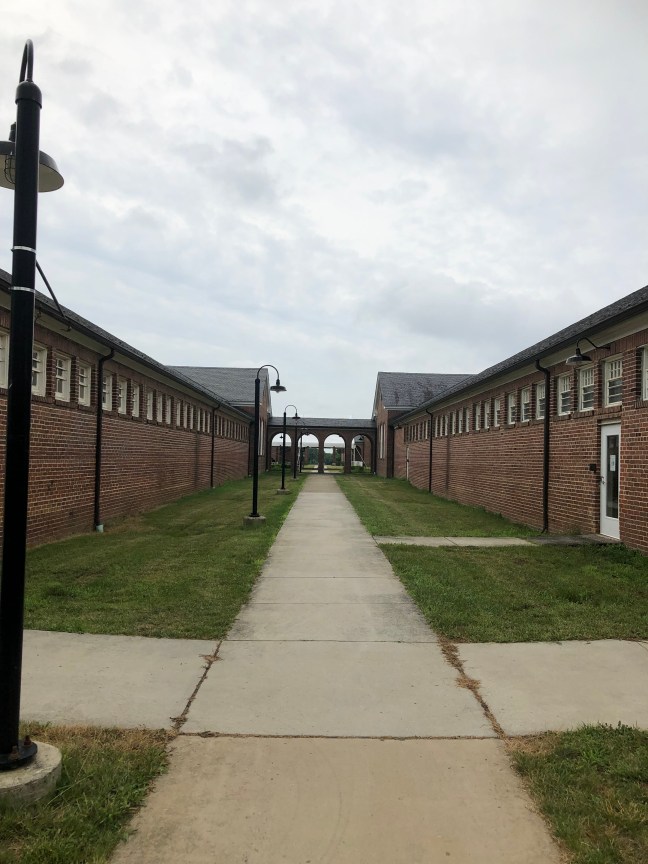
Occoquan Workhouse, Lorton, Virginia

Workhouse Arts Center Lorton, VA

Occoquan Workhouse Historical Marker, Lorton, VAThe historical marker commemorates the imprisonment of 70 suffragists during 1917. The women had been peacefully picketing on the White House sidewalk and were known as the Silent Sentinels.
The Washington, D.C., police arrested the women with the charge of obstructing traffic. They were given the choice of paying a $25 fine or going to jail. They refused to pay the fine since they considered it an admission of guilt. So, the women were jailed at the Occoquan Workhouse.

The suffragists were treated poorly at the workhouse, housed in rat-infested cells and given food that had maggots. They were forced to suffer physical and psychological violence.

On November 14, 1917, the superintendent of the workhouse told the guards that they could beat the suffragists. Then on November 15, 1917, 20 women were subject to severe assaults and torture. These included activists Lucy Burns and Dorothy Day. Many of the prisoners suffered severe repercussions. Alice Cosu had a heart attacked, and Dora Lewis was knocked unconscious.

Due to the brutality suffered, many consider this the turning point of the suffragist movement.

Historical Marker Inscription

In the nearby Occoquan Workhouse, from June to December, 1917, scores of women suffragists were imprisoned by the District of Columbia for picketing the White House demanding their right to vote. Their courage and dedication during harsh treatment aroused the nation to hasten the passage and ratification of the 19th Amendment in 1920. The struggle for woman’s suffrage had taken 72 years.

Location

9518 Workhouse Way Lorton, VA 22079 (intersection of Ox Road and Workhouse Way)

38° 41.839′ N, 77° 15.365′ W

Dobbin House, Gettysburg, Pennsylvania

Dobbin House, Gettysburg, PA Historical Marker

Reverend Alexander Dobbin purchased 300 acres within Gettysburg and the surrounding areas in 1774. Dobbin was a Scots-Irish Presbyterian minister and educator. He became one of the most influential people in Gettysburg at the time.

Dobbin built the house in 1776 as both a house and a Classical School. The school taught a combination liberal arts and theology. It later became a part of the Underground Railroad for runaway slaves. It also was a hospital for Confederate and Union soldiers after the Battle of Gettysburg during the American Civil War.

It is the oldest structure in Gettysburg. The house is now a restaurant and tavern that is listed on the National Register of Historic Places.

Historical Marker Inscription

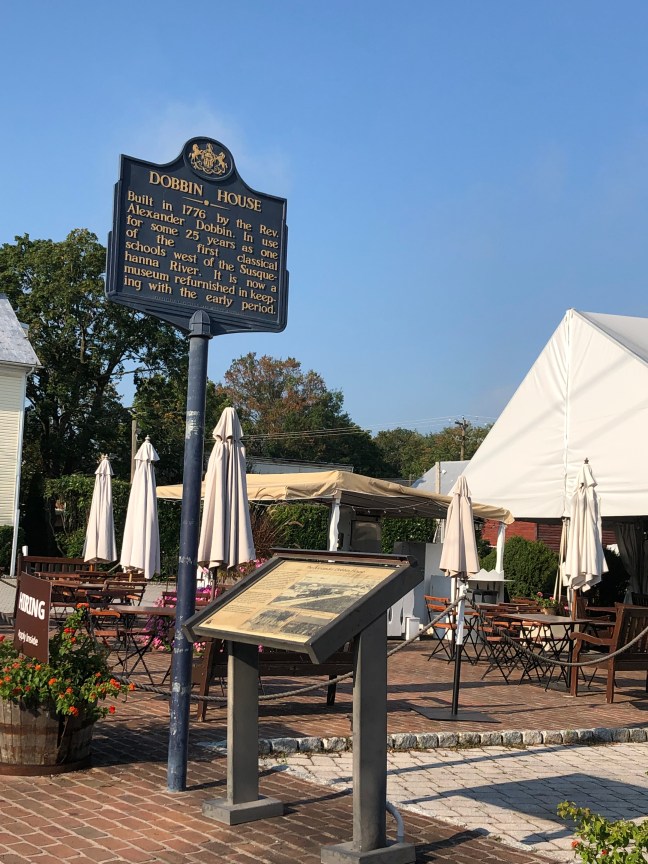
Built in 1776 by the Rev. Alexander Dobbin. In use for some 25 years as one of the first classical schools west of the Susquehanna River. It is now a museum refurnished in keeping with the early period.

Location

89 Steinwehr Ave, Gettysburg, PA 17325

39° 49.352′ N, 77° 13.951′ W


The Opelousas Post Militia of 1779, Opelousas, Louisiana

The Opelousas Post Militia of 1779 Historical Marker

This marker recognizes the contribution of the volunteer Opelousas citizen militia. During 1779, the militia took action in Baton Rouge against the British. The Opelousas militia marched across swamps and marshes to eventually join the Spanish Governor, General Bernardo de Galvez. The goal was to defend Baton Rouge and to keep the British from controlling the lower Mississippi River, especially the area between Natchez and New Orleans.

The militia left Fort Hamilton in the east of Opelousas in groups, heading towards Baton Rouge. They had to content with everything from snakes to alligators to the marshy areas.

Many of the last names of the members would be familiar with anyone from Louisiana, especially St. Landry Parish. These include Bertrand, Brignac, Dupre, Lafleur, Prudhomme, Richard, Trahan and more.

Historical Marker Inscription

In late August of 1779, men of the Opelousas Post Militia left from this place to join other militia units to attack British forces in the lower Mississippi Valley. They crossed the Atchafalaya swamp to join Brig. General Bernardo de Gálvez, the Governor of the Spanish province of Louisiana. The O.P.M. met him at Fort San Gabriel a few miles below present-day Baton Rouge. Total forces under Gálvez numbered 175 Spanish army veterans, 330 Spanish recruits, 80 free men of color, 160 Choctaws, plus about 600 men from various militias along the Mississippi River and from throughout the far-flung posts of civilization in Louisiana. On September 22, 1779, Gálvez’s effective forces, numbering less than 900, laid siege to and captured Ft. New Richmond at Baton Rouge. This victory forced the surrender of Ft. Panmure at Natchez, British headquarters in the lower Mississippi Valley. This generally unknown military action in American history in which the Opelousas Post Militia took part greatly aided in the winning of the American Revolution of 1775-1783.

Location

Le Vieux Village, 828 East Landry Highway, Opelousas LA 70570, United States

30° 31.906′ N, 92° 4.432′ W