William Washington was a distant cousin of George Washington. He was an officer of the Continental Army during the American Revolution. Lord Cornwallis even respected Washington, saying after the surrender at Yorktown, “there could be no more formidable antagonist in a charge, at the head of his cavalry, than Colonel William Washington”.
Born on February 28, 1752, he grew up with three brothers and two sisters on the family’s 1,200 acre-Virginia plantation, which had been located in Stafford County. When the Revolution started, he was elected as a Captain of the Stafford County Minutemen on September 12, 1775, which then became part of the Third Virginia Regiment in 1776. By the end of summer, the regiment joined the main army in New York. They were part of the Battle of Trenton on December 26, 1776. Captain Washington led a successful charge against Hessian soldiers.
By 1779, William Washington would become a lieutenant colonel, overseeing the Third Regiment of Continental Light Dragoons. Washington was instrumental throughout the war. In January 17, 1781, he led the charge that routed the British cavalry at the Battle of Cowpens.
On September 8, 1871, Colonel Washington was wounded and captured, and would spend the rest of the war as a prisoner of war in Charleston, SC. There, he would marry Jane Reily Elliott and obtain Sandy Hill Plantation. He became a low country planter. He was also elected as a representative to the South Carolina state assembly from 1787 to 1791, and later as a senator from 1792 to 1794 and 1802 to 1804.
William Washington died on March 16, 1810 after a prolonged illness.
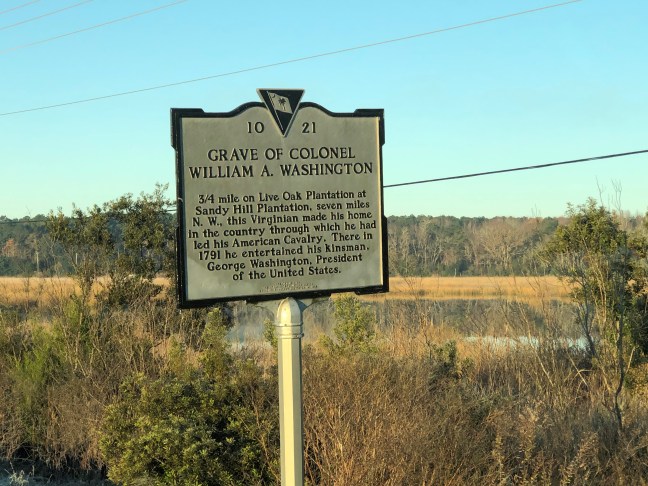
Historical Marker Inscription
3/4 mile on Live Oak Plantation at Sandy Hill Plantation, seven miles N.W., this Virginian made his home in the country through which he had led his American Cavalry. There in 1791 he entertained his kinsman, George Washington, President of the United States.
Location
Savannah Highway (U.S. 17) near Waldon Road, Johns Island, South Carolina.
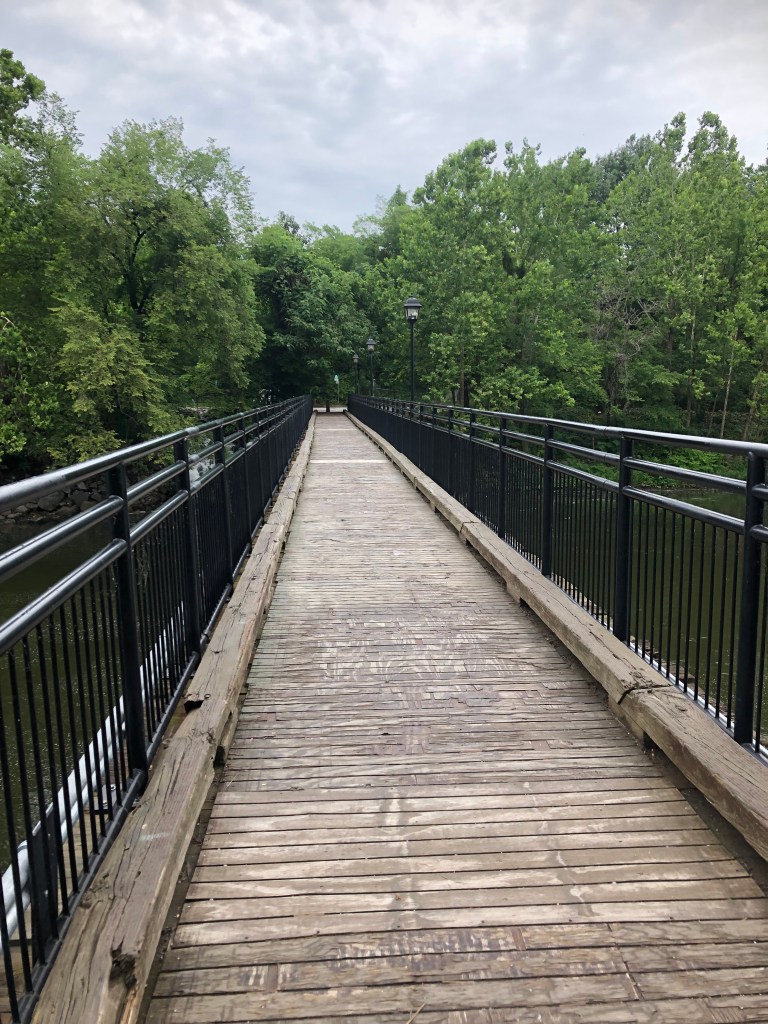
The Town of Occoquan is a suburb of Washington, DC, located in Prince William County, Virginia. The name of the town of derived from the Algonquian Doeg Native American’s word for “at the end of the water”. Long before Europeans settled the Americas, the area was used by indigenous people, using the river for transportation and trade.
During the 1600s, Captain John Smith sailed alone the river, exploring the area. By 1734, the town had public warehouses for tobacco, and by 1749, iron furnaces were put in place along the river by Charles Ewell and John Ballendine. The first automated grist mill in the nation (Merchant’s Mill) operated in the area from 1759 to 1924 when it was destroyed by a fire.
In 1804, Town of Occoquan was formally established – located on the 31 acres that was owned by Nathaniel Ellicott, Luke Wheeler and James Campbell. It became an industrial town with the mills, forges, mercantile shops and shipping of railroad ties. During the 1890s, excursion boats from DC would bring tourists to admire the natural beauty of the area. The town, however, had begun to decline as an industrial town by the mid-19th century. Presently, the Occoquan is known as a destination for ghost walks, antiques, art, dining and more.
Bridge over Occoquan River
Historical Marker Inscription
Nathaniel Ellicott formally established the town in 1804. Bringing to fruition industrial and commercial developments. Begun ‘at or near the falls of Occoquan’ by John Ballendine c. 1750 the estuary of the Occoquan has attracted the attention of travelers since the time of John Smith. Adjacent lands were patented by the 1850s; copper was being shipped from ‘King’ Carter’s Landing, and tobacco from a publish warehouse by the 1780s.
Prince William County Historical Commission – 1978
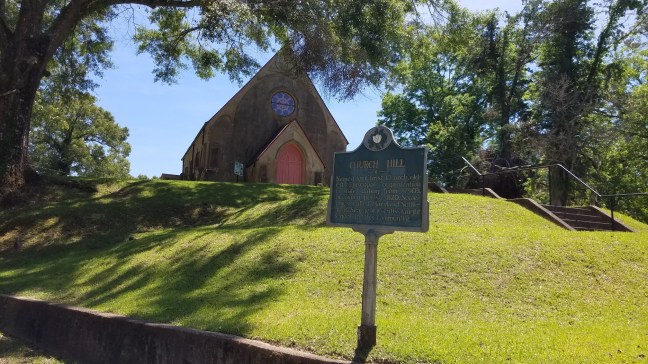
Church Hill, Mississippi, is named after Christ Church, which sits on a hill. The church was built around 1820 and is designed after county church buildings in England. It is located about 18 miles north of Natchez.
During the height of the cotton boom, the area was home to many wealthy cotton planters before the Civil War. During the 1800s, however, soil erosion caused the decline. Antebellum plantations still lie along Highway 553.
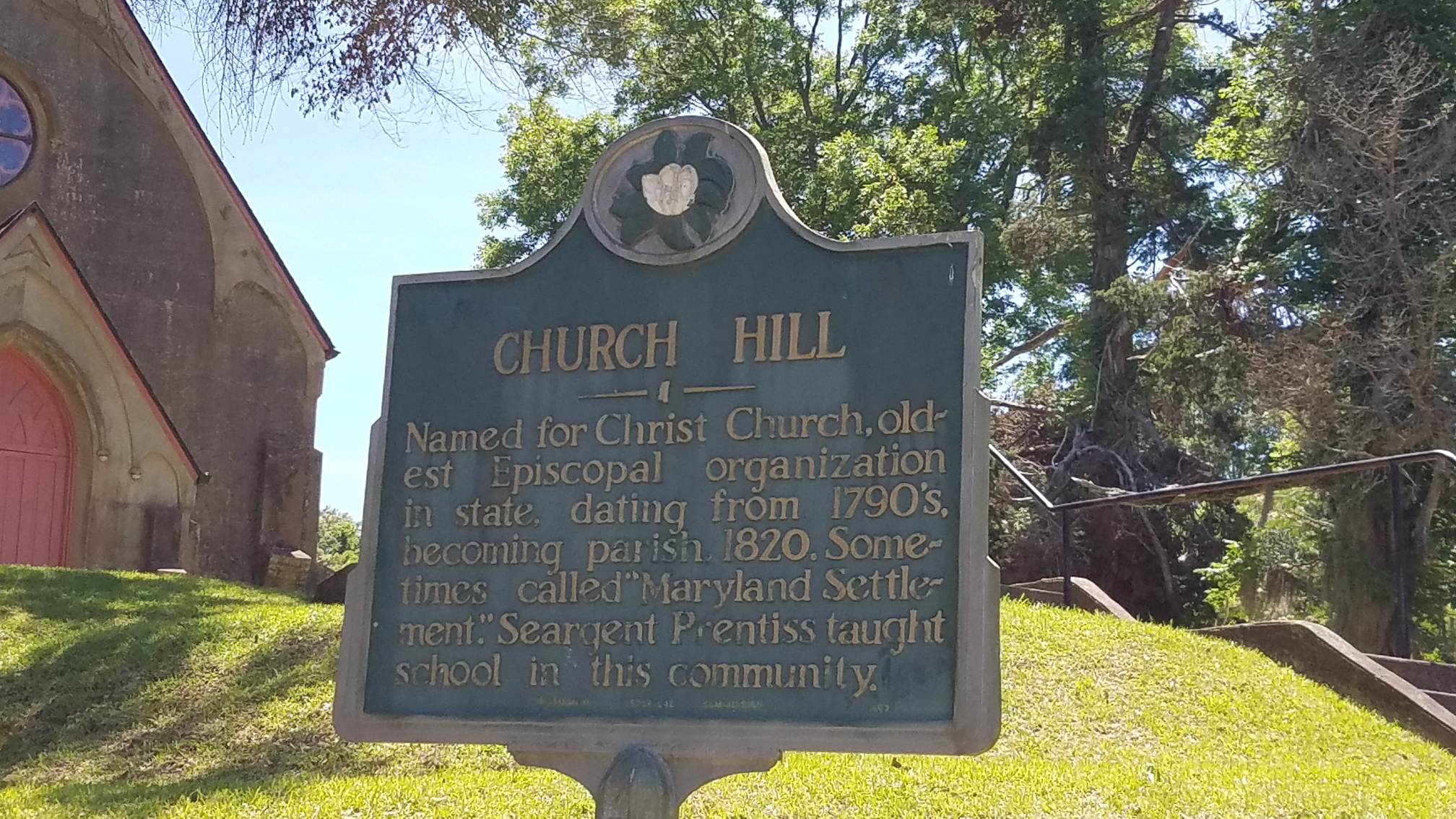
Named for Christ Church, oldest Episcopal organization in state, dating from 1790s, becoming parish, 1820. Sometimes called “Maryland Settlement.” Seargent Prentiss taught school in this community.
Location
Intersection of State Highway 535 and Church Hill Road, Church Hill, Mississippi, USA
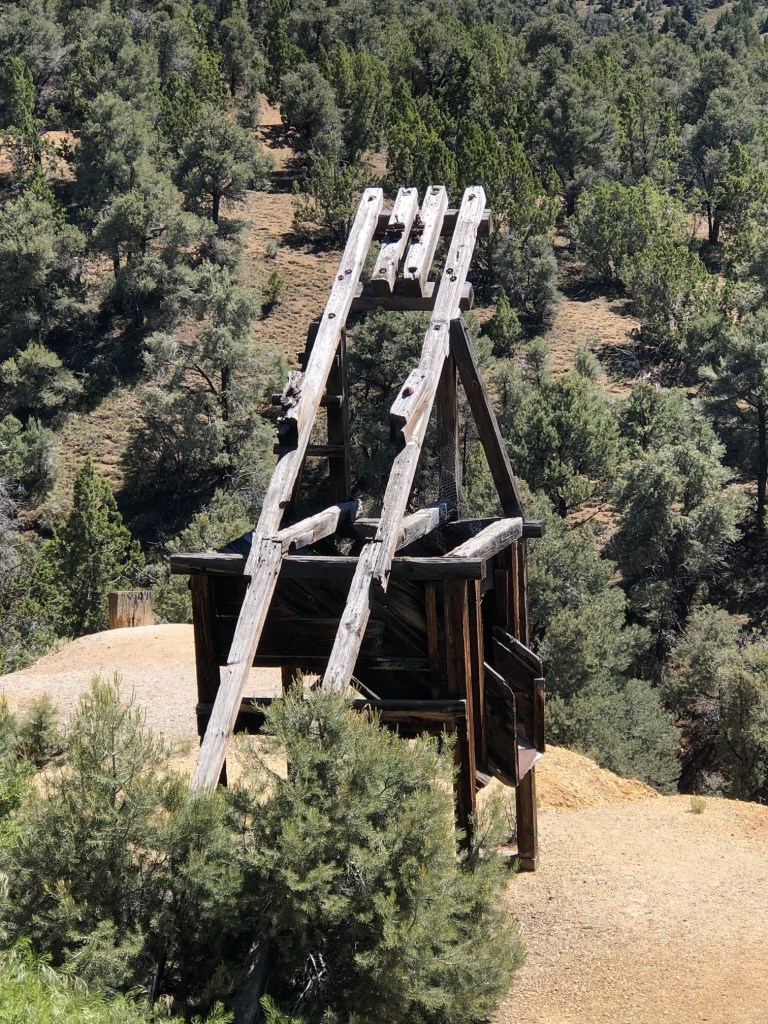
In 1875, the Tybo Consolidate Mining Company was created to manage the Two-G Mine, which was the largest producer in the area. By 1876, Tybo became a boom town with “around 1,000 residents, five stores, two blacksmith shops, a post office, and of course many saloons”, and, by the 1870s, the town became a leading lead producer.
By 1881, however, Tybo Consolidated Mining Company failed due to the drop in ore, and the population was reduced to about 100 people. In 1884, a major fire destroyed 32 buildings. Throughout the 1900s, different companies tried to resurrect the mines to differing success. The main mines of Tybo were eventually shut down in 1937.
Historical Marker Inscription
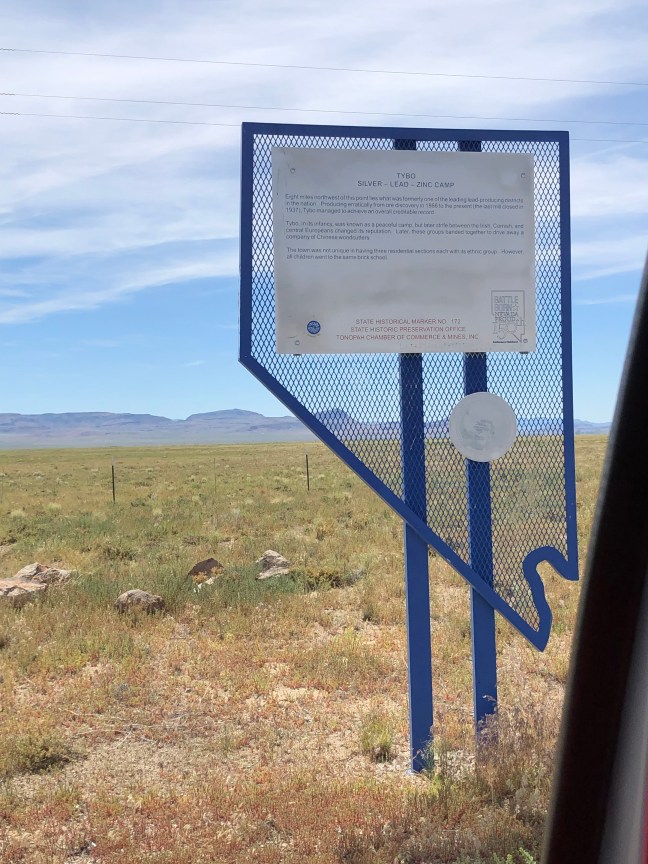
TYBO
SILVER – LEAD – ZINC CAMP
Eight miles northwest of this point lies what was formerly one of the leading lead-producing districts in the nation. Producing erratically from ore discovery in 1866 to the present (the last mill closed in 1937), Tybo has managed to achieve an overall creditable record.
Tybo, in its infancy, was known as a peaceful camp, but later strife between the Irish, Cornish, and central Europeans changed its reputation. Later, these groups banded together to drive away a company of Chinese woodcutters.
The town was not unique in having three residential sections each with its ethnic group. However, all children went to the same brick school.
Location
Tybo is in Nye County, which is off Highway 6 near Tonopah, NV, and a 17-mile drive from Warm Springs, NV.
Located on U.S. Highway 50 on the western slopes of the Toiyabe Range, Austin was founded in 1862 as part of the silver rush. The legend goes that a Pony Express horse kicked over a rock, exposing the silver. The city was named after Austin, TX.
The town grew rapidly, and, by 1863, it had a population of over 10,000 and became Lander County’s county seat. It also was a staging point for prospectors looking for new mines in Central Nevada. In January 1864, the town was incorporated, and this included adding police force, a fire department and schools.
Soon, in 1869, however, the White Pine area began to pull miners and prospectors away from Austin. Yet, Austin continued to produce silver and be prosperous, and, in 1880, the Nevada Central Railroad connected Austin to Battle Mountain via a transcontinental railroad. Yet, by 1887, most of the mines in Austin were closed. While considered largely to be a “living” ghost town, residents still reside in the town, and the International Hotel (which originated in Virginia City in 1859 and was moved to Austin in 1863) is supposed to be the oldest in Nevada. While it doesn’t rent out rooms anymore, it still offer meals to travelers.
One of the other attractions in the area is Stokes Castle, built by Anson Phelps Stokes as a summer home for his sons. Built between 1896 and 1897, it was only used once by the family between June and July 1897, and then was largely abandoned.
Historical Marker Inscription
Austin sprang into being after William Talcott discovered silver at this spot on May 2, 1862. Talcott came from Jacbobsville, a stage stop six miles to the west on the Reese River. He was hauling wood out of the Pony Canyon, directly below, when he made the strike that set off the famous rush to Reese.
A town called Clinton flourished briefly in Pony Canyon but fast growing Austin soon took over and became the Lander County seat in 1863. Before the mines began to fail in the 1880’s Austin was a substantial city of several thousand people. From Austin, prospectors fanned out to open many other important mining camps in the Great Basin.
Located near the Haystack Mountains and the North Platte River, Guernsey, Wyoming, was originally known as the “emigrant wash tub” since it was the area where the pioneers typically washed their clothes, took baths and watered whatever livestock they had with them. Guernsey was located right on the Oregon Trail. You can still see the ruts from the wagons in the area, and the carved names of the pioneers who traveled along the route.
The area is named after Charles A. Guernsey, a New Yorker who moved to the area in 1880. The town was officially incorporated in 1902. By this year, the Chicago, Burlington and Quincy Railroad had made it as far as Guernsey.
Historical Marker Inscription
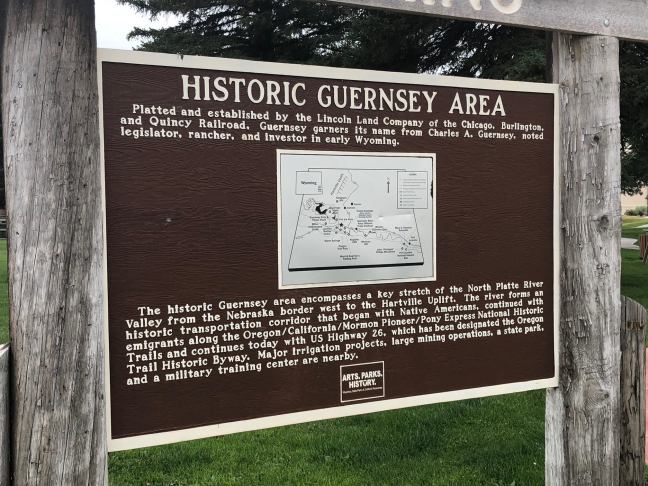
Platted and established by the Lincoln Land Company of the Chicago, Burlington and Quincy Railroad, Guernsey garners its name from Charles A. Guernsey, noted legislator, rancher, and investor in early Wyoming.
The historic Guernsey area encompasses a key stretch of the North Platte River Valley from the Nebraska border west to the Hartville Uplift. The river forms an historic transportation corridor that began with the Native Americans, continued with emigrants along the Oregon/California/Mormon Pioneer/Pony Express National Historic Trails and continues today with US Highway 26, which has been designated the Oregon Trail Historic Byway. Major irrigation projects, large mining operations, a state park, and a military training center are nearby.
The Natchez Trace Parkway is a 444-mile drive that stretches through Mississippi, Alabama and Tennessee – linking Nashville, TN, to Natchez, MS. The current roadway mainly follows the path of the Old Natchez Trace, which was a combination of a wilderness road, horse trail and foot path. One of most frequently used sections of the trail was known as Natchez or Chickasaw Trail.
It was regularly used throughout the late 1700s and early 1800s as a commercial road between the East and the Southwest and Mississippi River, but it had been animal and Native American trail for thousands of years. The original wilderness road ran through Old Town, MS, which was an area settled due to the abundance of bison and water. This section is known as the Old Natchez Trace.
Due the difficulty of navigating the Natchez Trace, in 1800, the U.S. Congress created legislation to create a major road that would allow for easier travel between Nashville and Natchez. “The Government Road” was completed in 1802, and this road linked Nashville with the original Trace.
Historical Marker Inscription
Two portions of a nearly 200 year old wilderness road, the Old Natchez Trace, are preserved here. Nearly 500 miles long, it grew from Indian trails to a national road and communications link between the Old Southwest and the United States to the northeast.
A short 5-minute loop walk to your left lets you see both sections and lets you stroll down a steeply eroded, sunken part of the Old Natchez Trace.
Location
Natchez Trace Parkway, Ridgeland, MS 39157, United States
Known as the “The Great Pathfinder”, John Charles Frémont was born in Savannah, Georgia, on January 21, 1813, and he was one of only two native Georgians that fought for the U.S. Army during the Civil War. During the years before the war, Frémont led several exploratory expeditions into the West. His goal was to create surveys and maps for the U.S. westward expansion.
During 1838 to 1839, he assisted Joseph Nicollet, a well-known scientist, in surveying the Upper Mississippi and Missouri Rivers. Frémont became famous for his campaigns into the west during the 1840s, including one that involved crossing the Sierra Nevada during the winter. He was instrumental in securing California for the U.S. during the Mexican-American War, capturing the cities of Presidio, Santa Barbara and sections of Los Angeles.
Frémont was fortunate to strike gold during the California gold rush and was a California senator from 1850 to 1851. He unsuccessfully ran for president of the U.S. in 1856, becoming the first Republican Party candidate.
One of two native Georgians who served as generals in the U.S. Army during the Civil War, John C. Frémont was born nearby on January 21, 1813. As an army officer, his 1840s explorations of the American West gained him fame as the “Pathfinder.” During the U.S.-Mexican War, Frémont seized California for the U.S. and was elected one of its first Senators in 1850. Opposed to slavery’s expansion, he ran unsuccessfully in 1856 as the first Republican presidential candidate. During the Civil War, Frémont’s 1861 proclamation freeing all Confederate-owned slaves in Missouri was annulled by President Lincoln. After lackluster performance as a combat commander, Frémont resigned from the U.S. Army in 1864. He later served as governor of the Arizona Territory (1878-1881) and died in New York in 1890.
Erected for the Civil War 150 commemoration by the Georgia Historical Society, the Georgia Department of Economic Development, and the Georgia Battlefields Association
While most burial mounds in Mississippi are dated to around 100 B.C. to 400 B.C. (the Middle Woodland period), the six burial mounds at Boyd Site date to around 800 to 1100 A.D. (the Late Woodland and Early Mississippian periods).
In 1964, the National Park Service excavated some of the mounds. One of the mounds appears to be 100 feet long, but is actually 3 different mounds. Within these 3 mounds, 41 burials were found.
While few artifacts were discovered within burial sites, the pottery that was discovered possibly indicate that the mounds were created in two different phases: one within the Late Woodland period and another within the Mississippian period.
Historical Marker Inscription
Archaeologists tell us that there was a house here sometime around 500 A.D. and that the pottery found in the mounds was made before 700 A.D. Likely, the population was continuous over centuries with customs being handed from generation to generation, relying on field, forest, and stream for food. The simple social system was probably based on family and close relatives.
United States Department of the Interior
National Park Service
Location
The mounds are located approximately 6 miles from I-55 on the Natchez Trace Parkway, Madison, MS 39110
Known as the “Singing Brakeman” and “America’s Blue Yodeler”, James Charles Rodgers, better known as Jimmie Rodgers, was a pioneering country music star. He has been regarded as the Father of Country Music, combining elements from different genres, including jazz, folk music and work chants.
Born on September 8, 1987, the son of a railroad section foreman, Jimmie was attracted to music from a young age. At 13, he won an amateur talent show and soon after ran away to join a traveling medicine show. His father found him and brought Rodgers back to work on the railroad. During the early 1900s, he worked as everything from a call boy to a brakeman to a baggage master.
In 1924, he developed tuberculosis – a disease that would plague him throughout his life and lead to his death – he abandoned railroad work and devoted himself to music. He wouldn’t, however, find success until 1927 working a regular, unpaid spot on an Asheville, North Carolina, radio station.
His luck turned again, when he learned that Ralph Peer, an agent for Victor Talking Machine Company, was doing field recordings. There was a positive response to his release, and he wound up recording again for Peer, leading to the release of “Blue Yodel (T for Texas), which became his first big hit.
Rodgers would spend the next five years traveling across the nation, appearing in a movie and recording with famous stars, including the Carter Family, Bill Boyd and Louis Armstrong.
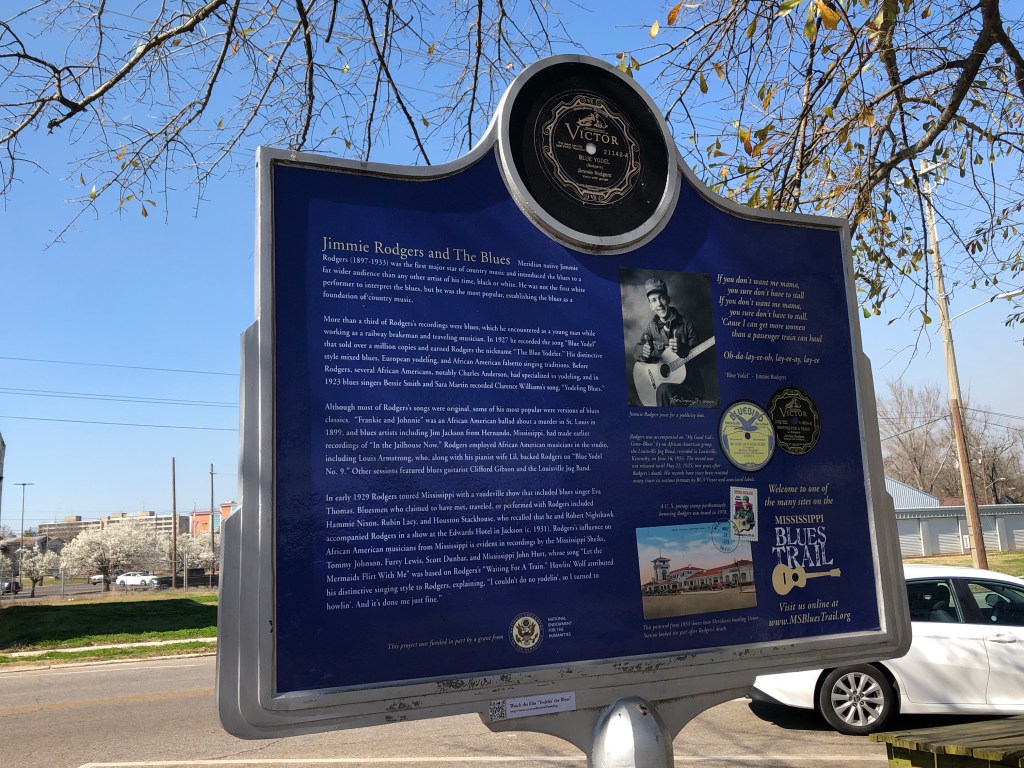
Jimmie Rodgers (1897 – 1933) is widely known as the “father of country music,” but blues was a prominent element of his music. The influence of his famous “blue yodels” can be heard in the music of Mississippi blues artists including Howlin’ Wolf, Mississippi John Hurt, Tommy Johnson, and the Mississippi Sheiks. His many songs include the autobiographical “T.B. Blues,” which addressed the tuberculosis that eventually took his life.
Side B
Jimmie Rodgers and The Blues Meridian native Jimmie Rodgers (1897-1933) was the first major star of country music and introduced the blues to a far wider audience than any other artist of his time, black or white. He was not the first white performer to interpret the blues, but he was the most popular, establishing the blues as a foundation of country music.
More than a third of Rodgers’s recordings were blues, which he encountered as a young man while working as a railway brakeman and traveling musician. In 1927 he recorded the song “Blue Yodel” that sold over a million copies and earned Rodgers the nickname “The Blue Yodeler.” His distinctive style mixed blues, European yodeling, and African American falsetto singing traditions. Before Rodgers, several African Americans, notably Charles Anderson, had specialized in yodeling, and in 1923 blues singers Bessie Smith and Sara Martin recorded Clarence Williams’s song, “Yodeling Blues.”
Although most of Rodgers’s songs were original, some of his most popular were versions of blues classics. “Frankie and Johnnie” was an African American ballad about a murder in St. Louis in 1899, and blues artists including Jim Jackson from Hernando, Mississippi, had made earlier recordings of “In the Jailhouse Now.” Rodgers employed African American musicians in the studio, including Louis Armstrong, who, along with his pianist wife Lil, backed Rodgers on “Blue Yodel No. 9.” Other sessions featured blues guitarist Clifford Gibson and the Louisville Jug Band.
In early 1929 Rodgers toured Mississippi with a vaudeville show that included blues singer Eva Thomas. Bluesmen who claimed to have met, traveled, or performed with Rodgers included Hammie Nixon, Rubin Lacy, and Houston Stackhouse, who recalled that he and Robert Nighthawk accompanied Rodgers in a show at the Edwards Hotel in Jackson (c. 1931). Rodgers’s influence on African American musicians from Mississippi is evident in recordings by the Mississippi Sheiks, Tommy Johnson, Furry Lewis, Scott Dunbar, and Mississippi John Hurt, whose song “Let the Mermaids Flirt With Me” was based on Rodgers’s “Waiting For A Train.” Howlin’ Wolf attributed his distinctive singing style to Rodgers, explaining, “I couldn’t do no yodelin’, so I turned to howlin’. And it’s done me just fine.”
If you don’t want me mama, you sure don’t have to stall If you don’t want me mama, you sure don’t have to stall. ‘Cause I can get more women than a passenger train can haul






 Historical Markers of the World