The Great Platte River Road

The Great Platte River Road Marker

The Great Platte River Road was a travel corridor that ran alongside the Platte River in Nebraska and Wyoming. The road was nearly 800 miles and ran from the Second Fort Kearny to Fort Laramie.

Known as the “grand corridor of America’s westward expansion” – or the Superhighway of the time – it was used from 1841 to 1866. The road was included in many other western routes, including the Mormon Trail, Trapper’s Trail, California Trail, Oregon Trail, Pony Express and military routes between Fort Laramie and Fort Leavenworth.

There is now a monument and museum dedicated to the people who took the Platte River path through Nebraska. It’s called the Great Plate River Road Archway Monument, and there is a fee to enter.

Historical Marker Inscription

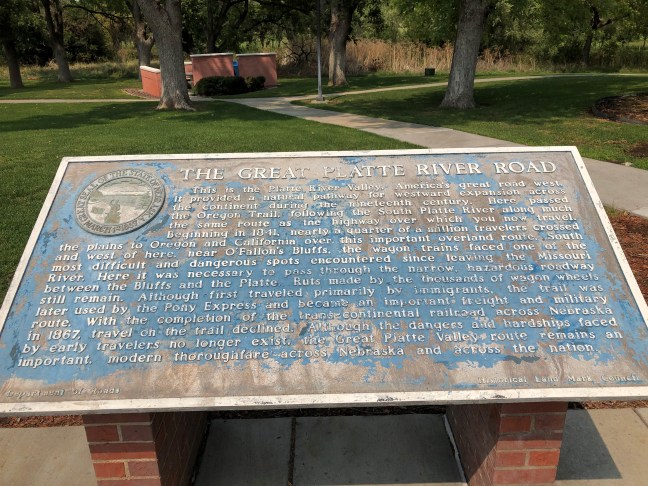
This is the Platte River Valley, America’s great road west. It provided a natural pathway for westward expansion across the continent during the nineteenth century. Here passed the Oregon Trail, following the South Platte River along much the same route as the highway over which you now travel. Beginning in 1841, nearly 250,000 travelers crossed the plains to Oregon and California over this important overland route. Here at O’Fallon’s Bluffs, the wagon trains faced one of the most difficult and dangerous spots on the trail. The Platte River cut directly against the bluff, making it necessary to travel the narrow roadway over O’Fallon’s Bluffs. Deep sand caught the wagon wheels, and Indian attacks were always a danger. A few feet southeast of this point, ruts made by thousands of wagon wheels still remain. Although first traveled primarily by immigrants, the trail was later used by the Pony Express and became an important freight and military route. With the completion of the trans-continental railroad across Nebraska in 1867, travel on the trail declined. Although the dangers and hardships faced by early travelers no longer exist, the Great Platte Valley route remains an important modern thoroughfare across Nebraska and across the nation.

Location: Sutherland Westbound I-80 Rest Area, 5 miles west of Hershey, NE

41.141302, -101.090121

Boyhood Home of John Wayne

John Wayne Birthplace, Brooklyn, WI

Marion Morrison was the son of Clyde and Molly Morrison. The family lived in Brooklyn, IA, in 1909 and again from 1913 to 1914. Marion had been born a short distance away in Winterset, IA, on May 26, 1907. While the name Marion Morrison wouldn’t be recognizable for most people, the actor that he would grow up to be would be known the world round: John Wayne.

Family History

Marion’s father was a registered pharmacist who had been hired by the Rainsburg & Dillsaver Drug Store, which was located in the town of Brooklyn in the business district on Jackson Street. The family was only in the area for a short while when Clyde decided to buy a pharmacy in Earlham, leaving the town in January 1910.

In January 1913, the family returned to Brooklyn and took up residence at the house on 717 Jackson Street. In 1914, the family would finally move away from Brooklyn for good, but not before a fire erupted on the porch of the home due to sparks from a pot-bellied stove, burning many of the items that had been prepared for the move. The incident left a lasting impression on the six-year-old Marion.

The family moved to California, and the rest they say is history.

Historical Marker Inscription

Boyhood Home of John Wayne

The Clyde Morrison family moved from Winterset to this house in 1909 and lived here again in 1913-14. Mr Morrison was a pharmacist employed by the Rainsburg Drug Store, located near the south end of Jackson Street on the west side. His elder son, Marion, attended kindergarten at the Brooklyn Elementary School and entered first grade there in the fall of 1913.

When Mr Morrison was diagnosed with tuberculosis he moved his family to California in 1914. In later years the Morrison’s older son, Marion, became the legendary Hollywood actor known as John Wayne.

Location: 717 Jackson Street, Brooklyn, IA 52211

Coordinates: 41.735458 N, -92.445128 W

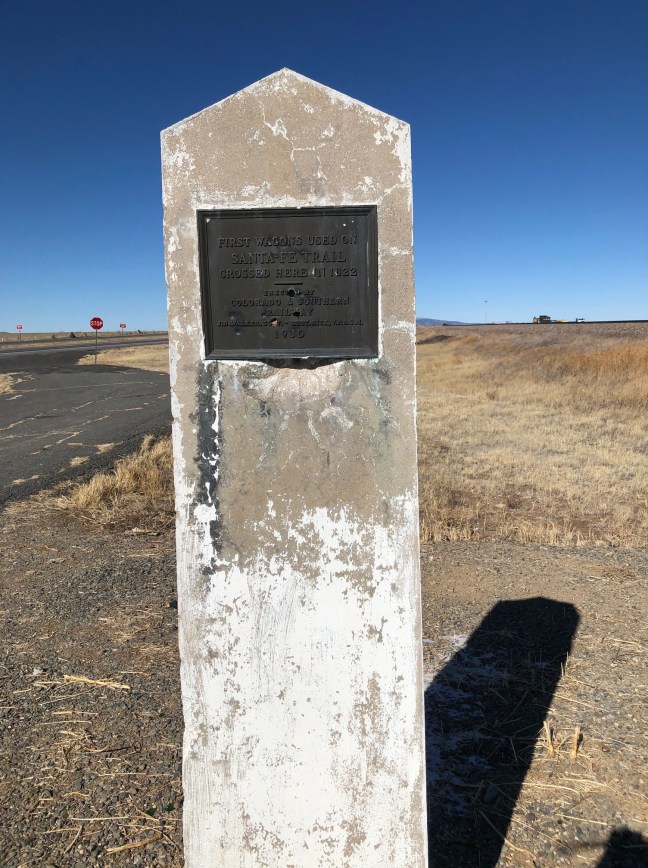
First Wagons Used on Santa Fe Trail

The Santa Fe Trail was a two-way commercial highway that connected Missouri to Santa Fe. Used between 1821 and 1889, it was frequented by both American and Mexican traders. It was also a path that the U.S. Army used to invade Mexico during the Mexican-American War.

Besides commerce, the Santa Fe Trail was also used during the Gold Rush by people heading to gold fields in both California and Colorado as well as by missionaries, emigrants and more.

The expansion of the railroad into Santa Fe in February 1880 brought an end to the trail.

Historical Marker Inscription

“First Wagons Used on Santa-Fe Trail Crossed Here in 1822.”

Accompanying sign:

“Stretching 900 miles from Franklin, Missouri, to Santa Fe, New Mexico, the Santa Fe Trail as one of the most important North America trade routes of the nineteenth century. Begun in 1821, it was used for 60 years until the arrival of the railroad. It was a hardy traveler who attempted the journey. Wagon trains up to 500 wagons long traversed the trail through blizzards, stampedes, dust storms, fires, disease, and Indian attacks. And often, they lacked for water.

Here, near two landmarks of the trail, Round Mound and Rabbit Ears, wagon trains camped for the night. William Becknell, the trader who inaugurated the Santa Fe Trail in 1821, came this way on his return trip east while forging the smoother Cimarron Route across the plains.

Two-way Street

Unlike the great emigrant trails to the north, the Santa Fe Trail ran both ways, with traders from Mexico, or returning U.S. traders, carrying Mexican silver, gold, mules, buffalo and beaver pelts to waiting markets in Missouri.”

Location: US-87 West, Clayton, New Mexico
Latitude: 36

Location: US-87 West, Clayton, New Mexico
Latitude: 36 degrees 33′ 59.520″ N
Longitude: 103 degrees 34′ 1.152″ W

Capulin Volcano

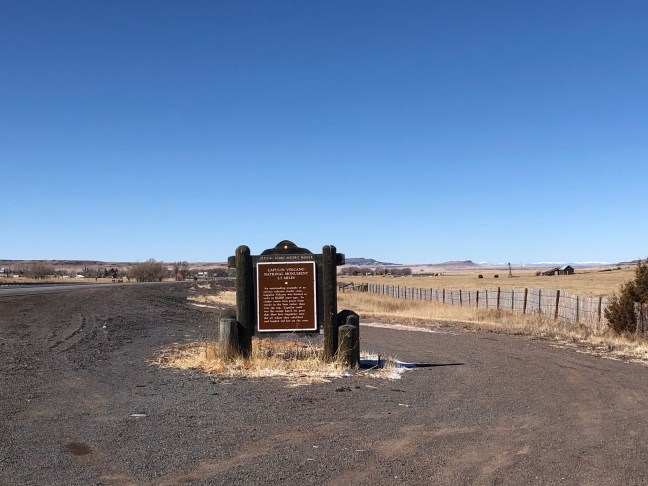
Driving down Highway 325 in New Mexico near Raton, you can’t miss the sign for Capulin Volcano National Monument. This national monument is an extinct cinder cone volcano that is part of the 8,000 square mile Raton-Clayton Volcanic Field. Designed to provide visitors with a look at the geology of Northwestern New Mexico, you can also view four states from the rim of the volcano.

The elevation of the volcano is 8,182 feet high and 400 feet deep, and it is approximately 60,000 years old. The name is derived from a type of choke cherry, Prunus virginiana. The area became a national monument on August 9, 1916.

Historical Marker Inscription

“An outstanding example of an extinct volcanic cinder cone, Capulin Volcano was formed as early as 10,000 years ago. In cinder cones, lava pours from cracks in the base rather than over the top. Capulin itself was the escape hatch for cases that blew lava fragments into the air where they solidified and landed red hot on the cone.”

Location: 46 Volcano, Capulin, NM 88414
36.7811 degrees North, 103.9695 degrees West

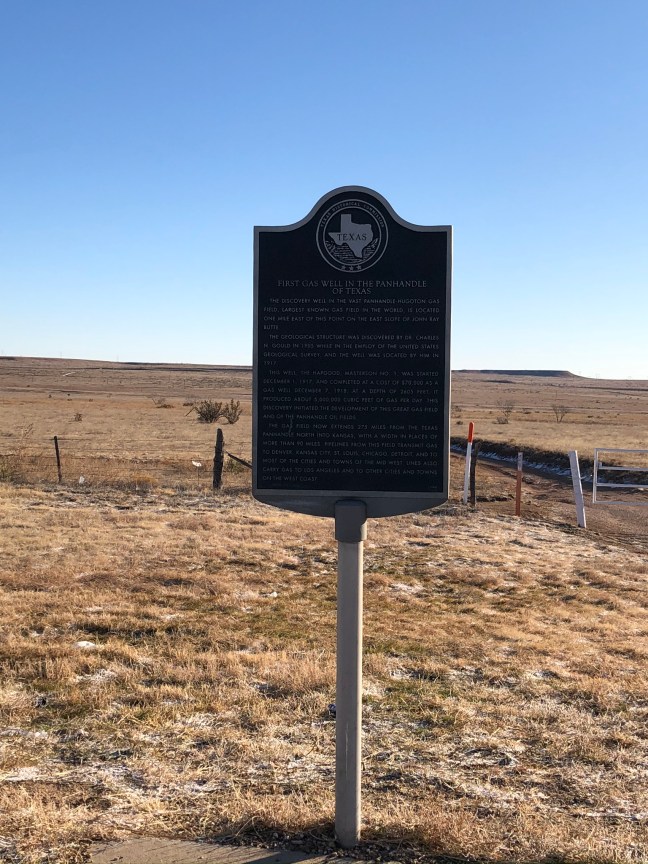
First Gas Well in the Panhandle of Texas

The first gas well discovered in the Panhandle of Texas was found by Dr. Charles Newton Gould and his team. Gould was a geologist born near Lower Salem, Ohio, on July 22, 1868. Having received a masters degree in geology in 1900, he was tapped as a territorial geologist and geology instructor by the University of Oklahoma. While during the fall he taught classes, over the summer months, he worked in the Indian Territory (areas where the government relocated Native American populations) on federal geological surveys.

During the summer of 1903, Gould was commissioned by the Hydrographic Branch of the United States Geological Survey to survey the geology and try to find underground water sources west of the Indian Territory and east of the Rocky Mountains. Over the course of three seasons during 1903 through 1905, Gould and his compatriots mapped the geological features of the Texas Panhandle.

Historical Marker Text

The discovery well in the vast Panhandle-Hugoton Gas Field, largest known gas field in the world, is located one mile east of this point on the east slope of John Ray Butte.

The geological structure was discovered by Dr. Charles N. Gould in 1905 while in the employ of the United States Geological Survey, and the well was located by him in 1917.

This well, the Hapgood, Masterson No. 1, was started December 1, 1917, and completed at a cost of $70,000 as a gas well December 7, 1918, at a depth of 2605 feet. It produced about 5,000,000 cubic feet of gas per day. This discovery initiated the development of this great gas field and of the Panhandle oil fields.

The gas field now extends 275 miles from the Texas Panhandle north into Kansas, with a width in places of more than 90 miles. Pipelines from this field transmit gas to Denver, Kansas City, St. Louis, Chicago, Detroit, and to most of the cities and towns of the mid-west. Lines also carry gas to Los Angeles and to other cities and towns on the west coast. (1965)

Location: 35.573383, -101.949463

Located 30 miles north of Amarillo off US 287

Headwaters of the Sabine River

The Sabine River is over 500 miles long and moves from Upper East Texas to the east and empties into the Gulf of Mexico. It starts in Hunt, Collin and Rockwall counties, and then flows towards Logansport, Louisiana, before it finally discharges near Orange, Texas. This river had served as the boundary between multiple territories, including the United States, Mexico, Spain and France.

The original name of the river was Sabinas, the Spanish name for red cedars, which are known to grow on its banks.

Historical Marker Text

A half mile to the west rises the Sabine River, lower channel of which separated New World empires of France and Spain and in 1836 became Republic of Texas – United States border. Fork here is called Cow Leach, for Indian chief who lived in the area. This marker is on a 3-way watershed: flow to the north goes into the Sulphur and to the Mississippi; the west drains to the Trinity; south goes into the Sabine, which forms Texas-Louisiana boundary and pours more water into Gulf of Mexico than any other Texas river (6,400,000 acre feet annually).

Location: Off Highway 69, Celeste, TX 75423
N 33° 19.366 W 096° 12.455

Louisiana: Site of Battle of Jackson Crossroads

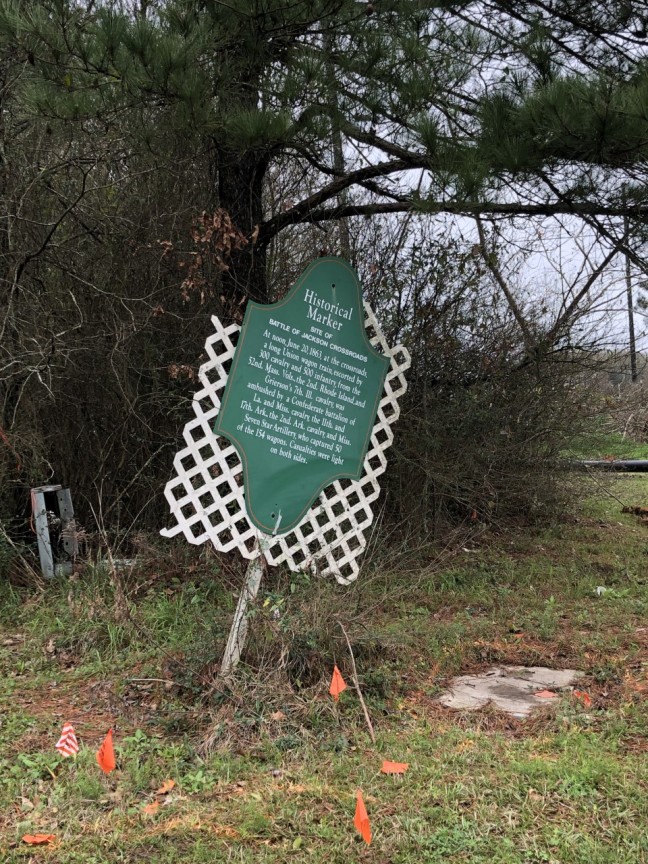
If you’re driving into Jackson, Louisiana, you might miss this historical marker. It sits near a light and is nearly tumbling over. But this hidden marker (green with a white picket fence background) marks the spot of a battle of the Civil War. In fact, Civil War reenactors regularly re-enact this battle on a field off Highway 68 near the original battle location.

The Historical Facts

Jackson was actually the location of two Civil War battles during 1863. The Union was trying to siege Port Hudson. This 48-day siege took place from May to July of 1863 when the Union was trying to recapture the Mississippi River so the Confederacy wouldn’t be able to use the river to transport supplies. While the siege failed, the river was eventually taken by the Union after Vicksburg fell.

Benjamin Henry Grierson, whose cavalry took part in the Battle of Jackson Crossroads, was known for the “Grierson’s Raid”, which was an expedition through Confederate holdings that successfully severed enemy communication lines between Vicksburg, Mississippi, and leaders in the East.

Historical Marker Text

“At noon, June 20, 1863, at the crossroads, a long Union wagon train, escorted by 300 cavalry and 500 infantry, from the 52nd. Mass. Vols., the 2nd. Rhode Island, and Grierson’s 7th. Ill. cavalry, was ambushed by a Confederate battalion of La. and Miss. cavalry, the 11th. and 17th. Ark., the 2nd. Ark. cavalry, and Miss. Seven Star Artillery, who captured 50 of the 154 wagons. Casualties were light on both sides.”

Location: 30.8374° N, 91.2176° W

Jackson, LA 70748 East Feliciana Parish. It is located at the intersection of Charter Street (State Highway 10 and Carrs Creek Road (State Highway 68) at the stoplight.

Littlefield Building, Austin

The Littlefied and Scarbrough buildings in Austin have lined the cityscape for over a century. In fact, these used to be the tallest buildings in Austin. The Littlefield Building actually as the tallest building between New Orleans and San Francisco during the early 1900s.

Littlefield was home to the American National Bank. Built by a former Confederate army major and president of the National Bank, George Littlefield started the groundwork for the new location of the bank in 1910. It was previously in the same location as the historic Driskill Hotel .

George Littlefield was a major player in the Austin area. During the first 50 years of the University of Texas, he was the college’s biggest financial contributor.

When the Littlefield building was completed in 1912, it was eight stories tall and had a garden rooftop for events. Then, he enclosed the top, creating a ninth story – effectively making it the tallest building in Austin.

To this day, the building is still home to office buildings.

Inscription

George Washington Littlefield (1842-1920) came to Texas from Mississippi in 1850. After serving in Terry’s Texas Rangers in the Civil War, he made his fortune ranching and driving cattle. He moved to Austin in 1883 and, in 1890, established the American National Bank, which included a ladies’ banking department. He hired architect C. H. Page, Jr., to design this Beaux Arts Classical building, which opened in 1912 with a rooftop garden. His bank was on the ground floor. For the corner entrance, he commissioned Tiffany’s of New York to cast bronze, Bas Relief doors by sculptor Daniel Webster. These were later donated to the University of Texas, of which Littlefield was a major benefactor.

Location

Latitude & Longitude: 30 15′ 58.043196″, -97° 44′ 31.835076″

Address: 601 North Congress, Austin, Texas


Kenner High School

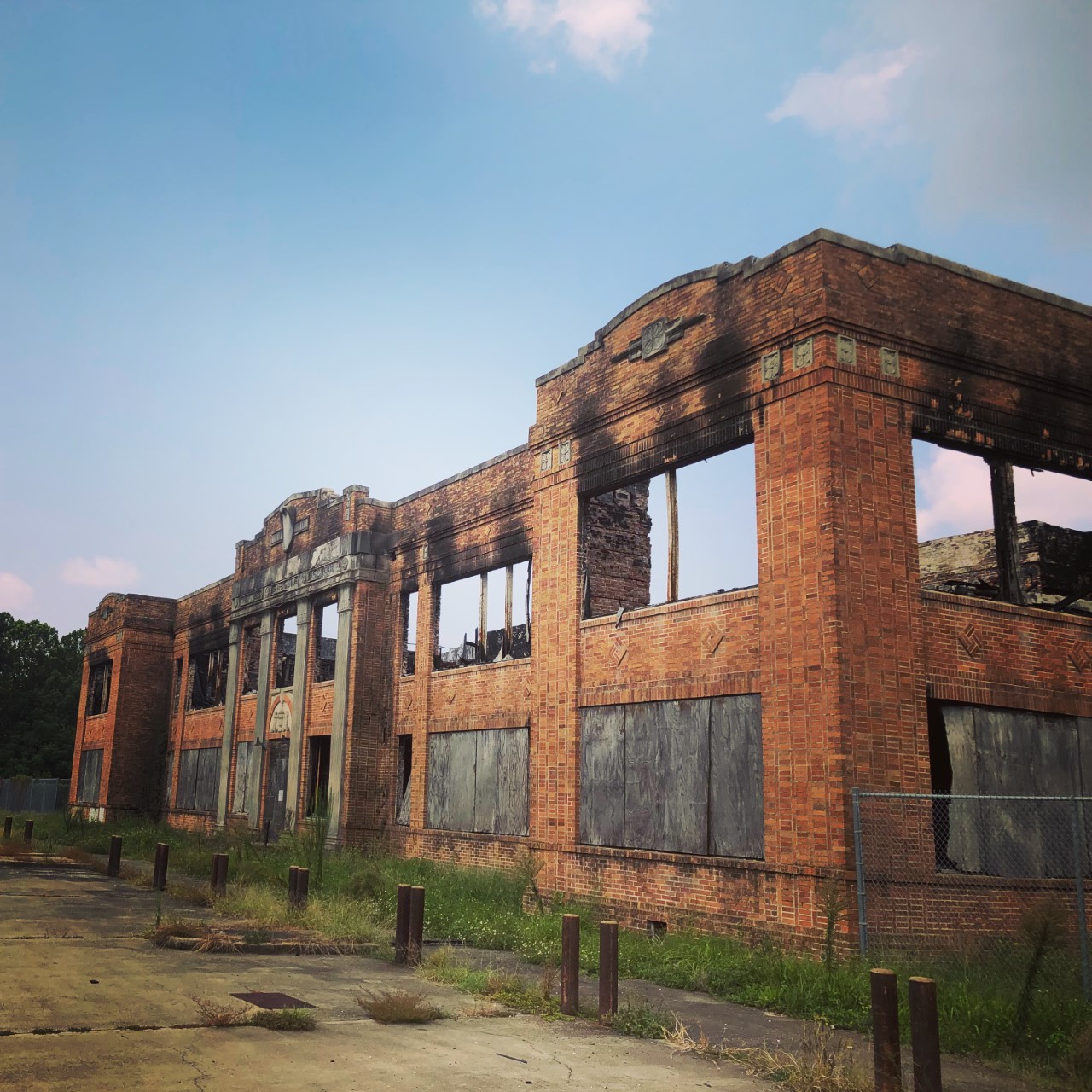
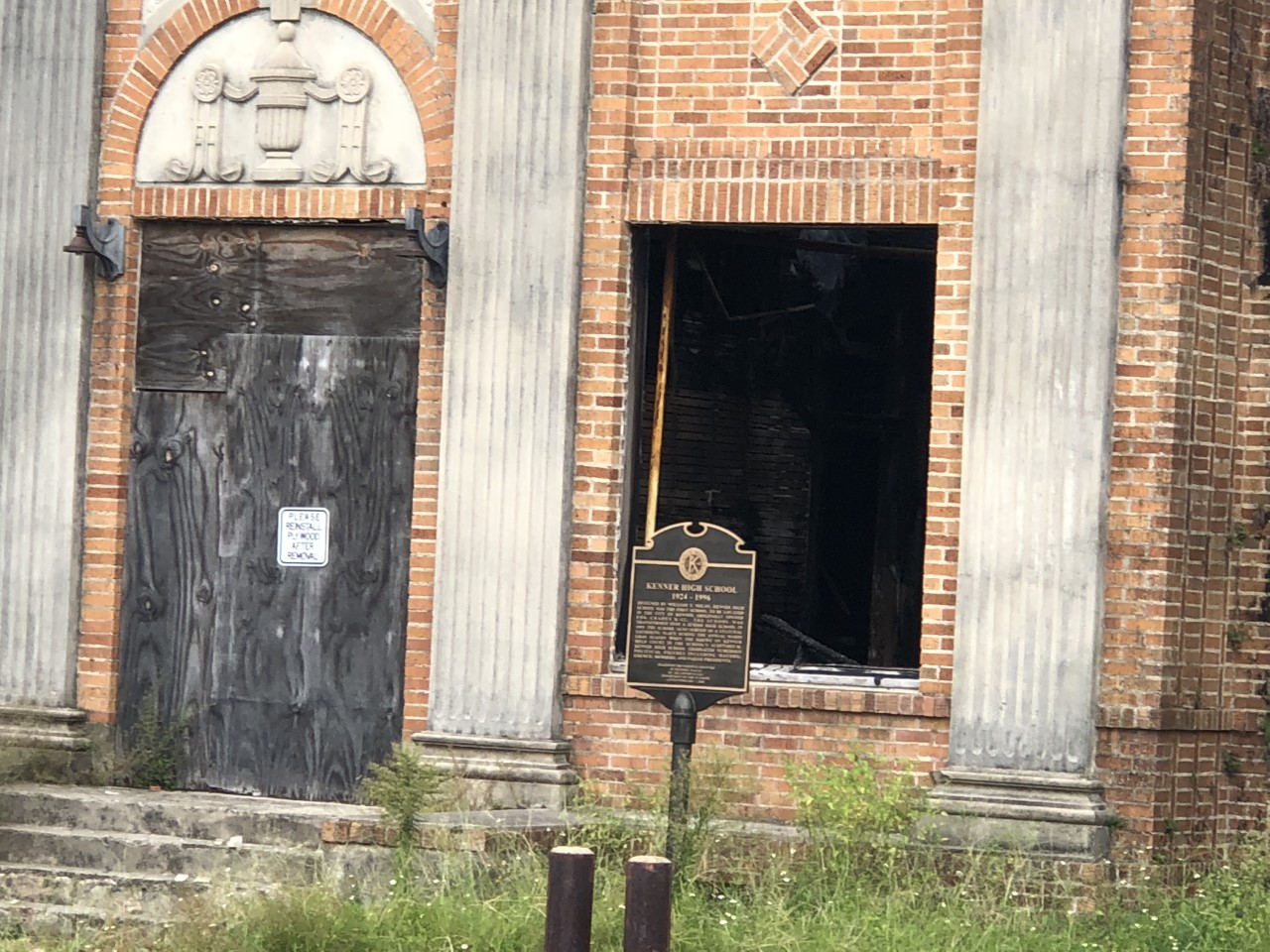
Behind a fence lies a ruin of a building that was once a high school and then a junior high school that existed for over 70 years. Gutted by a fire, this amazing building still holds court – as it once did for the Krewe of Kenner – on River Road. While you can’t get too close to the property, you can gaze through the fence at this amazing skeleton of a building.

The last senior to graduate from the school was in 1955, and it was a junior high school until it shut its doors in 1996.

There have been numerous plans to do something with this building, but as of this writing, it still sits as is. It’s been listed as one of New Orleans most endangered historic sites.

Kenner HS 3

Inscription

Designed by William T. Nolan, Kenner High School was the first school to be located in the City of Kenner. Originally opened for grades K-12, the school was transformed into a junior high school in 1955. The school also served as a cultural gathering place during the annual Mardi Gras season when the Krewe Of Kenner held court in the school’s auditorium. Kenner High School graduated numerous political figures including Mayors, Council members and Parish Presidents.

Placed on the National Register of Historic Places by the United States Department of the Interior. Listed February 7, 2008.

Kenner HS 1

Location

29° 58.483′ N, 90° 15.151′ W

Address: 1601 Rev. Richard Wilson Drive, Kenner, Louisiana

Leadville Historical Marker

It was the lure of gold that caused Leadville to be founded. Placer gold was found by Abe Lee in California Gulch, which is about a mile east of Leadville, during the Pikes Peak Gold Rush in 1860. The first gold was discovered in April, but by the end of summer, the population of Leadville would reach over 10,000.

By 1866, nearly all the gold deposits were exhausted, and many miners left. The rest moved closer to town, which had been covered with a heavy, black sand. It was discovered that this sand was actually cerussite, which contains at least 15 ounces of silver per ton.

Leadville was again a boom town by 1879. With the new influx, hotels, brothels, saloons, restaurants and more were built. Many mines also were created, and fortunes were made, especially by silver magnate and Tabor Opera House builder Horace Tabor and even the Guggenheims. Horace Tabor would even give the site its official name, based on the lead ore found in the area.

The Marker Inscription

Entering The Cloud City. Altitude 10,152 Ft.

“Here on the roof-top of the nation flourished about 1844 the most famous silver mining camp in the world. Perhaps 30,000 fortune hunters made this town about 1890 the second largest city of Colorado. Here grew fabulous fortunes – among many of H.A.W. Tabor. A Gay and cultivated social life, violent labor contests, ambitious projects like the ice palace marked the city.

In 1860, gold was discovered nearby in California Gulch but soon exhausted. The miners scattered. Seventeen years later a heavy sand discarded by prospectors as a nuisance in the pine woods hereabouts was found to be silver carbonate.

Westward loom Mount Elbert, Colorado’s highest peak, and Mount Massive. The Sawatch (Blue Earth) range to the west and the Mosquito to the east contain several of the loftiest mountains in North America.

Healy House and Dexter Cabin State Museum, Harrison Avenue and East Tenth Street, depicts life in pioneer Leadville.”

Location: 39° 15.785′ N, 106° 17.459′