Major Powell, Colorado River Explorer

John Wesley Powell was a geologist and explorer of the American West. He had also been a soldier for the Union Army during the American Civil War. Powell, however, is most well-known for his series of expeditions throughout the Rocky Mountains and the Green and Colorado Rivers.

In 1869, Powell and nine other members of his team set out into the West to explore both the Colorado River and the Grand Canyon. They had four boats and enough food for 10 months for their trip through Utah. Only six crew members made it all the way through the expedition. One quit early in the journey and three left right before the crew reached the mouth of Virgin River on August 30, 1869, where the journey ended.

The three men who quit headed out at Separation Canyon and were never seen again. There has been speculation for years as to what happened to these three. Because they were never found, many of Powell’s journals were lost because they had been sent out with them. We recently heard a story that a journal had been discovered by a young Mormon girl who wrote about three men entering their village. The elders took these three out of village, and nothing more was written.

The Marker

The Powell historical marker is located 1084 East Main Street in Elgin, UT – right in front of the Motel 6. Here is what is engaged on it:

The first organized attempt to conquer the swirling rapids and precipitous walled canyons of the Green and Colorado Rivers was made by Major John Wesley Powell, Civil War hero and explorer. Warned by Indians and mountaineers they would never return alive, Powell and 9 companions started from Green River Station, Wyoming Territory, on May 24, 1869, with 4 boats, instruments for making scientific observations, and provisions to last 10 months. For 97 days Powell and his men battled the elements, enduring tremendous deprivation and hardship.

One man (Frank Goodman) left the company early in the journey, and 3 others (William Dunn, O.G. and Seneca Howland) later killed by Shivwits Indians, deserted near Grand Canyon, Arizona. On August 29, 1869, the 6 remaining men arrived at the junction of the Rio Virgin in southern Nevada, having navigated and charted over 900 miles of the river.

In May, 1871, 2 years after his first river voyage, J.W. Powell again led an exploring party of 11 men in 3 boats down the Green and Colorado Rivers. Well into 1873 members of Powell’s party continued extensive and significant exploration and surveys of the region bordering the rivers traversed. The Powell Surveys are some of the most significant explorations achieved anywhere in the world.

NW 1/4, NW 1/4, NE 1/4, Sec. 15, TWP 21S, R 15E

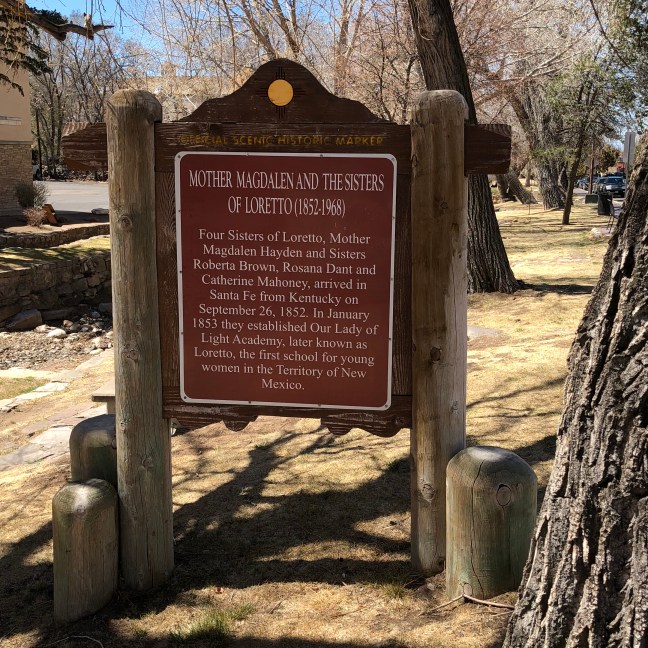
New Mexico Historical Marker: Mother Magdalen and the Sisters of Loretto


This marker is located in the downtown area of Santa Fe at the intersection of East Alameda Street and Old Santa Fe Trail. The marker commemorates Mother Magdalen Hayden and Sisters Roberta Brown, Rosana Dant and Catherine Mahoney, who established the Our Lady of Light Academy (which became known as Loretto). This was the first school for young women in the New Mexico Territory.

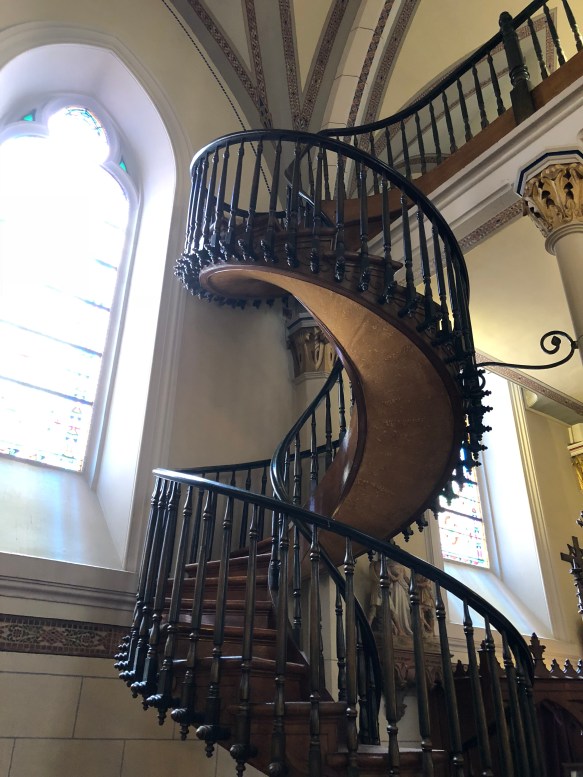
The Sisters also worked with the local people to raise funds from 1863 to 1879 to build the Loretto Chapel, which is known for its “miraculous staircase”, which is a marvel of construction because it has no visible means of support.

IMG_0031

Over the following century, hundreds of women, many who were of Hispanic decent, joined the Sisters of Loretto. The first native-born New Mexican superior of Loretto was Lucia Perea, who took over this position in 1896.

A note on the “A Catholic Mission” site provides a bit more information about Mother Magdalen:

“Joanna Hayden took on the name of Sister Magdalen Hayden when she took her vows to the Loretto Order in 1834. After spending time in Loretto, KY, Cape Girardeau and Bethlehem, MO, she entered the western missions.  In 1852, Sister Magdalen and a group of Loretto Sisters left the Kentucky Mother house for Santa Fe.  In route, the mother superior of the group died of cholera in Independence, MO.  Sister Magdalene became Mother Magdalene.  Mother Magdalene’s time in Santa Fe is well documented as the founder of several Catholic schools and the Superior of the Our Lady of Light Academy in Santa Fe, also known as the Loretto Academy.  The Loretto Academy in Santa Fe is very well known for the spiral staircase built during her time.”


Location: 35° 41.093′ N, 105° 56.279′ W

CO Historical Markers: Hardscrabble, Colorado

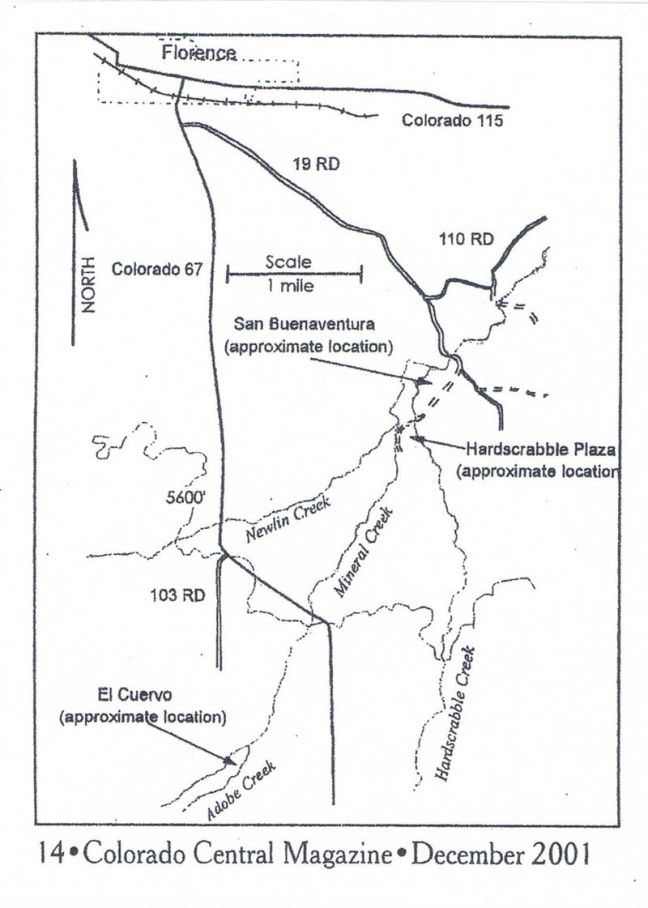
The village of Hardscrabble was established in the 1840s. Founded by traders and trappers, the town was located below the fork of the Hardscrabble and Adobe creeks. While little trace of the settlement still exists, we know that the walls and homes of the town were made of Adobe, creating a square to protect them against Native American attacks, especially from the Ute and Arapaho.

The Hardscrabble area attracted many Native American tribes, including Ute, Cheyenne, Arapaho, Sioux and Kiowa. According to the Wetmore Historical Society, Spanish explorers even came to the area in the 1600s in their search for gold and treasures. American, French and Mexican settlers, trappers and traders started coming to the area in the 1830s.

In 1844, Americans from El Pueblo created a trading post at San Buenaventura de los Tres Arrollos. This was about 5 miles northeast of Ft. LeDuc, which had been built around 1830 by French trappers who were seeking trade with Native Americans, settlers and mountain men. The name of the trading post was later changed to Hardscrabble.

The historical society indicates that:

According to George Simpson, one of its founders, the name came from the “hard scrabbling to get in a crop” in the gravelly soil. 

Tow of Hardscrabble in Custer County Colorado

The town of Hardscrabble traded with nearly anyone who passed through the area, but it wasn’t enough to sustain them. After only a few years of operation, Ft. LeDuc closed in the 1840s, and many residents of the surrounding areas left for the California gold rush.

For Hardscrabble itself, it’s location was a deterrent to success. It was far away from the Santa Fe Trail, and the community was tiny. By 1848, the community was nearly abandoned as observed by John C. Fremont and his men as they were passing through the area.

What’s left of Hardscrabble is located in Custer County. The historical marker is located off Highway 67 between the town of Wetmore and Florence: N 38° 15.872 W 105° 05.265.