Blog

Meridian, Mississippi, Historical Marker

Meridian, Mississippi

Located in Lauderdale County in the East Central Hills of Mississippi, Meridian started in 1831 after the Choctaw Indians left the land as part of the terms of the Treaty of Dancing Rabbit Creek. The city got its name from a settler who believed that the word “meridian” actually meant “junction” or “zenith”.

Richard McLemore of Virginia was the first to come to area and then offered free land to others to try to get them to move the region. By 1855, railroads had linked Meridian with other areas, and, by the 1860s, there were 15 families living in the town.

Meridian played a role during the Civil War. It was the location of the Confederate arsenal, a stockade for prisoners and a military hospital, and it even was the location of the state capital for a month in 1863. In February 1864, Union General William Tecumseh Sherman destroyed the city. The only surviving antebellum mansion in the area from before this time is Merrehope, a Greek Revival home.

For a period of time during the 1890s until 1930, Meridian was also the largest manufacturer in the state. It was known for timber and cotton production.

Historical Marker Inscription

Meridian, Mississippi, Historical Marker

Formerly Sowashee, it was chartered 1860, and throve as rail junction during the Civil War, serving in 1863 as temporary capital and as depository of the state’s official records.

Location

1805 Front Street Meridian, MS 39301

32° 21′ 52.698″ N, 88° 41′ 44.442″ W

Magnolia Springs, Alabama Historical Marker

Magnolia Springs, AL, Historical Marker

Magnolia Springs, Alabama, is located on the Magnolia River in Baldwin County. The headwaters for the river comes from the many springs in the area. It was established due due a Spanish land grant in the 1800s.  After the Civil War, many families and descendants of soldiers on both sides moved to the area.  During the 19th Century, many Creoles from the Mobile area also came to the area as their own community started to fail.

With so many pine forests, Magnolia Springs became known for the production of turpentine. In 1865 during the Civil War, the owners actually burned down the stills to prevent them from being confiscated by the Union Army.  Around the beginning of the 20th Century, chemical firms from Chicago came down and took water samples around the town. In their opinion, the springs around Magnolia Springs were deemed to be the purest in the world.

The town still boasts the only river postal delivery system in the United States, and you can find many boathouses along the banks. It also has a number of houses that are listed on the National Register of Historic Places. It was finally incorporated in 2006.

Historical Marker Inscription

Front:

Settlement of this area began in the early 1700’s and was expedited by a series of Spanish land grants in the early 1800’s. During the 1819-33 time period a brick factory along the south river bank supplied brick for construction of Fort Morgan at the mouth of Mobile Bay. In 1891 the community of Magnolia Springs was established when the first subdivision was platted. The village’s name was a combination of two local assets – the ever-flowing springs and the towering canopy of magnolia trees. Nestled along the banks of the Magnolia River, the village drew residents from Alabama, Vermont, Illinois, and Missouri. Those early settlers built homes and businesses along the main transportation artery, the Magnolia River. Early businesses included turpentine, lumber, and mercantile operations. Inns and hotels were established for the growing tourist trade. Steamers, such as “The Magnolia” brought supplies and passengers to the area. Today, mail is still delivered by boat, as it has been since 1916. It is the last year-round river mail delivery in the U.S.

Back:

For more than 100 years, the Magnolia Springs Community Association, with monthly potlucks, kept people abreast of local events. The Community Hall erected in 1894 still provides a meeting place for residents. A volunteer fire department established in 1961 serves the safety needs of the community. It was housed in a small cinder block structure behind the historic Community Hall and adjacent to Saint Paul’s Chapel (erected in 1902). Today, the Magnolia Springs Volunteer Fire Department has its own modern facility on the former grounds of the old Magnolia Springs School (the school was erected in 1927 and destroyed by fire in 1985). By the turn of the 21st century, residents of the little unincorporated village moved into a new historical phase when the Town of Magnolia Springs was incorporated in 2006. Magnolia Springs, a successful blend of natives and transplants, continue to offer the warmth of the traditional southern hospitality and the appeal of treasured historic heritage.

Location

Magnolia Springs, Alabama

N 30° 24.086, W 087° 46.266

Pueblo of San Ildefonso, Los Alamos, NM

Pueblo de San Ildefonso Church

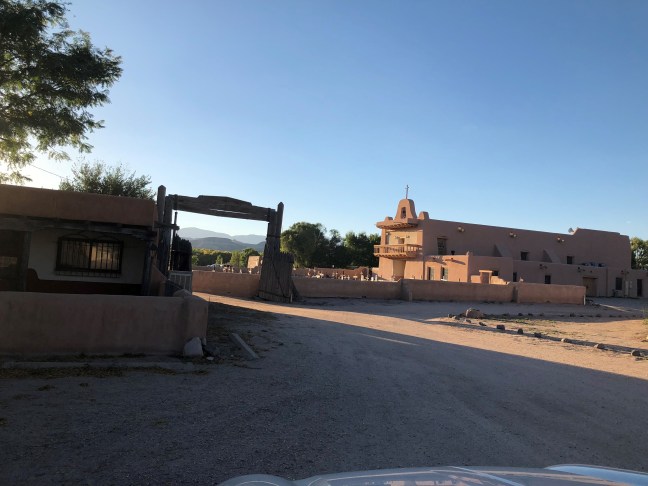
The history of Pueblo de San Ildefonso dates back to the 1300s when the original inhabitants moved from the Bandelier area to this location after a prolonged drought.  The Pueblo is close to the Rio Grande. These Ancient Puebloans had originally come from the settlement at Mesa Verde, Colorado.

In the 1500s, the Puebloans came in contact with the Spanish. In 1591, Casper Castaño visited the Pueblo. Then, in 1595, Antonio Gutierrez de Umana, and Francisco Leyba de Bonilla headed an unauthorized expedition into New Mexico. They made San Ildefonso their main headquarters.

In 1598, Juan de Oñate came to the area and officially gave the Pueblo its name. Around this time, the village was moved to its present location. Later in 1610, Fray Andrés Bautista created the first permanent mission here.

But the Spanish brought troubles to the people. They required that the Pueblo communities pay tribute to them as well as convert to Catholicism. The Pueblo Revolt of 1680 resulted in the Spanish being expelled from the region for a while, and the San Ildefonso people were a major part of that uprising.

The people resisted the Spanish for several more years after they came back to the area. It wasn’t until 1694 that the Spanish were able to remove the Tewa and Tano people from the mesa. Then, a drought in 1695 that weakened the colonists encouraged the Pueblos to rebel again in 1696. But the mission was reestablished, and a church was built in the village in the 1700s.

In 1821, the area was ruled by Mexico. In 1848, after the Treaty of Guadalupe Hidalgo, it became part of the United States. After Congress created the reservation system in 1858, a grant of over 17,000 acres of land was given to the village in 1864. It is still a federally recognized tribe.

The Pueblo is today comprised of 60,000 acres and about 750 people live there. It is made up of traditional kivas, a central plaza and a 1960s replica of a 1700s church.

Historical Marker Inscription

Pueblo de San Ildefonso Historical Marker

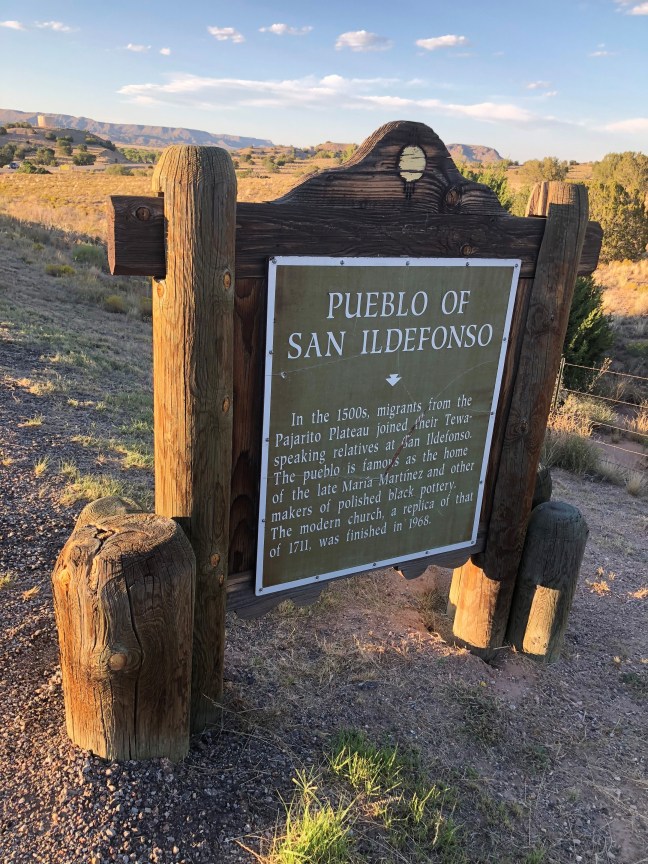
In the 1500s, migrants from the Pajarito Plateau joined their Tewa-speaking relatives at San Ildefonso. The pueblo is famous as the home of the late Maria Martinez and other makers of polished black pottery. The modern church, a replica of that of 1711, was finished in 1968.

Location

Off State Road 502 along the Rio Grande Valley, East of Los Alamos

N 35.89197, W 106.11836

Carrollton Neighborhood Historical Marker, New Orleans

Carrollton Neighborhood Historical Marker, New Orleans

The Carrollton Historic District is approximately two and a half square miles with buildings that date from around 1880 to 1937. The town of Carrollton began on the site of the former Macarty sugar plantation, which was originally located in Jefferson Parish. The property had been acquired by Laurent Millaudon, Samuel Kohn and John Slidell, real estate investors, as well as the New Orleans Canal and Banking Company. The land was subdivided in 1833, and the town of Carrollton was born.

The town was connected to New Orleans via the New Orleans and Carrollton Railroad, which would take passengers between the two areas two hours a day, seven days a week. Later in 1851, the Jefferson and Lake Ponchartrain Railroad was started. The ease of transportation created a real estate boom. The number of houses in the town went from 36 in 1841 to 1,470 within 10 years. People in the middle and upper classes lived in the area.

Incorporated on March 10, 1845, the town of Carrollton eventually became a city on March 17, 1859. It was even the parish seat from 1852 to 1874. It was finally annexed by City of New Orleans in 1874.

Historical Marker Inscription

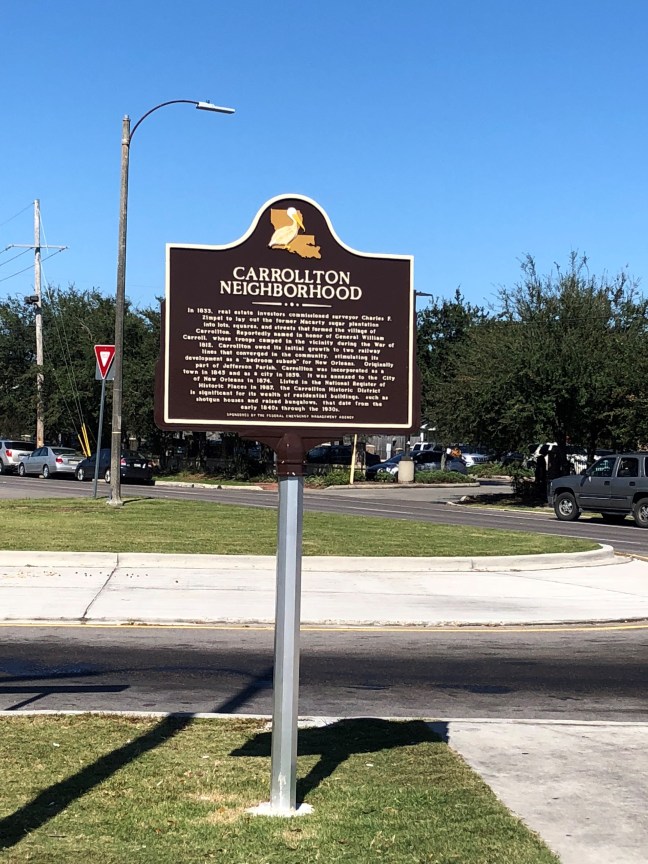
In 1833, real estate investors commissioned surveyor Charles F. Zimpel to lay out the former Macarty sugar plantation into lots, squares, and streets that formed the village of Carrollton. Reportedly named in honor of General William Carroll, whose troops camped in the vicinity during the War of 1812, Carrollton owed its initial growth to two railway lines that converged in the community, stimulating its development as a “bedroom suburb” for New Orleans. Originally part of Jefferson Parish, Carrollton was incorporated as a town in 1845 and as a city in 1859. It was annexed to the City of New Orleans in 1874. Listed in the National Register of Historic Places in 1987, the Carrollton Historic District is significant for its wealth of residential buildings, such as shotgun houses and raised bungalows, that date from the early 1840s through the 1930s.

Location

Intersection of South Claiborne Avenue and South Carrollton Avenue

29° 57.362′ N, 90° 7.245′ W

Escalante Canyon Historical Marker, Delta, CO

Escalante Canyon Historical Marker, Delta, CO

Escalante Canyon is a beautiful and historical canyon located near Delta, Colorado. The canyon is named after two Franciscan priests, Silvestre Vélez de Escalante and Atanasio Domínguez. They were part of expedition that happened in 1776 to find an overland route between Santa Fe, New Mexico, and a Roman Catholic mission in Monterey, California. While the priests didn’t actually pass through the canyon, it is still named after Escalante.

The canyon was formed over 600 million year ago and is a 1,300 foot deep gorge, carved by the Escalante Creek. The canyon features petroglyphs that trace back to the earliest people. It is known that the Ute Indians made the North Fork of the Escalante River their winter home, and early settlers eventually moved in to take advantage of the easy water supply, forcing many natives off their lands. Cattle outfits also began using the canyon in the late 1800s.

Escalante Canyon was a notable part of the Colorado Sheep War as well. The Spanish had introduced sheep into America, and their numbers had increased to over 2 million by 1896. Some settlers also brought sheep with them when the area was opened to settlers in 1882. With the rise of cattle in the region, conflicts between two sides for grazing lands was inevitable.

Cattle owners would threaten sheep owners by wearing masks. These marauders eventually became known as the Night Riders. In 1915, the Night Riders attacked at a band of sheep in the Oh-Be-Joyful Creek area. They drove a herd of 200 sheep of a cliff while the owner was tied to the tree. Then, on June 9, 1917, Ben Lowe and a former local Delta County sheriff, Cash Sampson, died during a shootout, each falling to the other’s gun.

The two had supper at J.W. Musser’s ranch. When they were leaving, they got into an argument that left both men dead only a few feet apart. While there were no witnesses to the argument, it is very likely that it was due to Sampson investigating Lowe as being part of the sheep slaughter than had taken place previous year.

Within the canyon, you can find the stone cabin of Captain Henry A. Smith, who was a Civil War veteran. He used local sandstone to build his cabin and made his living as a tombstone carver. The cabin is located 18 miles from the Escalante Bridge.

Historical Marker Inscription

Named after one of the two priests Escalante and Dominguez after their expedition in 1776. Rich in history this canyon has seen its share of human beings starting with the earliest Native Americans since circa 700 AD. After the Civil War, Captain Henry A. Smith, a tombstone carver, made this canyon his home. The canyon hosted the Colorado Sheep War during March 1916 and a shootout left residents Cash Sampson and Ben Lowe dead.

The previous plaque was dedicated June 12, 2003.

This plaque rededicated July 17, 2010 by Al Packer Chapter 100

E Clampus Vitus

Location

US-50 E, Delta, CO 81416

38° 47′ 2.760″ N, 108° 14′ 47.970″ W

The Historic Fort Collins Weather Station

The Historic Fort Collins Weather Station Historical Marker

Located on the campus of Colorado State University near the Lory Student Center, the Historic Fort Collins Weather Station began collecting data in the 1870s. It was located near the site of the “Old Main” building, which was lost to arson in 1970.

Data is available in both digital and hard copy forms dating back to 1889, and data is updated every 10 minutes. This data includes information about humidity, wind speeds and direction, temperature, pressure, soil temperatures and solar radiation.

Colorado State University

Historical Marker Inscription

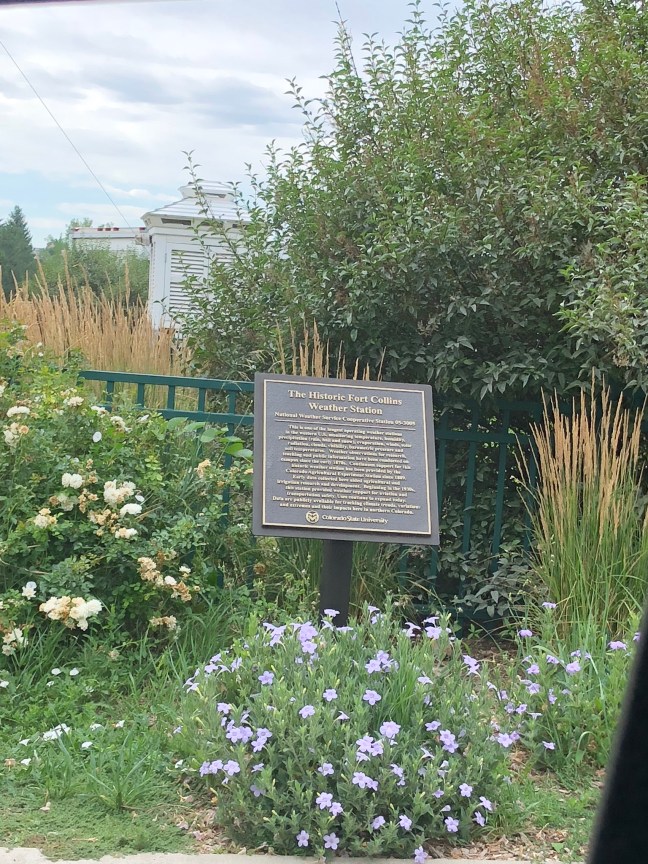
This is one of the longest operating weather stations in the western U.S. monitoring temperature, humidity, precipitation (rain, hail and snow), evaporation, winds, solar radiation, clouds, visibility, barometric pressure and soil temperatures. Weather observations for research, teaching and public information have been conducted on campus since the early 1870s. Continuous support for this historic weather station has been provided by the Colorado Agricultural Experiment Station since 1889. Early data collected here aided agricultural and irrigation research and development. Beginning in the late 1930s, this station provided weather support for aviation and transportation safety. Uses continue to expand today. Data are publicly available for tracking climate trends, variations and extremes and their impacts here in northern Colorado.

Location

Colorado State University, Fort Collins, CO 80523

40° 34.582′ N, 105° 5.158′ W

St. Mary’s German Catholic Parish Historical Marker

St. Mary's German Catholic Parish, Sandusky, OH

St. Mary’s Catholic Church was founded by German immigrants who had been worshiping at Holy Angels. Holy Angels had been originally comprised of both English and German immigrants, but the German immigrants broke off from the English group to form their own congregation and the second Catholic Parish in Sandusky, OH. The property for the parish was purchased on June 20, 1855. The original church itself was finished in 1856.

Originally, the Germans who had come to America were led by Father John P. Dolweck, who had been appointed by the Right Reverend Louis Amadeus Rappe, Bishop of the Diocese of Cleveland. He was succeeded by Father James J. Hamene. He helped complete the first church and rectory.

By 1857, St. Mary’s also had a school. In 1873, the parish began building a new church under the direction of Father Nicholas Moes, who hired Franz George Himpler to oversee the construction. Seven years later the new church was completed and dedicated to Mary, Mother of Sorrows. It is the largest church in the City of Sandusky.

St. Mary's German Catholic Parish, Sandusky, OH Historical Marker

Historical Marker Inscription

Side A:

During the 1840’s and the early 1850’s, the English-speak and the German-speaking immigrant Catholics of Sandusky formed on Congregation – Holy Angels. Increased emigration from Germany convinced Bishop Amadeus Rappe of the Diocese of Cleveland to permit a separation in 1853. The German congregation was assigned a pastor and chose the name St. Mary’s, but continued to use Holy Angels for separate services.

On June 20, 1855 the congregation became an independent parish when two lots were purchased on the S.E. corner of Jefferson and Decatur Streets. A stone church was begun at once and finished the following year.

This marker commemorates the 150th anniversary of the founding of St. Mary’s Parish

20 June 2005

St. Mary's German Catholic Parish, Sandusky, OH Historical Marker

Side B:

Architect: Francis George Himpler – 1833-1916

In 1867 six lots on Central Avenue and on Fulton Street were purchased as the site for a new and larger church. The architect based his plans for St. Mary’s on the first pure Gothic ecclesiastical structure in Germany the ELISABETHKIRCHE in Marburg. Begun in 1235 A. D. by the Knights of the Teutonic Order, the church was for centuries a pilgrimage site to the tomb of St. Elizabeth.

The cornerstone for the new St. Mary’s was laid on Sept. 28, 1873. Seven years later it was completed. On Nov. 28, 1880 Bishop Richard Gilmour, D. D. of the Diocese of Cleveland dedicated the church to Mary, the Mother of Sorrows.

The dimensions are: 76 feet wide by 184 feet long.

The spire is 200 feet high.

This marker commemorates the 125th anniversary of the dedication of the church

28 September 2005

Location

429 Central Ave, Sandusky, OH 44870

41.45231960171621, -82.7138909

The Mammoth Site of Hot Springs, SD, Historical Marker

Mammoth Site Hot Springs, SD

The Mammoth Site in Hot Springs, South Dakota, is an active dig site that allows visitors to view different fossils from the Ice Age, mainly mammoth, including tusks and skulls. The Mammoth Site was discovered in June 1974 when heavy equipment operator, George Hanson, began leveling ground to build a housing development. While grading a hill, Hanson discovered a tusk and other bones.

Phil Anderson, the landowner, contacted several universities to see if they were interested in seeing the find. All declined. George Hanson instead took the bones to his son, Dan Hanson, who had taken classes in archaeology and geology. He then called his former college professor, Dr. Larry Agenbroad, who later contacted Dr. Jim Mead.

Mammoth Site, Hot Springs, South Dakota

In 1975, Dr. Agenbroad and Dr. Mead along with volunteer students started excavating the area. What they found was a massive mammoth graveyard due to an ancient sink hole (animals would come to drink or eat at the location, fall in and couldn’t escape due to the steep, slippery sides). By the end of 1975, realizing that the area was of major interest to science, Phil Anderson along with the local community founded The Mammoth Site of Hot Springs, SD, Inc.

There is a fee to enter the active dig site.

Historical Marker Inscription

Mammoth Site, Hot Springs, SD, Historical Marker

Gigantic mammoths, ancestors of the majestic elephants of today, once roamed freely across the High Plains of North America. A repository of their remains, along with other kinds of animals, lay undisturbed until their discovery over 26,000 years later, in June of 1974.

Limestone deposits beneath the earth’s surface dissolved in water from underground springs. The land then collapsed and the resulting sinkhole filled with 95 degree water that lured mammoths to drink or feed on vegetation. Once in the water they could not get up the slippery, steep incline. Death by starvation or drowning was the fate of most animals that came to the sinkhole. Along with the mammoth, remains of the giant short-faced bear, white-tailed prairie dog, fish and other associated fauna have also been found at the site.

As centuries passed, the sinkhole gradually filled. Rain, snow and wind wore away the soil leaving a hill of buried skeletons. This hill remained undisturbed until 1974 when excavation for a housing project by Phil and Elenora Anderson revealed bones and tusks of these huge animals.

Location

1800 US 18 Bypass, Hot Springs, South Dakota 57747
N 43° 25.370 W 103° 29.028

Andrew Bryan – Savannah, GA, Historical Marker

Andrew Bryan - Georgia Historical Markers

Andrew Bryan was born in 1737 on a plantation in Goose Creek, South Carolina, which is near Charleston. Born a slave, he served as a coachman and body servant for Jonathan Bryan. Jonathan Bryan, his brother Hugh and a number of other planters had been arrested for preaching to slaves. They had been part of a group of plantation owners who had been trying to evangelize to the slaves.

Andrew become a Baptist in 1782, converted by George Liele, who was the first black Georgian Baptist. Both Andrew and his wife, Hannah, were baptized by Liele. Andrew continued to preach to small groups near Savannah even after Liele left the area.

Andrew was supported by the planters, and he wound up building a shack for his flock, which even included a handful of white people. Still, there were a number of masters who refused to allow their slaves to be baptized. And, many Georgian masters forbade their slaves to listen to sermons by Andrew due to fears of uprisings and desertions. Many of the slaves who attended the sermons were imprisoned, harassed and whipped. Even Andrew was imprisoned. When released, Bryan’s masters allowed him to continue preaching on a barn on the property.

In 1788, a white minister by the name of Abraham Marshall officially recognized Andrew’s small flock. He baptized more than 40 members of the group and ordained Andrew. After Jonathan Bryan died, Andrew Bryan purchased his freedom and raised money to erect a church in Savannah, Georgia, in 1794.

Starting with 575 members in 1788, the First African Baptist Church grew to nearly 2,800 members in 1831. By 1800, there were two satellite churches.

Andrew died on October 12, 1812, and he is buried in Savannah’s Laurel Grove Cemetery.

Historical Marker Inscription

Andrew Bryan was born at Goose Creek, S.C. about 1716. He came to Savannah as a slave and here he was baptized by the Negro missionary, the Reverend George Leile, in 1781. Leile evacuated with the British in 1782 at the close of the American Revolution and Bryan took up his work. He preached at Yamacraw and Brampton Plantation. On January 20, 1788, the Reverend Abraham Marshall (White) and the Reverend Jessie Peter (Colored) ordained Andrew Bryan and certified the congregation at a Brampton barn as the Ethiopian Church of Jesus Christ.

The Reverend Bryan moved from place to place with his congregation and was even imprisoned and whipped for preaching during a time when whites feared any slave gathering as a focus for rebellion. He persevered and finally bought his and his family’s freedom and purchased this lot for his Church. Andrew Bryan pastored until his death, October 6, 1812. He is buried in Savannah’s Laurel Grove Cemetery.

Location

The marker lies within the Yamacraw Square Park, which is located across the street from the First Bryan Baptist Church
565 West Bryan Street, Savannah, GA 31401

N 32° 04.937 W 081° 05.934

Site of St. Andrew’s Hall

St. Andrew's Hall Historical Marker

The St. Andrew’s Society was founded in Charleston, South Carolina, on November 30, 1729. Currently active, it is a social organization founded by men who were mainly of Scottish descent, but membership wasn’t limited to Scottish descendants. The purpose of the organization was to celebrate St. Andrew’s Day.

During the 1700s, the organization was extremely popular, and membership grew to include many of South Carolina’s most prominent people, including lawyers, planters, merchants and more. Through dues, gifts, admissions fees and bequests, it generated a substantial revenue and, through these, provided relief to the poor.

Officially incorporated in 1798, it opened a school for the poor on January 9, 1804, and began constructing its own hall in 1814. The hall was completed in 1815.

Throughout its history, the hall hosted many events, including social activities as well as being the meeting place for the Secession Convention. As the first state to secede from the Union, the Ordinance of Secession was officially passed at St. Andrew’s Hall on December 20, 1860.

The building burned on December 11, 1861, which was part of The Great Fire of 1861. This fire burned throughout Charleston, destroying vast extents of the city.

St. Andrew's Hall Historical Marker

Historical Marker Inscription

Site of the St. Andrew’s Hall
Designed by Hugh Smith
for
the St. Andrew’s Society of Charleston, S.C.
founded in 1729,
the oldest benevolent organization in the
State of South Carolina
corner stone laid July 4, 1814,
building destroyed by fire December 11, 1861.

Here such societies as the South Carolina Jockey Club, the St. Cecilia society, and the Hebrew Benevolent Association also held their meetings: Here President James Monroe and the Marquis de Lafayette were lodged as guest of the city; and here on December 20, 1860, was passed the South Carolina Ordinance of Secession.