Blog

Copper Country, Nevada

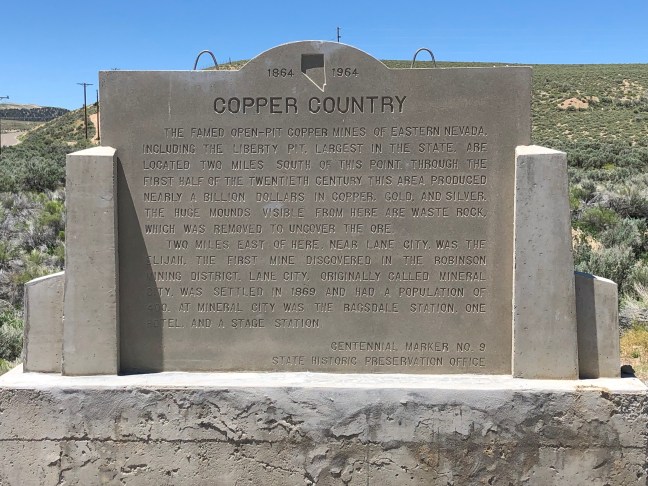
Copper Country Historical Marker, Nevada

Eastern Nevada’s copper boom was known locally as the “Age of Kennecott“, after the Kennecott Copper Company, which was the world’s leader in copper output throughout much of the twentieth century.

The Liberty Pit was the largest copper mine in the state at an elevation of 7,001 feet. It started production in 1907. The ore that was mined in the area consisted of copper, chalcocite and fluorite. The minerals in the area can be traced back to the Upper Cretaceous period, which was from 100.5 to 66 million years ago.

Historical Marker Inscription

The famed open-pit copper mines of Eastern Nevada including the Liberty Pit, largest in the state, are located two miles south of this point. Through the first half of the twentieth century, this area produced nearly a billion dollars in copper, gold, and silver. The huge mounds visible from here are waste rock, which was removed to uncover the ore.

Two miles east of here, near Lane City, was the Elijah, the first mine discovered in the Robinson Mining District. Lane City, originally called Mineral City, was settled in 1869 and had a population of 400. At Mineral City was the Ragsdale Station, one hotel and a stage station.

Nevada Centennial Marker No. 9
State Historic Preservation Office

Location

Intersection of U.S. 50 and Nevada Route 267, near Ruth, Nevada

39° 17.015′ N, 114° 57.855′ W

Adams County, Gettysburg, Pennsylvania

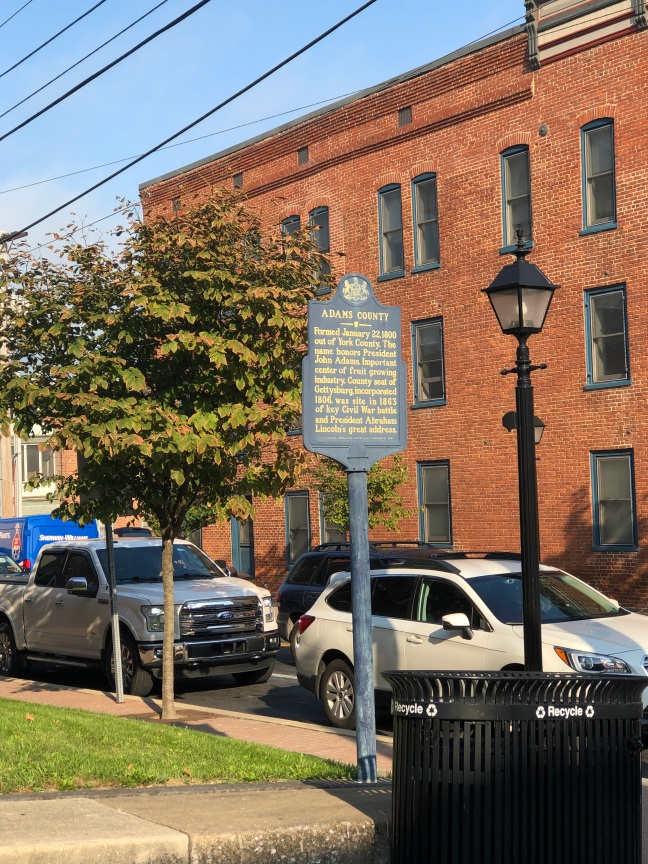
Adams County, Pennsylvania

Gettysburg – the location of a key battle of the American Civil War – is the county seat of Adams County. The county was founded on January 22, 1800. The Battle of Gettysburg was fought between July 1 – 3, 1863.

According to the U.S. Census Bureau, the county is 522 square miles, and the Borough of Gettysburg is located at the center of the county.

Historical Marker Inscription

Formed January 22, 1800 out of York County. The name honors President John Adams. Important center of fruit growing industry. County seat of Gettysburg, incorporated 1806, was site in 1863 of key Civil War battle and President Abraham Lincoln’s great address.

Location

111 Baltimore Street, Gettysburg, PA, 17325 United States

39° 49′ 46.620″ N, 77° 13′ 52.380″

Shady Grove School/Community Building, DeRidder, LA

Shady Grove School/Community Building Historical Marker

The Shady Grove School was completed in 1953 on six acres of land, which had been donated by Roland and Ida Pompey. The school was created to centralize the education of African American children in the Vernon, Louisiana, and the surrounding communities. The school hosted children in grades first through eighth.

The elementary school was active until 1969 when sections were moved to the newly established Vernon Elementary School. Afterwards, the site was given to the City of Vernon, and it is now a public park named Shady Grove Park.

Shady Grove School/Community Building (2)

Historical Marker Inscription

Built 1919 – used as a school until 1928. Bought by community families to be used for cultural and social activities. Placed on the National Register of Historic Places December 2002.

Location

Intersection of State Highway 26 and Don Gray Road, DeRidder, Louisiana

30° 48.254′ N, 93° 10.494′ W.

City of Eunice, LA, Historical Marker

City of Eunice, Louisiana, Historical Marker

The City of Eunice, Louisiana, is located in St. Landry Parish, and it is considered to be a part of the Lafayette Metropolitan area. The city was founded by C.C. Duson, who named the area after his second wife. Duson had previously founded Crowley, LA, as well.

As part of his founding the area, he added 160 acres to the town, and Duson was also responsible for linking Eunice to the Southern Pacific Railroad. The village was officially chartered on September 12, 1894, and it was later reincorporated on June 4, 1895.

Eunice is considered the “prairie” Cajun capital of Louisiana.

Historical Marker Inscription

On this site C.C. Duson drove a stake and said: “On this spot I will build a town and name it for my wife, Eunice.” An auction of lots was held here to start the town, Sept. 12, 1894. Depot listed on the National Register of Historic Places.

Location

Located near 220 S CC Duson St, Eunice, LA 70535

30° 29.589′ N, 92° 24.906′ W

The Natchez Burning Historical Marker – Mississippi Blues Trail

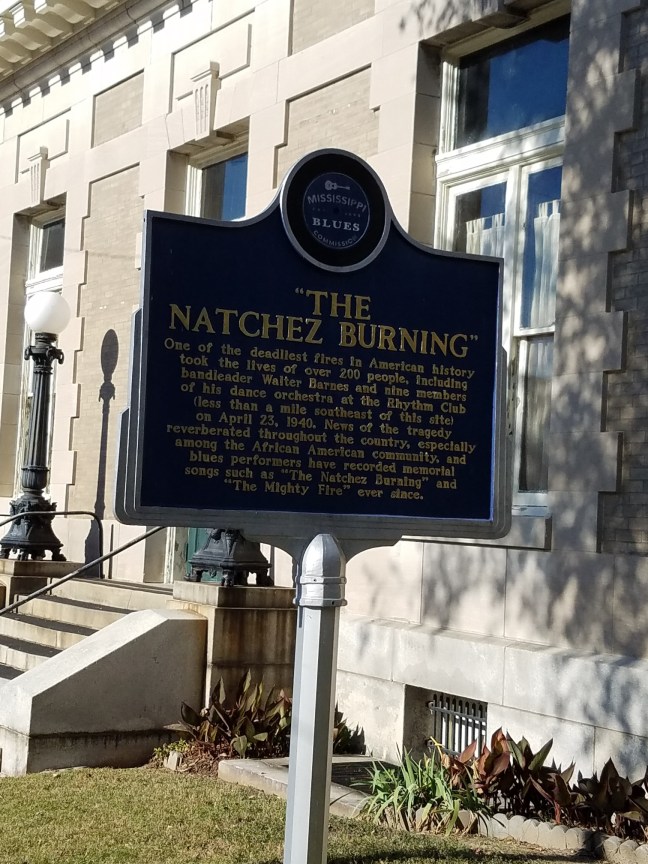
Natchez Burning Historical Marker

The Rhythm Club was a dance hall that was a central part of life for African Americans in Natchez, MS. The Rhythm Club Fire occurred on April 23, 1940, killing 209 people.  All the people who died in the club were African American.

While this has become a case study for firefighters, and it ranks in the top five of deadliest fires, few in the public actually know about the tragedy.

On the night of the fire, band leader Walter Barnes and His Royal Creolians added an additional stop on their tour in Natchez. Since Walter Barnes was extremely popular, the club was packed, with over 700 people paying the cover to hear them.

At some time near midnight, a fire broke out at the club’s entrance. It quickly spread, helped by flammable insecticide that had been put on the Spanish moss.

With boarded-up exits, and the front doors the only way out, the crowd rushed to the front. Since the doors swung inwards, the rush of the crowd prevented the doors from opening. Hundreds were trapped inside with the band still played to try and calm the crowd.

Many who died were teens. Many deaths were caused by asphyxiation or from being scalded to death when the water from the fire hoses came in contact with the corrugated metal, which caused deadly steam. Others were trampled to death as people tried to reach the exit. The rest were burned.

The club owner and Walter Barnes and many of his band members were among the dead.

Historical Marker Inscription

One of the deadliest fires in American history took the lives of over 200 people, including bandleader Walter Barnes and nine members of his dance orchestra at the Rhythm Club (less than a mile southeast of this site) on April 23, 1940. News of the tragedy reverberated throughout the country, especially among the African-American community, and blues performers have recorded memorial songs such as “The Natchez Burning” and “The Mighty Fire” ever since.

Location

Intersection of Main Street and North Wall Street, Downtown, Natchez, Mississippi

N31° 33.651′, W 91° 24.249′

Gainesville Volunteers, Gainesville, MS

Gainesville Volunteers Historical Marker, Gainesville, MS

Located on the Louisiana and Mississippi border is the town of Gainesville, located in Hancock County. In the past, the town was an active port on the Pearl River, but declined during the 1800s. Later in 1962, the land was acquired by NASA and is now home to the Stennis Space Center.

The Gainesville Volunteers served the Confederate States of America during the American Civil War. It was organized in 1860 and served at Vicksburg and Atlanta. It made up the Company G of the Third Mississippi Infantry.

Historical Marker Inscription

GAINESVILLE VOLUNTEERS

In 1860, John Deason, a Mexican War veteran, organized a militia company here. The “Gainesville Volunteers” entered Confederate service in 1861 as Co. G of the Third Mississippi Infantry. During the Civil War, the unit served in the Gulf Coast region and fought in the Vicksburg, Atlanta, Middle Tennessee, and Carolina campaigns.

Location

Mississippi Welcome Center, Interstate 10, Mile Marker 2, Gainesville, MS – Border of Louisiana and Mississippi

30° 18.789′ N, 89° 36.002′ W

L’Ouverture Hospital Historical Marker, Alexandria, VA

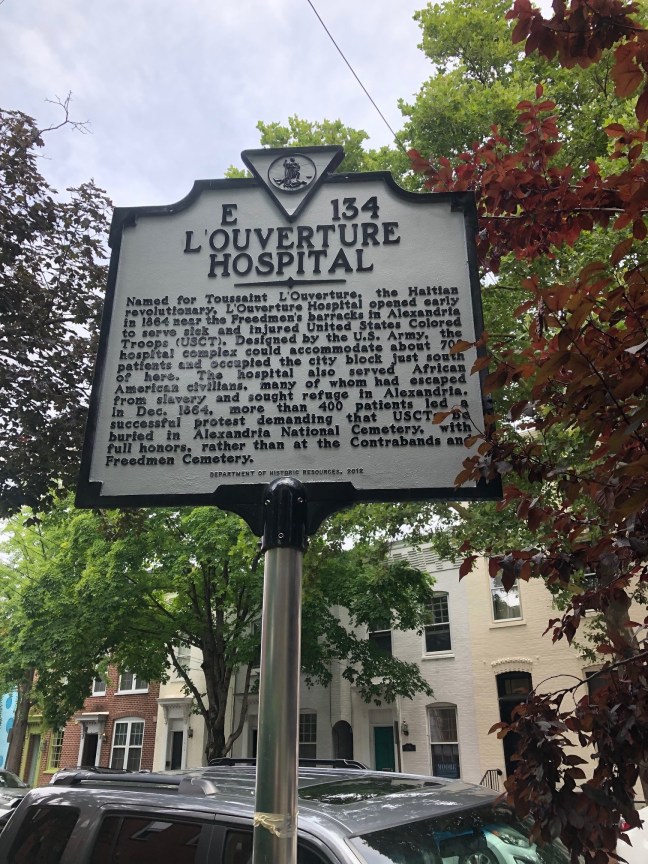
L'Ouverture Hospital Historical Marker, Alexandria, VA

Named after Toussaint L’Ouverture (1743-1803), the slave leader of the Haitian Revolt, the hospital was completed in 1864. On land formerly owned by slave dealers in Alexandria prior to the Union Army taking control of the area in 1861, the hospital served U.S. Colored Troops. It also treated former enslaved African Americans.

The hospital treated more than 1,400 soldiers from 1864 to 1865. The complex consisted of a cook house, mess hall, dispensary, tents, housing and jail.

A successful protest in 1864 resulted in African American soldiers being interred in Alexandria National Cemetery as opposed to the Contrabands or Freedmen Cemetery.

Historical Marker Inscription

Named for Toussaint L’Ouverture, the Haitian revolutionary, L’Ouverture Hospital opened early in 1864 near the Freedmen’s barracks in Alexandria to serve sick and injured United States Colored Troops (USCT). Designed by the U.S. Army, the hospital complex could accommodate about 700 patients and occupied the city block just south of here. The hospital also served African American civilians, many of whom had escaped from slavery and sought refuge in Alexandria. In Dec. 1864, more than 400 patients led a successful protest demanding that USCTs be buried in Alexandria National Cemetery, with full honors, rather than at the Contrabands and Freedmen Cemetery.

Location

1302 Prince Street, Alexandria, VA 22314

38° 48.284′ N, 77° 3.245′ W

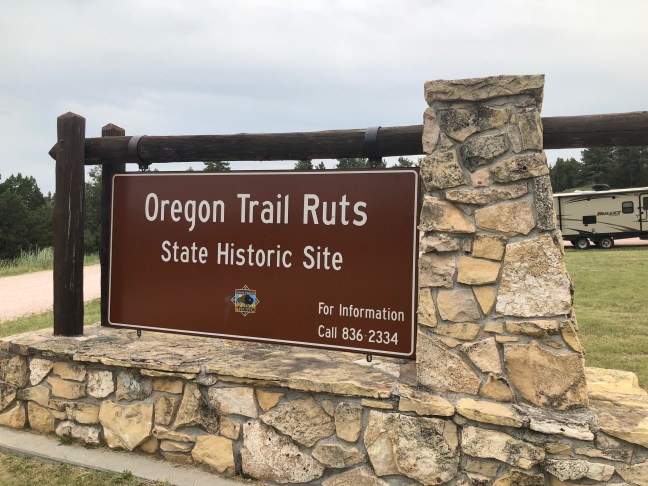
Oregon Trail Ruts, Guernsey, Wyoming

Oregon Trail Ruts, WY

The Oregon Trail Ruts are actual, highly visible ruts carved by the hundreds of thousands of travelers along the Oregon Trail. These ruts were left by the iron wagon wheel tires as well as cuts made by the emigrants who were moving westbound from 1841 to 1869 to ease the grade.

The first person to officially use the route was Robert Stuart and six companions in 1812. Over the years, many others also used the path, including trappers and traders.

The Bartleson-Bidwell party was the first wagon train of settlers to use the route in 1841. The goal of many of the more than 300,000 emigrants was to reach Oregon or California.

The road was used consistently until 1869 when the Union Pacific Railroad was completed.

Oregon Trail Ruts, WY

Historical Marker Inscription

Oregon Trail Ruts, Wyoming Historical Markers

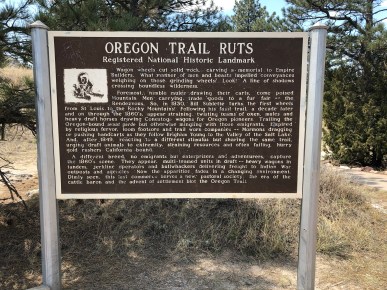
Oregon Trail Ruts

Registered National Historic Landmark

Wagon wheels cut solid rock, carving a memorial to Empire Builders. What manner of men and beasts impelled conveyances weighting on those grinding wheels? Look! A line of shadows crossing boundless wilderness.

Foremost, nimble mules drawing their carts, come poised Mountain Men carrying trade goods to a fur fair — the Rendezvous. So, in 1830, Bill Sublette turns the first wheels from St. Louis to the Rocky Mountains! Following his faint trail, a decade later and through the 1860’s, appear straining, twisting teams of oxen, mules, and heavy draught-horses drawing Conestoga Wagons for Oregon Pioneers. Trailing the Oregon-bound avant-garde but otherwise mingling with those emigrants, inspired by religious fervor, loom footsore and trail worn companies — Mormons dragging or pushing handcarts as they follow Brigham Young to the Valley of the Salt Lake. And, after 1849, reacting to a different stimulus but sharing the same trail, urging draft animals to extremity, straining resources and often failing, hurry gold rushers California bound.

A different breed, no emigrants but enterprisers and adventurers, capture the 1860’s scene. They appear, multi-teamed units in draft — heavy wagons in tandem, jerkline operators and bullwhackers delivering freight to Indian War outposts and agencies. Now, the apparition fades in a changing environment. Dimly seen, this last commerce serves a new, pastoral society; the era of the cattle baron and the advent of settlement blot the Oregon Trail.

Location

N 42° 15.363, W 104° 44.908

Near Guernsey, WY

Ward Mining District, Nevada

Ward Mining District, Nevada Historical Marker

Ward is a ghost town located near Ely, Nevada, once known for its silver ore. In 1875, it was the largest town in White Pine County with a population of of over 1,000. Located at over 8,000 feet in elevation, it boomed from approximately 1876 to 1882, with a peak in 1877 due to new discoveries. The Martin White Company of San Francisco bought all the existing mines in 1875.

By 1877, the town had over 2,000 residents. During this time Wells Fargo opened, and a city hall was constructed.

While crime did happen early on, it became nearly crime-free due to the 601 Vigilantes. Reportedly, the name came from “six feet under, no trial, and one rope“. By 1878, the town began to decline due to disappearing ore deposits and the rise of Cherry Creek, another mining town. By 1885, there was only one operating business.

Basically a ghost town by this point, it would see some revival from 1906 to 1920 when the Martin White Company sold its holdings to the Nevada United Mines Company.  As of the present, it still is an active mining area.

Historical Marker Inscription

Nevada State Historical Marker No. 54

Silver Ore

The ghost town of Ward, in the foothills of the Egan Range, lies some eight miles west of here. Booming from 1876 until 1882, with a peak population of 1,500, Ward was somewhat of a lawless mining camp. Early killings did occur, but justice was meted out by the vigilante committee and the hanging rope.

A million dollars worth of silver was taken from a single chamber of the Ward mine, yet an abandoned house was used for the first school and no movement was ever started to build a church.

The town was abandoned by the late 1880s, but new discoveries and better mining methods prompted a resurgence of activity in 1906 and again in the 1960s.

Location

N 39° 05.333, W 114° 45.173

Located on U.S. 93 in White Pine County near Ely, Nevada

Willow Shade

Willow Shade Historical Marker

Willow Shade was the childhood home of Willa Cather, who was renown for writing stories about life on the Great Plains. Willow Shade was actually mentioned in her last novel, Sapphira and the Slave Girl, which was written in 1940.

“The slats of the green window shutters rattled, the limp cordage of the great willow trees in the yard was whipped and tossed furiously by the wind. I had been put in my mother’s bed so that I could watch the turnpike, then a macadam road with a blue limestone facing.”

Cather wrote 12 novels, many works of nonfiction and 6 collections of short fiction. She died on April 24, 1947 in New York City.

Historical Marker Inscription

This house, built in 1858, was the childhood home of novelist Willa Cather from 1874 to 1883, when she moved with her family to Nebraska. It was the setting of the final chapters of her novel Sapphira and the Slave Girl. Willa Cather was born December 7, 1873, one mile south in the community of Gore then known as Back Creek Valley.

Location

39° 16.139′ N, 78° 18.535′ W, near Gore, Virginia