Blog

Headwaters of the Sabine River

The Sabine River is over 500 miles long and moves from Upper East Texas to the east and empties into the Gulf of Mexico. It starts in Hunt, Collin and Rockwall counties, and then flows towards Logansport, Louisiana, before it finally discharges near Orange, Texas. This river had served as the boundary between multiple territories, including the United States, Mexico, Spain and France.

The original name of the river was Sabinas, the Spanish name for red cedars, which are known to grow on its banks.

Historical Marker Text

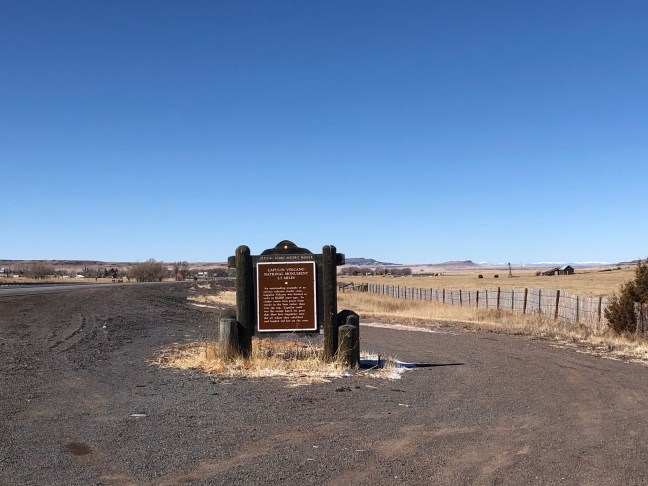
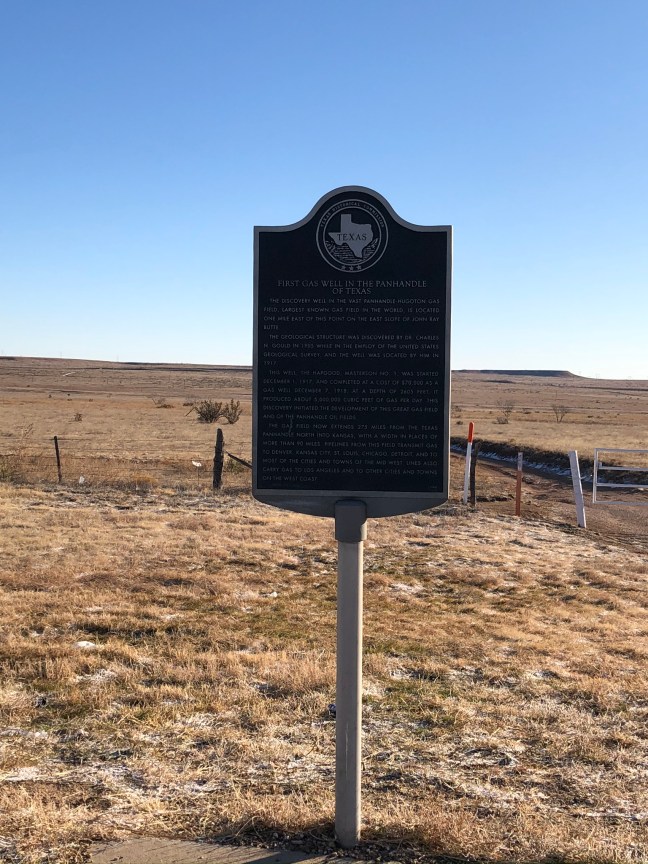
A half mile to the west rises the Sabine River, lower channel of which separated New World empires of France and Spain and in 1836 became Republic of Texas – United States border. Fork here is called Cow Leach, for Indian chief who lived in the area. This marker is on a 3-way watershed: flow to the north goes into the Sulphur and to the Mississippi; the west drains to the Trinity; south goes into the Sabine, which forms Texas-Louisiana boundary and pours more water into Gulf of Mexico than any other Texas river (6,400,000 acre feet annually).

Location: Off Highway 69, Celeste, TX 75423
N 33° 19.366 W 096° 12.455

Louisiana: Site of Battle of Jackson Crossroads

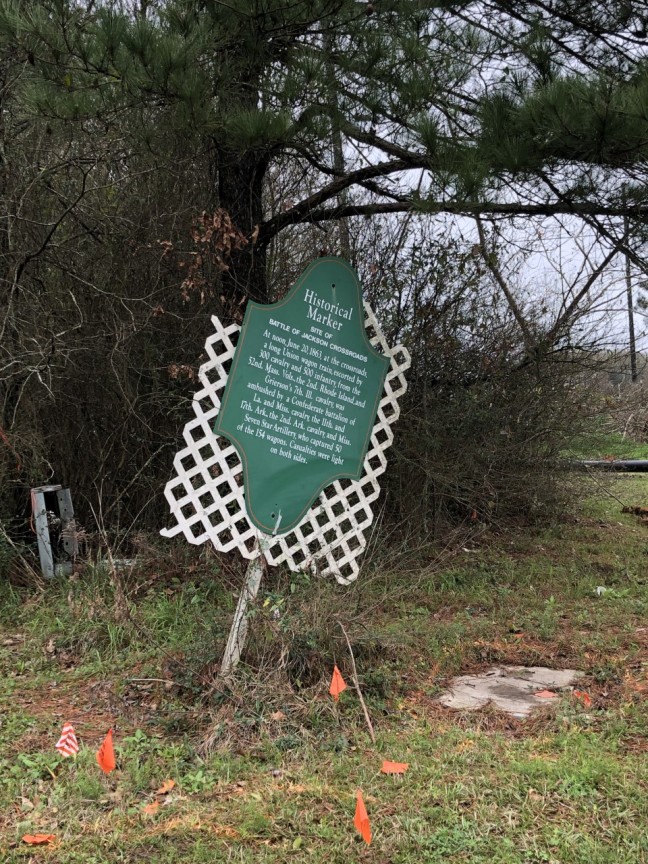
If you’re driving into Jackson, Louisiana, you might miss this historical marker. It sits near a light and is nearly tumbling over. But this hidden marker (green with a white picket fence background) marks the spot of a battle of the Civil War. In fact, Civil War reenactors regularly re-enact this battle on a field off Highway 68 near the original battle location.

The Historical Facts

Jackson was actually the location of two Civil War battles during 1863. The Union was trying to siege Port Hudson. This 48-day siege took place from May to July of 1863 when the Union was trying to recapture the Mississippi River so the Confederacy wouldn’t be able to use the river to transport supplies. While the siege failed, the river was eventually taken by the Union after Vicksburg fell.

Benjamin Henry Grierson, whose cavalry took part in the Battle of Jackson Crossroads, was known for the “Grierson’s Raid”, which was an expedition through Confederate holdings that successfully severed enemy communication lines between Vicksburg, Mississippi, and leaders in the East.

Historical Marker Text

“At noon, June 20, 1863, at the crossroads, a long Union wagon train, escorted by 300 cavalry and 500 infantry, from the 52nd. Mass. Vols., the 2nd. Rhode Island, and Grierson’s 7th. Ill. cavalry, was ambushed by a Confederate battalion of La. and Miss. cavalry, the 11th. and 17th. Ark., the 2nd. Ark. cavalry, and Miss. Seven Star Artillery, who captured 50 of the 154 wagons. Casualties were light on both sides.”

Location: 30.8374° N, 91.2176° W

Jackson, LA 70748 East Feliciana Parish. It is located at the intersection of Charter Street (State Highway 10 and Carrs Creek Road (State Highway 68) at the stoplight.

Littlefield Building, Austin

The Littlefied and Scarbrough buildings in Austin have lined the cityscape for over a century. In fact, these used to be the tallest buildings in Austin. The Littlefield Building actually as the tallest building between New Orleans and San Francisco during the early 1900s.

Littlefield was home to the American National Bank. Built by a former Confederate army major and president of the National Bank, George Littlefield started the groundwork for the new location of the bank in 1910. It was previously in the same location as the historic Driskill Hotel .

George Littlefield was a major player in the Austin area. During the first 50 years of the University of Texas, he was the college’s biggest financial contributor.

When the Littlefield building was completed in 1912, it was eight stories tall and had a garden rooftop for events. Then, he enclosed the top, creating a ninth story – effectively making it the tallest building in Austin.

To this day, the building is still home to office buildings.

Inscription

George Washington Littlefield (1842-1920) came to Texas from Mississippi in 1850. After serving in Terry’s Texas Rangers in the Civil War, he made his fortune ranching and driving cattle. He moved to Austin in 1883 and, in 1890, established the American National Bank, which included a ladies’ banking department. He hired architect C. H. Page, Jr., to design this Beaux Arts Classical building, which opened in 1912 with a rooftop garden. His bank was on the ground floor. For the corner entrance, he commissioned Tiffany’s of New York to cast bronze, Bas Relief doors by sculptor Daniel Webster. These were later donated to the University of Texas, of which Littlefield was a major benefactor.

Location

Latitude & Longitude: 30 15′ 58.043196″, -97° 44′ 31.835076″

Address: 601 North Congress, Austin, Texas


Kenner High School

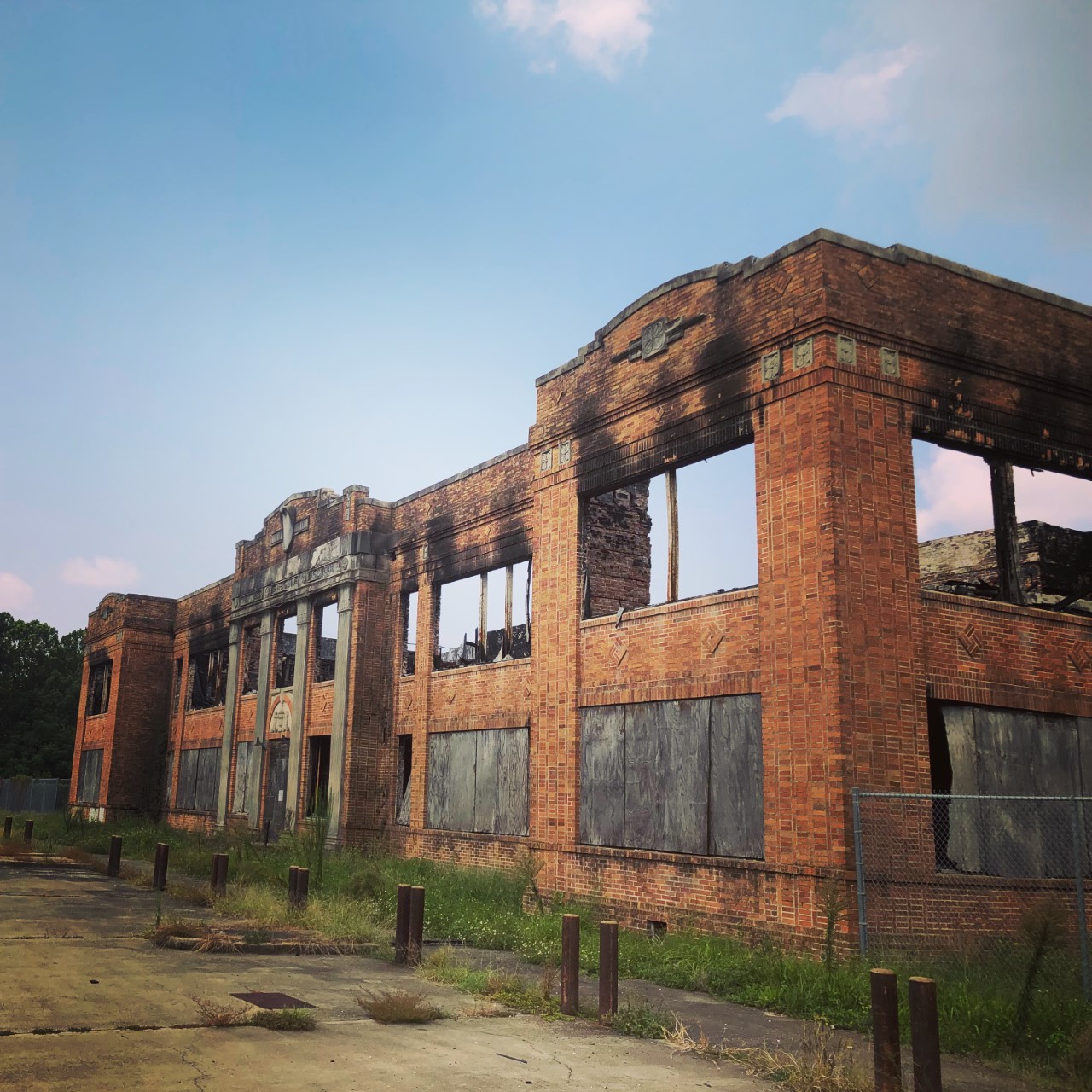
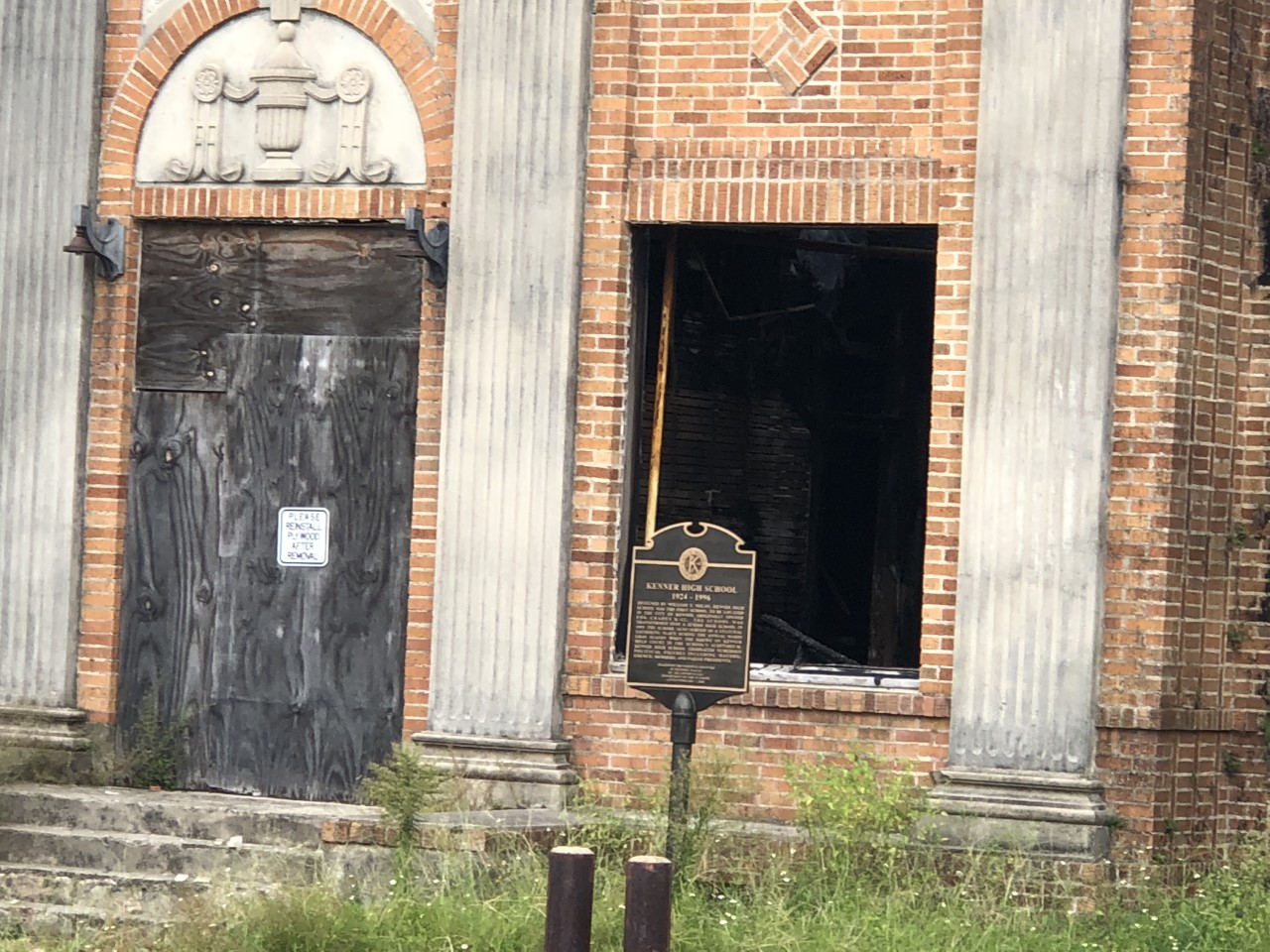
Behind a fence lies a ruin of a building that was once a high school and then a junior high school that existed for over 70 years. Gutted by a fire, this amazing building still holds court – as it once did for the Krewe of Kenner – on River Road. While you can’t get too close to the property, you can gaze through the fence at this amazing skeleton of a building.

The last senior to graduate from the school was in 1955, and it was a junior high school until it shut its doors in 1996.

There have been numerous plans to do something with this building, but as of this writing, it still sits as is. It’s been listed as one of New Orleans most endangered historic sites.

Kenner HS 3

Inscription

Designed by William T. Nolan, Kenner High School was the first school to be located in the City of Kenner. Originally opened for grades K-12, the school was transformed into a junior high school in 1955. The school also served as a cultural gathering place during the annual Mardi Gras season when the Krewe Of Kenner held court in the school’s auditorium. Kenner High School graduated numerous political figures including Mayors, Council members and Parish Presidents.

Placed on the National Register of Historic Places by the United States Department of the Interior. Listed February 7, 2008.

Kenner HS 1

Location

29° 58.483′ N, 90° 15.151′ W

Address: 1601 Rev. Richard Wilson Drive, Kenner, Louisiana

Leadville Historical Marker

It was the lure of gold that caused Leadville to be founded. Placer gold was found by Abe Lee in California Gulch, which is about a mile east of Leadville, during the Pikes Peak Gold Rush in 1860. The first gold was discovered in April, but by the end of summer, the population of Leadville would reach over 10,000.

By 1866, nearly all the gold deposits were exhausted, and many miners left. The rest moved closer to town, which had been covered with a heavy, black sand. It was discovered that this sand was actually cerussite, which contains at least 15 ounces of silver per ton.

Leadville was again a boom town by 1879. With the new influx, hotels, brothels, saloons, restaurants and more were built. Many mines also were created, and fortunes were made, especially by silver magnate and Tabor Opera House builder Horace Tabor and even the Guggenheims. Horace Tabor would even give the site its official name, based on the lead ore found in the area.

The Marker Inscription

Entering The Cloud City. Altitude 10,152 Ft.

“Here on the roof-top of the nation flourished about 1844 the most famous silver mining camp in the world. Perhaps 30,000 fortune hunters made this town about 1890 the second largest city of Colorado. Here grew fabulous fortunes – among many of H.A.W. Tabor. A Gay and cultivated social life, violent labor contests, ambitious projects like the ice palace marked the city.

In 1860, gold was discovered nearby in California Gulch but soon exhausted. The miners scattered. Seventeen years later a heavy sand discarded by prospectors as a nuisance in the pine woods hereabouts was found to be silver carbonate.

Westward loom Mount Elbert, Colorado’s highest peak, and Mount Massive. The Sawatch (Blue Earth) range to the west and the Mosquito to the east contain several of the loftiest mountains in North America.

Healy House and Dexter Cabin State Museum, Harrison Avenue and East Tenth Street, depicts life in pioneer Leadville.”

Location: 39° 15.785′ N, 106° 17.459′


John B. “Texas Jack” Omohundro 1846-1880

As you’re entering Leadville on the south end of town on Highway 24, you’ll run into two historical markers: one is the main Leadville marker, and the second is dedicated to John B. “Texas Jack” Omohundro.

The History

Texas Jack lived from July 26, 1846 until June 28, 1880. He served as a Confederate soldier during the American Civil War and then later as a scout for the U.S. Army during the Indian Wars.

Texas Jack moved to Fort Hays, Kansas, in 1869. Here, he met both Wild Bill Hickok, famous gunfighter, gambler and showman, and California Joe Milner, who was a miner and frontier scout. Within the same year, he always become friends with William F. “Buffalo Bill” Cody, who was at Fort McPherson working with the 5th U.S. Cavalry.

By 1872, Cody and Texas Jack were appearing on stage together as part of the live show “Scouts of The Prairie”. In 1873, Wild Bill would join the show, which was renamed “Scouts of The Plains”. Throughout the 1870s, Texas Jack would be part of the theater.

Texas Jack died due to pneumonia on June 28, 1880 in Leadville, Colorado, about one month short of his 34th birthday. Unlike Hickok and Cody, he never became a household name.

To learn more about Texas Jack, check out the Buffalo Bill Center of the West site.

The Historical Marker

The inscription on the marker is as follows:

“Born in Virginia, Texas Jack came west after the Civil War at age 16 to become a cowboy. He later made a name for himself as a plainsman and U.S. government scout who led the Pawnee Indians on their summer hunts and was guide for such notables as the Earl of Dunraven.

In 1872, with friend W. F. (Buffalo Bill) Cody, he achieved national fame by starting the first wild west shows in America. (Texas Jack was honored posthumously in 1994 by induction into the National Cowboy Hall of Fame’s Hall of Great Western Performers located at Oklahoma City).

Jack and his lovely wife, the celebrated danseuse Mlle. Guiseppina Morlacchi resided in Leadville where on June 28. 1880 he died at age 33. He is buried in Leadville’s Evergreen Cemetery.”

Location: 39° 15.785′ N, 106° 17.459′

Olivier Plantation House & St. Mary’s Orphanage

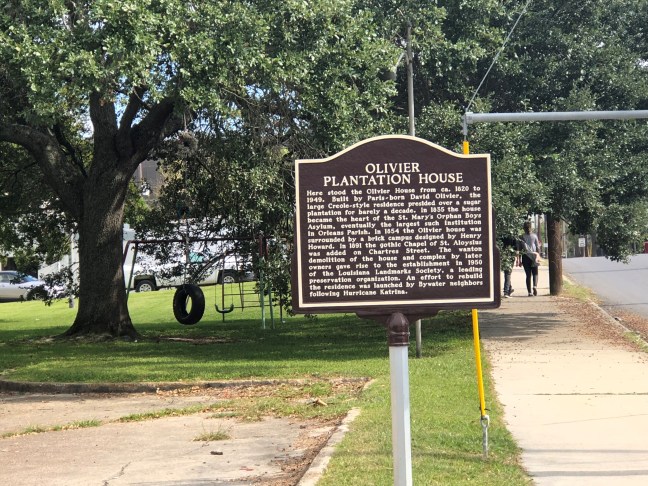
Olivier Plantation Historical Marker New Orleans

What is now an empty lot in the Bywater neighborhood of New Orleans used to be a plantation owned by Antoine David Olivier, who was born in Lyon, France in 1759. By the 1800s, he was living in America as a wealthy man. In the 1820s, he began building a lavish, West Indies-influenced, French Creole home near the Mississippi River. The house was part of an extensive plantation complex. In fact, the property was 2 arpents wide and 40 arpents deep. An arpent is an old French unit of land and is equivalent to about 1 acre. Olivier died in 1844, but the home had been sold before then.

In 1833, Etienne Carraby bought the place. It passed through several hands until Albert Piernas sold it right after the Civil War to the Sisters of the Order of the Holy Cross, which converted it into a boy’s orphanage.

During this time, the exterior buildings were torn down, including the kitchen, pigeonniers and stables. It became St. Mary’s Orphan Asylum, and a large dormitory wing was added to the house. The orphanage closed in the 1930s due to Huey P. Long placing most social services under the handling of the State of Louisiana. The building had begun to deteriorate, and it was eventually torn down in 1949.

Yet, there was some controversy to tearing this historical plantation down. A local historian tried to stop the demolition by talking to the contractor right before the bulldozer was set to tear it apart. The contractor and the leaseholders gave the historian a few weeks to try and save the property. He along with a few other interested parties tried everything from attempting to get a company to renovate the property to raising money.

When no plans worked, they instead worked to salvage some of the architecture, and some final pictures were taken. Yet, the simple act of tearing down an old building would create a coalition dedicated to preserving Louisiana historical places.

You can see pictures of the original building on this website. You can also read how the demolition of this plantation led to the creation of the Louisiana Landmarks Foundation in this article.
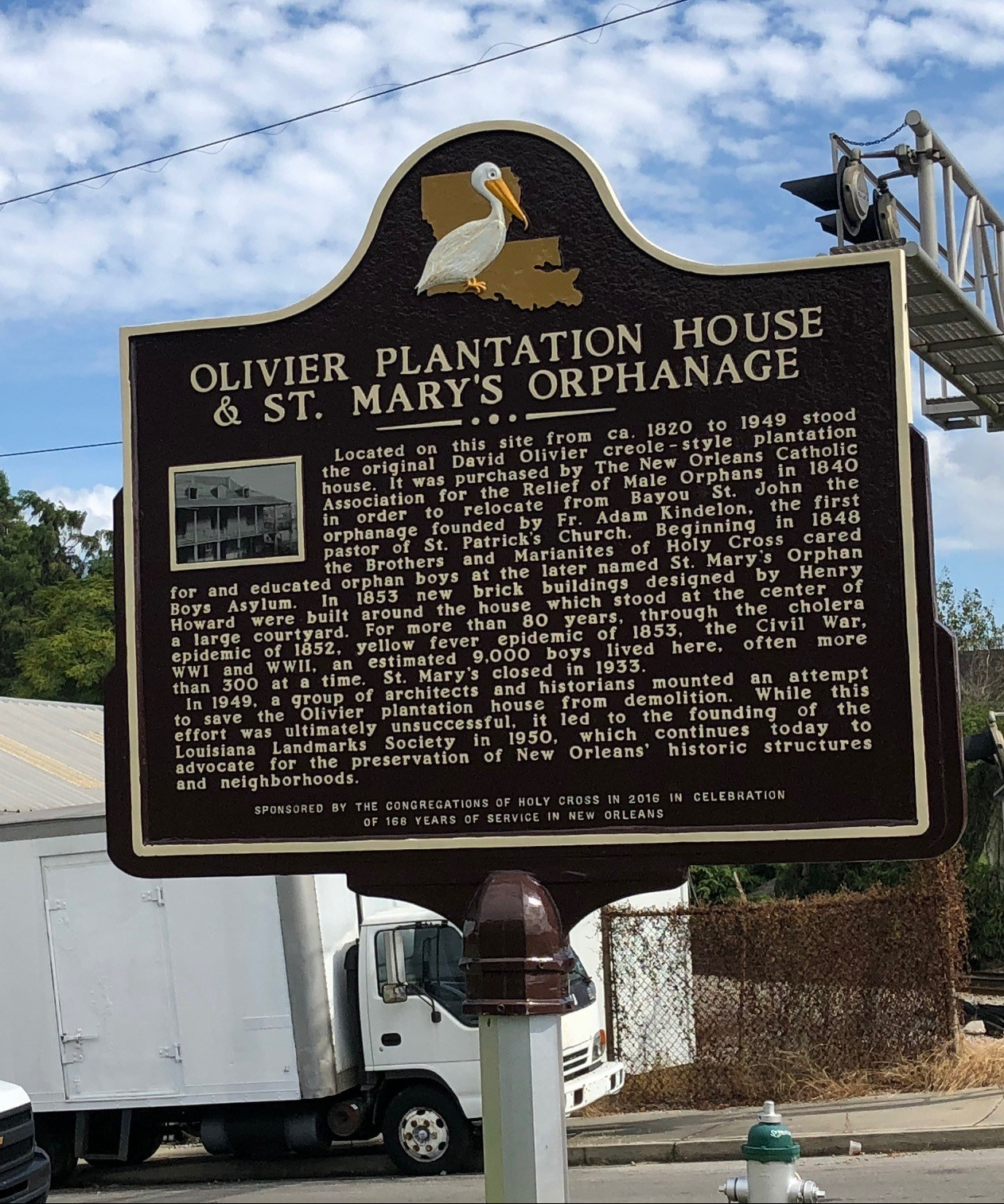
Olivier Plantation House & St. Mary's Orphanage Historical Marker

Inscriptions

One side: Here stood the Olivier House from ca. 1820 to 1949. Built by Paris-born David Olivier, the large Creole-style residence presided over a sugar cane plantation for barely a decade. In 1835 the house became heart of the St. Mary’s Orphan Boys Asylum, eventually the largest such institution in Orleans Parish. In 1854 the Olivier house was surrounded by a brick campus designed by Henry Howard. In 1891 the gothic Chapel of St. Aloysius was added on Chartres Street. The wanton demolition of the house and complex by later owners gave rise to the establishment in 1950 of the Louisiana Landmark Society, a leading preservation organization. An effort to rebuild the residence was launched by Bywater neighbors following Hurricane Katrina.

Other side: Located on this site from ca. 1820 to 1949 stood the original David Olivier creole-style plantation house. It was purchased by The New Orleans Catholic Association for the Relief of Male Orphans in 1840 in order to relocate from Bayou St. John the orphanage founded by Fr. Adam Kindelon, the first pastor of St. Patrick’s Church. Beginning in 1848 the Brothers and Marianites of Holy Cross cared for and educated orphan boys at the later named St. Mary’s Orphan Boys Asylum. In 1853 new brick buildings designed by Henry Howard were built around the house which stood at the center of a large courtyard. For more than 80 years, through the cholera epidemic of 1852, yellow fever epidemic of 1853, the Civil War, WWI and WWI, an estimated 9,000 boys lived here, often more than 300 at a time. St. Mary’s closed in 1933.

In 1949, a group of architects and historians mounted an attempt to save the Olivier plantation house from demolition. While this effort was ultimately unsuccessful, it led to the founding of the Louisiana Landmarks Society in 1950, which continues today to advocate for the preservation of New Orleans’ historic structures and neighborhoods.

Location: 29° 57.619′ N, 90° 2.145′ W

Intersection of Chartres Street and Mazant Street. 4111 Chartres Street, New Orleans, LA.

Dr. James M. Jackson – Miami’s First Physician

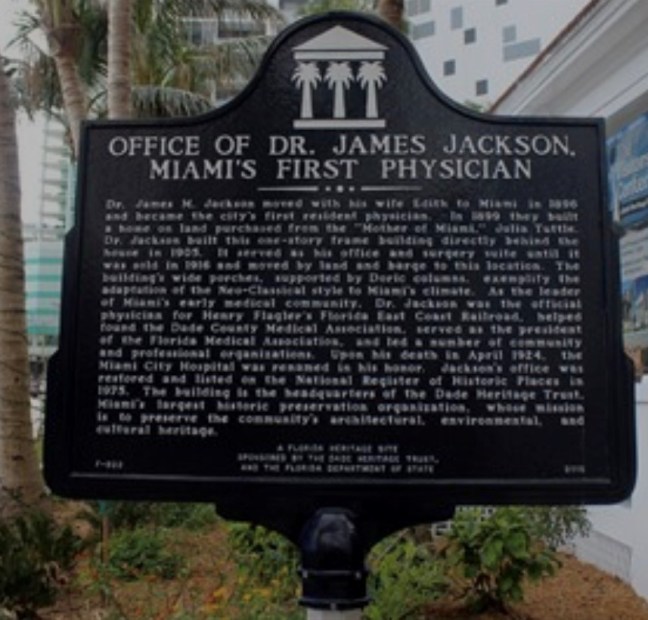
On a random corner in Miami, you’ll run into the historical marker that signifies the location of the site of Miami’s first resident physician: Dr. James M. Jackson. The location housed both his office and the surgery facility. The building was added to the U.S. National Register of Historical Places on February 24, 1975.

Historical Marker Description

Dr. James M. Jackson moved with his wife Edith to Miami in 1896 and became the city’s first resident physician. In 1899 they built a home on land purchased from the “Mother of Miami,” Julia Tuttle. Dr. Jackson built this one-story frame building directly behind the house in 1905. It served as his office and surgery suite until it was sold in 1916 and moved by land and barge to this location. The building’s wide porches, supported by Doric columns, exemplify the adaptation of the Neo-Classical style to Miami’s climate. As the leader of Miami’s early medical community, Dr. Jackson was the official physician for Henry Flagler’s Florida East Coast Railroad, helped found the Dade County Medical Association, served as the president of the Florida Medical Association, and led a number of community and professional organizations. Upon his death in April 1924, the Miami City Hospital was renamed in his honor. Jackson’s office was restored and listed on the National Register of Historic Places in 1975. The building is the headquarters of the Dade Heritage Trust, Miami’s largest historic preservation organization, whose mission is to preserve the community’s architectural, environmental, and cultural heritage.

Jackson is buried in the Miami City Cemetery (also on the National Register of Historic Places), which is located at 1800 Northeast 2nd Avenue.

Location: 190 Southeast 12th Terrace, Miami, FL

N 25° 45.680 W 080° 11.398

Elephant Corral, Denver, CO

While the origins of the name are murky, some people believe it comes from the old saying “Seeing the Elephant”, which was a gold rush slogan. Located in Lower Downtown (LoDo) Denver, this marker commemorates a hotel and stable for emigrant families and their animals (no elephants were recorded having been boarded here). It also functioned as a trading post, bar, stockyard and brothel.

People from around the world came to Denver trying to get rich off of gold, including people from the Northeast, Midwest and foreigners from around the world. And, these people needed a place to stay. The original proprietors were said to gather people up from the train station and bring them to the establishment.

Located in the Denver and Auraria settlement, the Elephant Corral was the largest building in the settlement at 32 feet wide and 100 feet long. Started by Charles Blake and Andrew Williams, they eventually sold it to Robert Teats, who made the property even larger and officially named it the Elephant Corral.

Historical Marker Text

Immediately north east of this point and covering much of Block 18 East Denver stood the famous Elephant Corral camp ground, immigrant headquarters and stock yards of pioneer Denver. Begun early in 1859 by Black & Williams with their Denver House, the first hotel in Denver City. Horace Greeley was a guest here and addressed the pioneers June 6, 1859. During the 1860s the corral was surrounded by an eight-foot wall having loopholes for Indian defense.

Location: 39.748597° N, 105.001822° W

Wagon Mound, NM

For travelers along the long Santa Fe Trail, landmarks ensured that they were going in the right direction. One such landmark was the nearly 7,000-foot butte known as Wagon Mound, which was named due to its shape and the fact that it kind of looked like a covered wagon. It signaled the location of the Cimarron Cutoff, which was a settlement route that connected St. Louis, MO, and Santa Fe, NM.

Wagon Mound told travelers two things. It was the last major landmark before getting to Santa Fe and the end of their journeys. Two, it meant that there was a water source nearby in the Santa Clara Canyon. But, groups had to be careful in this area because there were hostile Native Americans in Santa Clara Canyon.

The route that took travelers near this landmark was popular from about 1822 to the 1870s.

Historical Marker Text

This last great landmark on the Santa Fe Trail was named for its resemblance to the top of a covered wagon. At Wagon Mound, travelers could cross from the Cimarron Cutoff to Fort Union, which is located on the Mountain Branch of the Trail. The two branches joined south of here at Watrous.

Location: 36° 0.697′ N, 104° 42.393′ W in Wagon Mound, NM, at the intersection of State Road 120 and I-25.